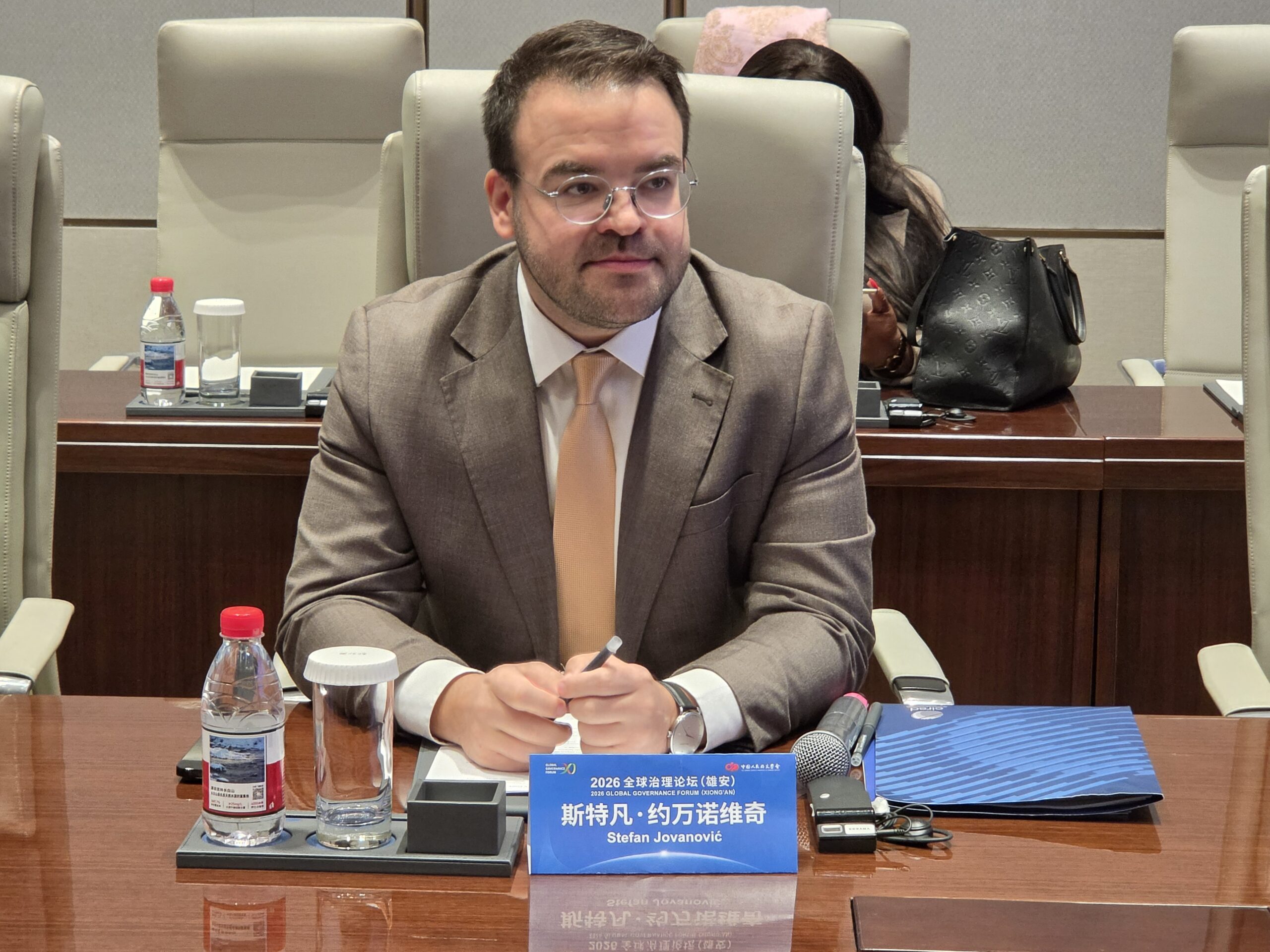
XIONG’AN, China — Stefan Jovanović, Vice President of the Center for International Relations and Sustainable Development (CIRSD), delivered a keynote address at the Global Governance Forum in Xiong’an, China, calling for stronger international cooperation, reform of global governance, and closer ties between Europe and China to accelerate progress towards the United Nations Sustainable Development Goals (SDGs).
The Forum was opened by Chinese Foreign Minister Wang Yi, who read a letter from Chinese President Xi Jinping and delivered opening remarks. Organized by the Chinese People’s Institute of Foreign Affairs (CPIFA), the gathering brought together nearly 400 political leaders, diplomats, academics, business representatives, and international organization officials from more than 90 countries.
Jovanović addressed the session titled “Advocating Win-Win Cooperation and Building Consensus on Accelerated Development,” held on October 24 as part of the Forum’s discussions on advancing the green and low-carbon transition for global sustainable development.
In his remarks, Jovanović warned of the growing gap between international commitments and tangible progress in implementing the UN 2030 Agenda for Sustainable Development.
“In 2015, the international community made a promise: that where a person is born should no longer determine whether they live in poverty, attend school, or have access to basic healthcare. Today, only 36 percent of assessable SDG targets are on track or making moderate progress. This gap between promise and delivery has become a test of the United Nations’ credibility,” he said.
Jovanović welcomed the Global Governance Initiative proposed by Chinese President Xi Jinping, emphasizing its commitment to reforming the international governance system, maintaining the central role of the United Nations, upholding international law, and strengthening the voice of developing countries.
Addressing the challenges of financing sustainable development, he noted that developing countries face an annual SDG financing gap of approximately $4 trillion. He called on developed nations to honor their development assistance commitments, international development banks to expand affordable long-term financing, and creditors to accelerate efforts to resolve unsustainable debt.
A central focus of Jovanović’s address was the relationship between the European Union and China, particularly the opportunities for cooperation in green technologies and sustainable industrial development.
“The European Union has made the green transition a strategic priority, while China has achieved remarkable industrial and technological progress, from electric vehicles and batteries to solar power and equipment for clean hydrogen production,” Jovanović stated.
Illustrating the extraordinary transformation of China’s industrial capabilities over the past four decades, Jovanović highlighted the dramatic reversal in automobile production between Europe and China.
“In 1980, Europe produced almost 1,900 times more passenger cars than China. Today, China produces more than two and a half times as many passenger cars as the European Union,” he noted.
He argued that China’s industrial scale and Europe’s technological capabilities, regulatory experience, and ambitious climate objectives provide a strong foundation for mutually beneficial cooperation.
“Europe has a clear interest in strengthening cooperation with China, particularly in green technologies. European leaders should therefore avoid measures that harm both sides and actively seek opportunities for mutually beneficial cooperation,” he said.
Jovanović emphasized that the green transition offers a concrete opportunity to translate shared interests into new investments, technological progress, and job creation.
Turning to Serbia’s role, Jovanović emphasized the country’s potential to serve as a bridge between European and Chinese development efforts.
“As a European country with an ironclad friendship with China, Serbia has a strong interest in cooperation that transcends political differences. We welcome Chinese companies’ growing contribution to infrastructure development in Serbia and see considerable potential for further cooperation in clean energy, sustainable transport, and green industry,” he said.
He also highlighted the importance of cooperation between universities and businesses through joint research, technological innovation, and technical training.
Concluding his address, Jovanović stressed that the success of international initiatives must ultimately be measured by concrete results rather than declarations and commitments.
“The task before us is Herculean. We must ensure it does not become Sisyphean: an endlesscycle of promises, effort and disappointment. The next generation will judge our commitments by the opportunities available to them and the world they inherit,” he said.
“The SDGs must not become a broken promise. The credibility of the United Nations depends on what its members deliver together,” Jovanović concluded.