

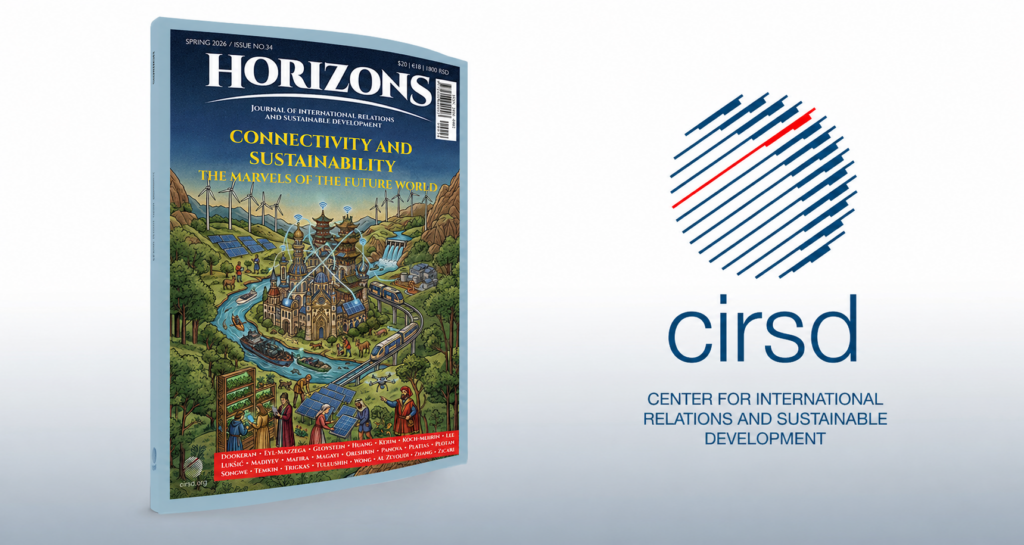
WHEN Marco Polo returned from his quarter-century-long travels across the Silk Road in 1295, he described a world so densely connected and abundant in its marvels that few of his contemporaries chose to believe him. The routes he traversed were not merely commercial arteries—they were the foundations of an emerging world order, binding civilizations together through the exchange of goods and ideas. Today, humanity stands before what this issue of Horizons calls the “Marvels of the Future World”: a new age of connectivity and sustainability whose ambitions are no less extraordinary than Marco Polo’s own discoveries, and whose realization is no less uncertain.
THE energy transition is perhaps the most visible of these marvels. The disruptions in the Strait of Hormuz have exposed with extraordinary clarity what years of analysis had failed to convey: a global system still tethered to fossil fuels and concentrated supply routes is deeply fragile. Countries that invested in renewable infrastructure entered this crisis with resilience; most of those that deferred found themselves at the mercy of chokepoints they could not control. The lesson is unsparing—the grid, not the pipeline, is the infrastructure of the future.
YET building that future requires materials whose geography is itself a source of tension. Lithium, cobalt, and rare earth elements are the new strategic commodities, and the capacity to refine and distribute them remains asymmetrically concentrated. ASEAN sits atop extraordinary reserves; Africa holds critical minerals whose value the world is only beginning to reckon with. But endowment is not leverage. Converting natural wealth into strategic power requires investment, regulatory clarity, and regional coordination that has so far proved elusive. For hundreds of millions of households, meanwhile, the most fundamental connectivity gap is measured not in gigawatts but in the smoke rising from an open cooking fire every day.
CONNECTIVITY is not only physical. It is digital, institutional, and deeply political. Artificial intelligence is now infrastructure in the fullest sense—material, energy-intensive, and contested. The race to build sovereign AI systems, smarter power grids, and resilient pharmaceutical supply chains is a race to determine who designs the architecture of the next century and on whose terms. These are among the defining “Marvels of the Future World”—not spectacles to be admired, but transformational systems to be built and made to work for the many rather than the few.
SUSTAINABILITY has outgrown the vocabulary of environmental policy. It is now a question of whether the systems we are building are capable of enduring the pressures placed upon them. The SDGs were conceived as a roadmap; a decade on, they read more like a rescue plan. Development finance remains insufficient. Corporate sustainability too often stops at compliance. The multilateral architecture, designed for a world that no longer exists, struggles to channel the investment that the transition demands.
MARCO Polo’s marvels were not as much about any particular destination as about the fact of connection itself. The “Marvels of the Future World” are by all means attainable. Whether we seize them depends on choices being made now, in government ministries, corporate boardrooms, regional blocs, and international institutions. The contributors to this issue map those choices with clarity and without illusion. The road ahead is open. The question is who will travel it, and how fast.


