Stefan Antić is a Visiting Fellow at the Hungarian Institute of International Affairs.
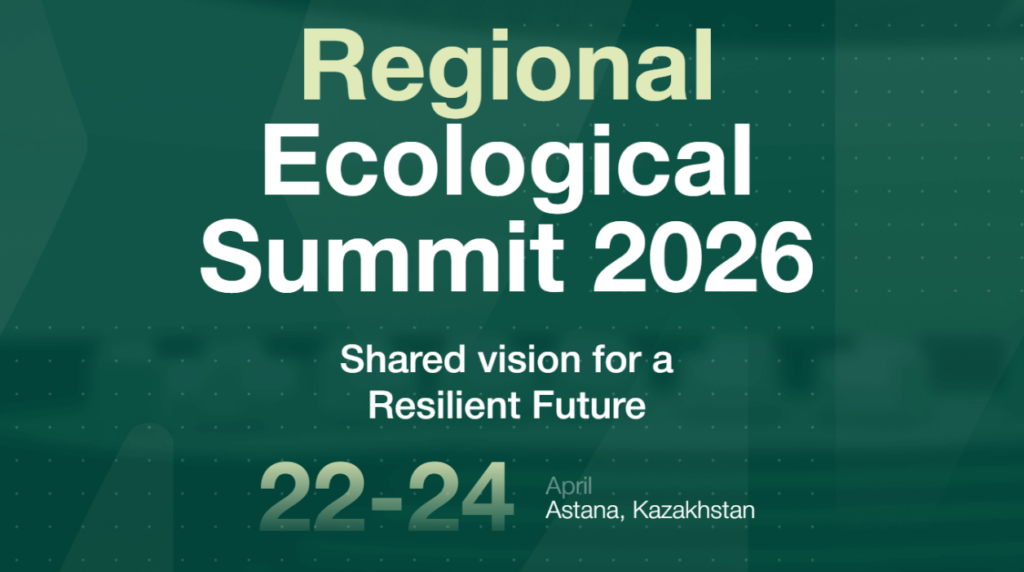
The upcoming Regional Ecological Summit (RES 2026) in Astana, scheduled for April 22-24 will serve as another venue for Kazakhstan to act as Central Asia’s regional agenda-setter. Two particular initiatives have positioned the summit as a major diplomatic project. First, its initiation during the 78th session of the UN General Assembly, and second, the expansion of the Summit’s scope and mandate at the Astana International Forum. From the very beginning, the UN endorsement of the effort, embodied in General Assembly Resolution 78/147, regarded Kazakhstan’s initiative as a tool for “strengthening regional solidarity” on matters of environmental resilience. Such a strategic approach that involved careful multilateral anchoring and regional support has become quite symptomatic of Kazakhstan’s broader foreign policy, which has a sense of where and when to utilize the obvious issues of common interest while circumventing potential areas of contestation like hard security or geopolitical projections.
What adds value to this undertaking is the delicacy of detail and institutional support that Kazakhstan has been able to mobilize in the process. In the scope of the upcoming Summit, 18 UN agencies have been tasked with co-organizing 27 sessions and five workshops, all of which are designed to tackle issues like “climate action, environmental resilience, and sustainable development” as individual thematic segments. As the country that crafted the agenda, led the consultations in the preparatory phase, and finally the host-to-be of the upcoming event, Kazakhstan’s voice and policies will essentially serve as a blueprint of environmental governance in the region. The event is already expected to result in a Joint Declaration of Central Asian presidents and the Program of Action for a period between 2026 and 2030. Once these documents provide a pathway for further processes, Kazakhstan’s position will be one of natural coordinator of any future developments.
Broadly speaking, the initiative also falls in line with Kazakhstan’s longstanding pursuit of pragmatic and balanced foreign policy. Given their general reputation as soft issues, environmental matters are a useful avenue for Kazakhstan to continue parallel cooperation with the West, the Turkic world, Russia, and China, without involving itself too deep in many of the ongoing forms of geopolitical competition between them. Kazakhstan’s environmental initiative has thus far received formal endorsements of different regional organizations, including the 2024 Karabakh Declaration of the Organization of Turkic States and the Joint Statement of the Sixth Consultative Meeting of the Heads of Central Asian states. Besides allowing Kazakhstan to play a role of constructive mediator, the summit might also emerge as a diplomatic safe zone, where participants could engage in constructive dialogue and set aside zero-sum impulses for other theaters.
In addition to its usefulness in the geopolitical and diplomatic domains, RES 2026 can become both a boost to and an advertisement of Kazakhstan’s modernization efforts. The scope of the summit alone provides Astana with an opportunity to clearly communicate what its renewable-energy ambitions are, as well as to promote its investment-ready projects, and appeal to the right addresses regarding its financing needs. While the ecological portion of the event will surely yield some economic benefits, the continuation of this trend will invariably depend on Kazakhstan’s ability to maintain and guarantee stability and continue on its reformist path—something that will remain vial both for the country and the investors it seeks to attract. As events of the past have repeatedly proven, environmental diplomacy is very closely tied to development financing and technological partnerships, which will only continue and expand with the advancements of AI-powered systems. If it utilizes most opportunities to position itself as a regional hub for cooperation on economic and environmental issues, Kazakhstan stands to gain significant leverage to address a variety of international funding mechanisms for its strategic projects. Moreover, it would clearly signal that when it comes to the Central Asian region, it stands as a stable, predictable, and reliable partner to all looking for major capital investments.
As is commonly the case with summits organized within strategic frameworks of Turkic states, this one too makes key references to folk wisdom and cultural tradition. This time, the summit places the concept of Bir Tamyr (“Same Root”) at its center, which emphasizes the common heritage, the centuries of ties, and collective destiny of Central Asians. For Kazakhstan, this is a useful way to promote regional unity—in which it would naturally play a leading role—without imposing itself as an overly domineering state. This already fits perfectly into Kazakhstan’s style of diplomatic engagement, which has long relied on consensus-building efforts and carefully calibrated legitimacy—usually formally reaffirmed by international institutions like the UN.
Better yet, ecological pursuits are a very pertinent topic, especially as all Central Asian states struggle with dire environmental problems, including water scarcity and disappearing natural ecosystems, with consequences reverberating across an array of fields. This is where consensus-building is perhaps easiest, and Kazakhstan’s role as the region’s largest state is more naturally accepted. In comparison, contentious issues like security, energy transit, and infrastructure corridors would have been a higher hurdle to jump over. RES 2026 is also expected to amplify Kazakhstan’s profile globally. The fact that the summit is UN-backed serves well in portraying Kazakhstan as a responsible actor with the strategic wherewithal to plan for the future. Another sign of this is the 2025 opening of the UN Regional Center for the Sustainable Development Goals for Central Asia and Afghanistan in Almaty, inaugurated personally by UN Secretary-General Antonio Guterres. This sort of global visibility and recognition remains essential for a middle power that aims to be seen as a responsible actor—both within the region and beyond.
All told, it is safe to say that the Regional Ecological Summit will be much more than just an environmental event. While its ecological dimension is certainly genuine, its broader aim is to help Kazakhstan stand out as a regional leader, test more tools of its multi-vector diplomacy, draw in more foreign investment, and create a unifying regional initiative in which Astana will serve as its natural centerpiece.