


The recent summit between President Xi Jinping and President Donald Trump inaugurated a period of stability that will be modestly constrictive. That is a significant improvement on much of the Biden presidency, when ties were more confrontational. But at the same time, the two sides are eroding the economic foundation of the relationship—pulling away from each other in the key dimensions of trade and investment that provide ballast for the current diplomacy. The best analogue from recent history is the U.S. relationship with the Soviet Union, a diplomacy that experienced instability in part because it did not rest on a strong economic base. Yet another lesson also flows from the U.S.-Soviet experience: the two sides must decide that some issues are too important for cooperation to fail, and that they can compartmentalize and cooperate on them.
Toward Constructive Strategic Stability
Current U.S. relations with China are defined by a shared desire to bound competition. Strategic stability, competitive coexistence, and a weak G-2 all describe the relationship accurately. This period dates from June 2025, when an agreement reached in London halted both a tariff war and Chinese moves to withhold critical minerals. The two sides deepened ties at Busan in October 2025, when Trump and Xi met, and then, at the Beijing summit in May 2026, the presidents agreed to a new framework of “constructive strategic stability.” The latter two words came from the U.S., while China added “constructive”—a formulation reflecting a slight difference of emphasis, with the U.S. looking more for strategic guardrails and China for constructive cooperation.
The recent summit focused on expanding cooperation and creating three new mechanisms. In addition to existing cooperation on fentanyl and on breaking up scam operations, the Beijing meeting created a Board of Trade, a Board of Investment, and a new AI working group. The trade mechanism is the most fleshed out; it will initially focus on keeping tariffs as low as possible and on devising deliverables for the planned September summit in Washington. The investment mechanism is at a more preliminary phase, in which the two sides are still deciding on the body’s mandate. The task ahead is to determine which specific areas of investment fall within its scope.
The AI working group, arguably the most important of the new bodies, is not yet developed. The two sides need to discuss the management of the most destabilizing AI scenarios—those that could break cybersecurity systems, and those that could produce a program or weapon capable of neutralizing the other side’s nuclear deterrent. Neither has yet specified which ministries or agencies will lead the group. Military-to-military ties remain at a low level, which the U.S. views as insufficient, correctly arguing that more senior officials should be involved. The two sides need a better mechanism to manage and prevent miscommunication during a crisis.
Another arena prone to misunderstanding—and one that threatens the new stability—concerns a list of heavy rare-earth metals that Beijing placed under export controls, reducing flows shortly after “Liberation Day” in April of last year, before agreeing two months later, at the London meeting, to resume supply. The list includes dysprosium and terbium, dual-use metals important for the magnets used in automobiles and other civilian sectors. Press reports say China is withholding the metals, but Chinese officials claim they are delivering both the metals and the magnets that contain them. Beijing appears to be supplying mainly finished magnets containing dysprosium and terbium, rather than the pure metals—capturing the value chain and impairing U.S. efforts to make the magnets domestically. The issue is contained, but it poses a risk to constructive stability if more press reports come to focus on it.
Gone, in any case, are the days of “autocracy versus democracy” and the other antagonistic formulations that populated the Biden years. Former Secretary of State Antony Blinken and his colleagues espoused a commitment to democracy that resembled neoconservatism, though they also endorsed multilateralism and were cautious about the use of force. The application of that worldview to U.S.-China relations was one reason for the rocky ties that characterized the first three years of Biden’s presidency.
The current relationship works off the idea of mutual assured disruption. Each side recognizes that the other can disrupt its economic and military policy severely enough to make a truce the preferred outcome. The U.S. has sought to slow China’s technological progress and to use tariffs for leverage on many issues. But Beijing fought the tariff war to a draw, found in critical minerals a very powerful source of leverage, and—through DeepSeek and other companies—made advances that surprised U.S. observers and jeopardized the American lead in building large language models. China disrupted U.S. policy. Likewise, Taiwan is the most important political-military issue for Beijing; yet the U.S. maintains enough air and naval power in and around the first island chain to cast doubt on whether China could win a war there. That, in turn, makes Beijing’s coercive diplomacy toward Taiwan more difficult. The U.S., too, has achieved assured disruption.
Finally, the two sides remain interdependent. The leaders recognize that their countries are the world’s leading economic powers and preside over a still-hefty trade balance of roughly $410 billion in goods, or $490 billion including services. That creates interest groups in both countries that lobby for closer ties. Relatedly, mutual assured disruption is possible only because the two powers cohabit and interact within shared global economic ecosystems—which in turn creates dense networks of linkage between them.
This era of constructive stability is also buttressed by a newly similar approach to governance in the two countries. Both favor strong executive power, to the extent that political scientists Stacie Goddard and Abraham Newman argue “neo-royalist cliques” hold sway in each. Both also practice intrusive industrial policy. And each is engaged in a national project—MAGA in the U.S., rejuvenation in China. The two political systems remain vastly different, but these converging trendlines help begin to bridge the trust gap between them.
Interdependence and Hollowing Out
This essay is about to argue that the U.S. and China are hollowing out a relationship of stability for which interdependence is an important cause. The argument rests on an assumption that interdependence is normatively good because it causes peace. Political scientists have investigated this chain of causality, and numerous studies have found that it does not hold—that, historically, interdependence is as likely to cause friction and war as it is to foster peace-inducing connections. Yet in current international relations, the case for interdependence producing peaceful outcomes is strong. The size and complexity of today’s trade and finance relationships are unprecedentedly vast, making rupture more expensive than ever. Technology companies, moreover, are global, powerful, and self-regulating across national boundaries, which increases connectivity. And interdependence today exists against a nuclear backdrop for the great powers, which limits the risk that economic friction could escalate to war.
A final, less-discussed cause of constructive stability is that each side seeks a calm environment in which to decouple from the other, secure its supply chains, and reduce interdependence. Ironically, this very cause of stable ties could lead to their undoing.
Across many key dimensions of trade and investment, the two sides are decoupling. On supply chains and technology, part of China’s rejuvenation is a drive to reduce radically its dependence on the U.S. across the complex of businesses involved in semiconductors and chip-design tools. Many Chinese elites view U.S. export controls as attempts to stifle Chinese modernization, and favor developing indigenous capabilities in response. The U.S., meanwhile, is trying to reverse key Chinese chokepoints in critical minerals, battery materials, and pharmaceutical ingredients.
In the financial sector, China seeks to reduce its enormous dependence on the dollar in international trade and finance. Progress is slow but steady in settling accounts in renminbi and using alternative payment systems such as CIPS. The U.S., for its part, is further reducing its already low financial exposure by screening flows of private equity into China’s tech sector. On R&D and talent, China is seeking greater retention through returnee programs and the expansion of domestic PhD programs, while on the U.S. side, student inflows and research collaboration are in decline, primarily because of uncertainty over the visa status of Chinese citizens. Firms in both countries show diminishing interest in the other’s market. U.S. firms are investing less in China, partly by choice and partly because of intensifying local competition.
Finally—and central to the argument that interdependence is weakening—total trade between the U.S. and China has decreased significantly over the past decade. Total trade in goods is down 28 percent since 2016. On the U.S. side, 9 percent of direct goods imports now come from China, against 21 percent a decade earlier; on the Chinese side, 5 percent of goods imports originated in the U.S. in 2025, down from 9 percent in 2016. Alongside constructive stability, in other words, the two countries are undertaking a slow-motion divorce.
That said, the new boards of trade and investment will, if they work well, increase interdependence to some extent. But standing them up to the point where they make a large impact will be difficult, requiring the two sides to overcome bureaucratic hurdles and mutual distrust. And in any case, the structural forces for decoupling will likely outweigh whatever effect the new boards produce.
Sclerotic Ties and the Need for Leadership
Over the coming decade, mutual decoupling will erode key drivers of structural stability. As the U.S. and China retreat into domestic production and friendly supply chains, mutual assured disruption will weaken, and the stability produced by standoff will lessen. That will make the relationship more vulnerable to the misperceptions and accidents that cause crises—such as the balloon affair of 2023, when a wayward Chinese balloon triggered a bilateral standoff. It will also make the relationship even more dependent on the personalities of the two presidents and the chemistry between them. And it makes it incumbent on both sides to use the remaining two and a half years of the Trump presidency to build cooperative mechanisms that a successor would find difficult to dismantle.
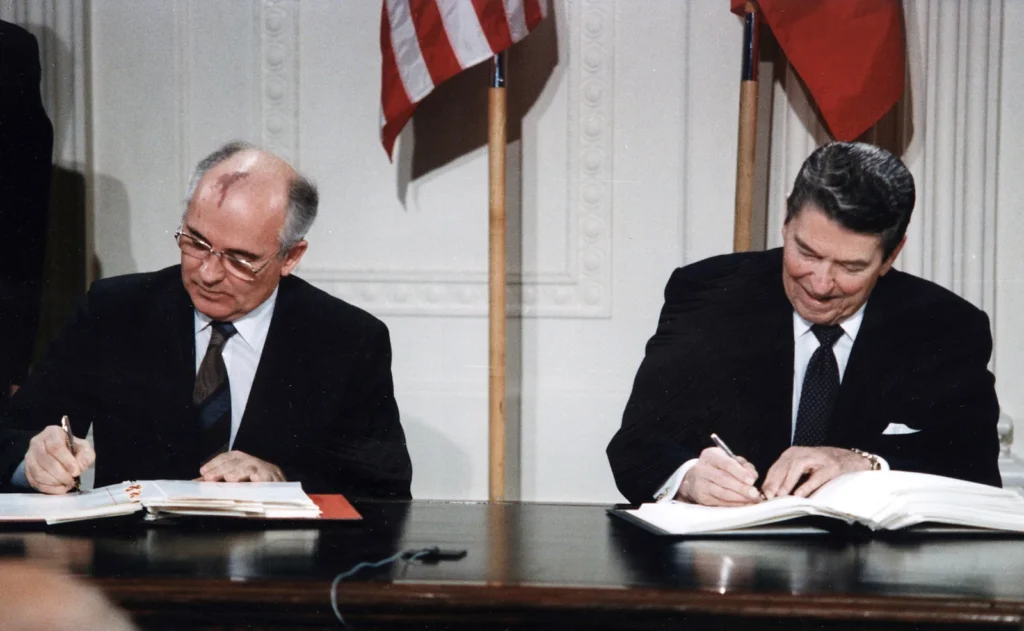
An instructive historical parallel to the future of U.S.-China ties is the U.S. relationship with the Soviet Union. In that case, trade and investment ties were very small, and the relationship was a direct function of prevailing geopolitics. Mutual assured destruction applied, but not mutual assured economic disruption. Partly as a result, U.S.-Soviet relations were hostile and entailed global rivalry, and there were no vested private interests favoring constructive ties.
But U.S.-Soviet relations also serve as a template for what the two sides should do if they do indeed hollow out their relationship. From the 1970s onward, the U.S. and the Soviets compartmentalized the one issue they judged too important to succumb to geopolitics: the control and reduction of nuclear weapons. The degree to which that issue was insulated from wider geopolitics is vividly illustrated by a single fact: the U.S. mined Haiphong harbor during the Vietnam War just two weeks before the two sides signed SALT I in 1972.
The U.S. and the Soviets built an impressive web of agreements. The first SALT treaty capped the number of ballistic-missile launchers. The Anti-Ballistic Missile Treaty, also signed in 1972, was designed to limit defenses and keep mutual deterrence intact. In 1979, the two sides signed SALT II, which lowered the number of permitted warheads and launchers. A treaty limiting theatre missiles followed in 1987. In 1991, START I reduced deployed strategic warheads and delivery systems. And in 2010, Russia and the U.S. signed New START, which lowered the number of warheads and launchers on both sides still further.
U.S. and Chinese leaders should look over the horizon at the issues they will need to compartmentalize. Nuclear weapons will again be near the top of the list, especially given China’s planned buildup and the expiration of New START—the only remaining nuclear arms-control treaty. The Chinese side will need to abandon its position of accepting no arms control until it reaches nuclear parity with the U.S. and Russia. AI, too, will be a ripe arena for crisis; the two sides should develop an agenda and amply staff the AI working group. Given the rate at which AI advances, current and former industry experts—not just the relevant members of government—will need to contribute to it. Breakout risk is already upon us: Anthropic’s new Mythos model can, when directed and given access, autonomously discover and exploit vulnerabilities in cybersecurity systems. On both nuclear arms control and AI, compartmentalization will be necessary.
But these two spheres are not the only ones that deserve attention. The COVID pandemic appears to have been too weak a shock to jar the U.S. and China into significant joint action. Political science tells us that shocks are the most common source of new regimes, yet none emerged for pandemics. The U.S. must move past its fixation on the theory that COVID originated in a Wuhan lab. Since significant cooperation on pandemic research is not happening, the two sides should at least compartmentalize it. Climate change, lastly, also makes the list. The Trump administration regards it as a hoax and is out of the game; but China’s leaders should work closely with the EU and the Bretton Woods institutions to move the issue forward and should begin preparing an agenda for cooperation with a future U.S. administration.
U.S.-China relations will devolve from constructive stability onto thin ice over the coming decade. Both sides need to be aware of the dangers of the paths they have chosen—and take steps to mitigate them.


