

Donald Trump’s election to the presidency of the United States is not merely a major shift in American foreign policy. It brings about an upheaval of the world order and a genuine strategic revolution. When a political changeover occurs, continuity generally prevails over novelty in a nation’s diplomacy. It is otherwise with Donald Trump: his return to the presidency does indeed seem to signal the end of a world—the end of an international order.
Strategic revolutions of this magnitude are rare. They require the convergence of two factors: a leader who breaks completely with his predecessors, and who stands at the head of a major power. Through perestroika, Mikhail Gorbachev sought to modify and regenerate the communist system and to move beyond confrontation with the West. He failed to modernize the USSR, which imploded, but he succeeded in ending the East–West divide of the bipolar world that had structured international relations since the end of World War II. In the same way, Deng Xiaoping, from the moment he took power, put an end to Maoist autarky and opened his country to globalization. He utterly transformed China and changed the world. China is no longer the poor, rural, inward-looking country it once was; it has become a global actor, rivalling the United States and a candidate for the position of leading world power.
The various fault lines—between the Western world and Russia since Moscow’s aggression against Ukraine, between the West and the “Global South,” and between China and the United States—have all been profoundly reshuffled. The Western world, which formed a coherent civilizational bloc under American leadership, has ceased to exist. Since the end of World War II, the security of European countries had rested on Washington’s protection against Moscow. Yet Donald Trump has asserted that NATO no longer imposes any obligation on him and has even contemplated creating a Washington–Moscow axis over the heads of the Europeans.
Since 1945, the man who enters the White House has asked himself how he is going to manage the international system. Donald Trump, for his part, asks how to be rid of it. Attacking the whole set of multilateral institutions built in the aftermath of World War II—notably by Washington itself—he displays a sovereign contempt for international law. He perceives it as an illegitimate and unacceptable constraint on the sovereignty of the United States: a limit on power, and Donald Trump can abide no such limit. Since this body of law was developed to protect the weak, it is, in his eyes, useless. Whereas his predecessors tried to conceal their non-compliance with international norms, Donald Trump makes plain that he does not care—placing the European democracies, which claim to be attached to those norms (even if more so over Ukraine than over Palestine), in an awkward position. The Western countries, once a bloc unified in relation to the “Global South” and Russia, are now divided between Europe—and Canada, perhaps Australia—on one side, and the United States on the other.
In his speech before the United Nations General Assembly in September 2025, Donald Trump expressed all the contempt he holds for the organization, whose escalators and teleprompters, according to him, do not even work. He portrays it as costly and useless, while claiming that, by his action alone and without any thanks from the UN, he has ended seven conflicts. The American superpower’s distrust of multilateralism is nothing new—but it has never been so openly displayed. Donald Trump withdrew the United States from the Paris Agreement on climate change, from UNESCO, and from the World Health Organization. Since his return to the White House, the United States has withdrawn from 66 international bodies, including 31 UN agencies. And where it remains within other organizations, it seeks to block their functioning through the attrition of resources—by drastically reducing the American contribution, or by delaying the payment of funds. As a result, the UN system is set to be subjected to a particularly severe diet.
The example of the International Criminal Court is glaring. The United States never joined the ICC—yet Donald Trump went so far as to impose sanctions on its judges, who had the audacity to issue an arrest warrant against Benjamin Netanyahu. The judges saw their access to all digital networks dependent on the United States, including their bank cards, abruptly cut off, and were treated like dangerous terrorists or drug traffickers.
Worse still, in July 2026, Marco Rubio went so far as to declare that the ICC was the “bête noire” of the United States, that it was waging “a war against [his] country, not with bullets and missiles, but with statutes and compacts and the force of so-called international law.” He called on the states party to the Rome Statute to withdraw from it, “to combat this threat weighing on Americans ready to risk their lives to protect others.” This amounts to demanding impunity for war crimes. And the American Secretary of State threatens the countries that continue to adhere to the ICC with the loss of United States aid, or even with suffering its wrath. All EU Member States—and Canada—recognize the jurisdiction of the ICC and declare themselves attached to it. How are they to respond to this frontal attack? Doing nothing means losing all credibility; acting means confrontation with Washington.
That same Marco Rubio declared: “The post-war global order is not just obsolete. It is now a weapon being used against us.” Donald Trump does not merely break the solidity of the Atlantic bloc; it is the entire world order that he calls into question, with all that this implies for the very concept of the “Western family.” For him, international law is an illegitimate constraint hindering the free exercise of American power. He wants to overturn the slow and difficult construction of a world regulated by law—admittedly still very imperfect, but nonetheless preferable to the pre-1939 world, where only the balance of forces counted. The UN, the international organizations, multilateralism, international law, everything that made up the creed of the West—even if it was never fully respected in practice—no longer counts. Donald Trump wishes never again to have to account for himself.
The European states now know that they can no longer take United States protection for granted, and that they must reconsider their strategic positioning. Beyond the security dimension, the Western world had asserted itself as an identity bloc founded on shared values. That is no longer the case. This is an express divorce—or rather a repudiation. And the Europeans are the more disoriented in that they believed they had always fulfilled their obligations as loyal, even obedient, allies.
From the Capitol to the Tarpeian Rock is but a short step. The outbreak of the war in Ukraine will have been at once the peak of NATO’s vitality and its swan song. Donald Trump understood that the massive aid granted to Kyiv was increasingly seen as an unbearable burden by a majority of his fellow citizens, who felt they had other priorities. On the campaign trail, he promised to end the war in 24 hours, arguing that it would never have occurred had he been president. He even accused his rival, Kamala Harris, of wanting to send American soldiers to risk their lives in Ukraine.
The United States is not only no longer the protector of the Europeans; it could become their predator. Donald Trump considers the European Union an enemy created to “screw” the United States. He directly threatens the territorial integrity of two founding members of NATO: Canada, and Denmark, whose Greenland he covets, and where he takes the liberty of conducting an influence campaign among the inhabitants—a clear act of interference. For him, the alliance is a source of burdensome and useless obligations, whereas bilateral agreements, struck case by case, are far more advantageous to a United States that can more easily impose a balance of power in its own favor.
Having promised to resolve the war in Ukraine in 24 hours, he pressures Volodymyr Zelensky so that the latter, deprived of all American support, has no option but to accept a deal concluded over his head—and over that of the Europeans—between Moscow and Washington. The European allies are not consulted on the conduct of subsequent operations. While the Europeans, pursuing a line determined jointly with Washington, consider Vladimir Putin—against whom the ICC has issued an arrest warrant—to be beyond the pale, Donald Trump received him with great pomp, and to his own applause, at Anchorage, Alaska, on August 15th, 2025, wrong-footing every other NATO capital. He did so without consultation, pursuing a purely national agenda.
Donald Trump’s position on Ukraine is a mixture of realism and offhandedness. The fundamental error of the Europeans in this affair is never to have set their own war aims themselves. Although he clearly signified to them that he was dismissing them—that, for him, the Atlantic Alliance was a dead star—they, instead of taking note and moving on, did everything to try to rekindle the flame. Although German Chancellor Friedrich Merz had declared that Germany must become independent of the United States, and the French President was returning the concept of European strategic autonomy to the public arena, irenicism very quickly prevailed over realism.
Like desperate, spurned lovers, the Europeans did everything to win back Donald Trump’s heart, even at the cost of going very far in their concessions. The fear aroused by Russia leads them to think there is no other option than to be protected by Washington. They could nevertheless consider that Russia, bogged down in Ukraine, is not ready to attack the European Union—and that they therefore have a window in which to build autonomy, rather than prolonging and even deepening their dependence. Yet the opposite choice was made, under the impetus of the German Chancellor and the President of the Italian Council, spurred on from outside the Union by the British Prime Minister, and under the leadership of the President of the Commission, Ursula von der Leyen. She who, in other times, had argued for a geopolitical Commission would become the very embodiment of submission.
This submission unfolded in several stages. At the NATO summit of June 2025, the European countries, though skeptical, agreed—for the sole purpose of pleasing Donald Trump—to raise their military spending to 5 percent of GDP. Only the Spanish Prime Minister, Pedro Sánchez, had the courage to oppose it publicly and to expose the uselessness and vacuity of the measure. All of this came at the very moment when Donald Trump was reaffirming that there were “several ways” of interpreting Article 5 of the North Atlantic Treaty—which amounts to disowning the automatic character of solidarity among members in the event of aggression. The European countries were delighted that the President of the United States had consented to attend the summit at all. They had, moreover, shortened its duration to be sure that he would. One is easily satisfied.
But the scale of the concessions was only to intensify. The President of the Commission agreed to travel to the American President’s private golf course, located outside European Union territory, in Scotland. Can one imagine the American President travelling to the Commission President’s holiday resort? At least she did not wait 3 days in the snow, like the Germanic Emperor Henry IV at Canossa, come to beg the clemency and forgiveness of Pope Gregory VII. She came to negotiate a particularly unbalanced trade agreement, one that entailed a 15 percent tax on European products while exempting, by contrast, products exported by the United States. Once again, the European leaders settled for an unbalanced outcome, on the grounds that it could have been worse. Paraphrasing Churchill, one might say that the European leaders accepted the humiliation of Donald Trump’s private golf course in order to avoid a trade war; they got the humiliation but did not avoid the trade war, Trump adding, shortly afterwards, further products to the list of taxable items.
Finally, for fear that the United States would abandon Ukraine altogether, the European leaders came to refer the matter to Washington, accompanied Volodymyr Zelensky there, and agreed—gratefully—to pay, to the tune of $90 billion, for the American arms supplied to Ukraine. Donald Trump thus pulled off a double coup: he satisfied his electorate by showing that there was no more wasteful spending on Ukraine’s behalf, and he fed his military-industrial complex by making the Europeans foot the bill. To crown it all, it emerged that he was demanding nothing less than that Europe dismantle its rules and its regulation of the American digital giants.
Never had a President of the United States been so demanding of the Europeans, even at the height of the Cold War. And never had the Europeans practiced, to such a degree, the voluntary servitude of which the Secretary General of NATO, Mark Rutte, offers so deplorable an image. Back then, at least, they faced an existential military threat from the Soviet Union and enjoyed the protection of a United States that exercised a benevolent leadership over them. Today they face a real military threat—though a lesser one than in the days of the USSR—with a United States that guarantees no protection yet wants them aligned behind it. Should Europe yield on the digital issue, one will be able to say that Donald Trump has successfully appropriated, for his own ends, the concept of “limited sovereignty” developed by Brezhnev in 1968—reducing the European states to the equivalent of Moscow’s satellites in the Cold War era.
To believe that making concessions to Donald Trump might mollify him is a strategic mistake. He can only deduce from them that the European Union is in a position of weakness, and that he may therefore demand more. Donald Trump draws no distinction based on the nature of regimes, as his predecessors officially did. His dividing line runs between the weak and the powerful—and the Europeans appear to him weak. What is more, this is also the message the European Union is sending to the rest of the world.
Faced with this American desertion, the Europeans could have chosen to wean themselves off their dependence and build for the long term. They seem unwilling to do so: dependence has become too ingrained a habitus. But above all, they could have set themselves apart from Donald Trump on the plane of values. His constant challenging of international law, his ceaseless attacks on the United Nations and the multilateral system, his loathing of international organizations, the brutality of his conduct, the coarseness of his words, the contempt he displays for all other civilizations and nations, his unlimited faith in hard power and his rejection of soft power—all are the antithesis of the principles proclaimed by the European Union. The Union could have capitalized on this, particularly towards the countries of the so-called “Global South,” by distinguishing itself from the United States. The problem is that, in doing so, it brings its own contradictions to light—notably over the situation unfolding in Gaza, and its attitude towards Israel.
The European countries reacted in scattered order during the assault launched against Venezuela and the capture of Nicolás Maduro. Whatever one thinks of the man, he was the president of a sovereign state, and the raid organized by the United States was flatly contrary to international law. This violation of a body of law to which the Europeans claim to be attached was not firmly condemned by them. The accusation of double standards, which recurs regularly in the Global South’s grievances against Western countries, thus finds itself reinforced once again. And while the Europeans did not take part in the war launched against Iran by Israel and the United States, neither did they condemn its illegal character—placing themselves, once more, in contradiction with themselves.
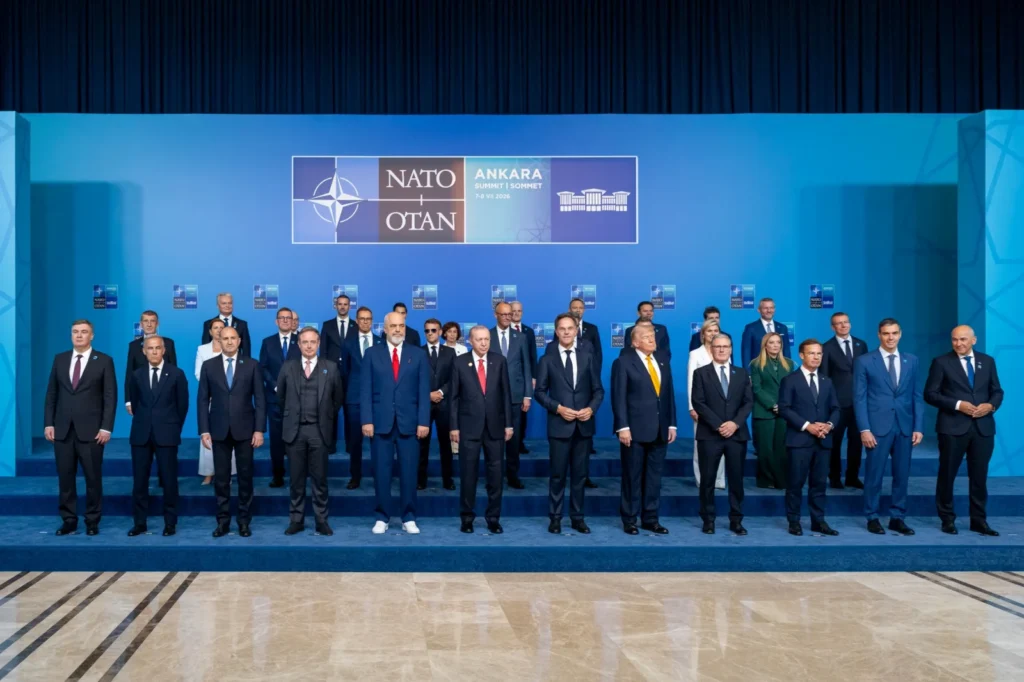
At the NATO summit of July 2026 in Ankara, the Member States congratulated themselves on their unity and solidarity. President Trump—who had been feared either not to come at all, or to make a scene if he did—even declared at the summit’s close that there was “a lot of friendship, a lot of unity” in the alliance. Since on arriving he had said he was very angry with the European countries and Canada, which had not supported him in his war against Iran, his mere presence came as good news to the allies. The final communiqué even reaffirmed “our unwavering commitment to our collective defense under Article 5 of the Washington Treaty and to the transatlantic bond. An attack on one is an attack on all.”
This was a relief for the European countries, which live in dread of a Russian military threat and worry about Trump’s questioning of Article 5—he having declared on numerous occasions that there were “several ways” of interpreting it, thereby casting doubt on automatic solidarity. Another piece of good news: whereas until then Donald Trump had shown Ukrainian President Zelensky as little esteem as solidarity, and whereas the European countries make the defense of Ukraine a strategic priority, Trump held a bilateral meeting with him and gave his agreement for Ukraine to manufacture the Patriot missiles it so vitally needs.
Is all, then, for the best in the best of Western worlds? Far from it. Donald Trump renewed his threats to annex Greenland, which forms part of the territory of Denmark, a founding member of NATO, and threatened to cease all trade with Spain, insufficiently docile in his eyes. Nothing will prevent him, in future, from making further personal pronouncements calling NATO and the European allies into question.
In truth, the unity of the Western world is broken, and the Europeans are in denial. The Western world as we have known it for 80 years no longer exists. But giving up the comfort it provided is too painful for the European countries to find the courage to face reality. For eight decades, the European countries and the United States were united by security interests and by a professed adherence to common values. We no longer share the same conception of security. We can no longer trust in the automatic guarantee of the United States. And on values, the divorce is equally profound: Trump despises everything to which the Europeans say they are viscerally attached—the UN, multilateralism, respect for international law, the sovereignty of states, and a rules-based order.
The United States’ Western allies are thus confronted with a difficult choice. Publicly acknowledging that they do not share the world-vision their American ally would impose on them risks bringing down his anger upon them. But saying nothing will arouse the contempt and resentment of the Global South, which will readily denounce both their weakness and their hypocrisy. Either way, their moral and strategic credibility stands to be lastingly degraded.


