

The surging contradictions of capitalist globalization require regulation in order to meet the common interest of the whole global community, including both present and future generations. If the contradictions are not addressed through collective action, the human species facing the prospect of extinction in anything like its current form. Almost 40 years ago, the “Bruntland Report” addressed the issue of humanity’s common future. The breadth and gravity of the task facing the human species has intensified since the report was published. Individual economies can take actions to address the contradictions. However, even giant economies such as the U.S. and China can only construct partial solutions.
In the absence of enforceable global regulation, there exists the likelihood of ‘regulatory arbitrage’ across the multiple domains that threaten the human species. Effective global regulation requires establishment and acceptance of a just system of global governance, in which the interests of each individual on the planet is represented equally and fairly, with the voice of the poorest person counting equally with the richest person. In order to be effective in overcoming the multi-facetted contradictions of globalization, regulation must be enforceable across countries of different sizes and economic strength.
Addressing the common challenges confronting the human species requires global collective action. The United Nations is the only entity with the potential to lead the whole human community towards a sustainable future. The United Nations was established in June 1945 with the objective of ‘maintaining international peace and security, developing friendly relations among states, promoting international cooperation, and serving as a center for harmonizing the actions of states in achieving these goals.’ There is fierce debate about the future of the UN and its capability to lead the whole global community to face common existential challenges for the human species. The interests of the countries of the Global North and those of the Global South have become increasingly complicated, which has produced severe governance challenges for the UN.
The UN’s governance structure was shaped by the small group of Global North countries that were the victors in World War II: the U.S., Russia, Britain and France. The governance structure established in 1945 has hindered the UN’s capacity to function in the common interest of the whole global community, both current and future. Moreover, the governance structure has failed to adapt to the huge changes in global politics and economics that have taken place since 1945 and accelerated during the era of globalization. When the UN was established, there were just 51 members. A large part of the developing world was still under colonial rule. As the independence movement gathered momentum in the 1960s and 1970s the number of countries in the UN increased. By 2025 the number had risen to 193.
The distribution of global population and economic power is tremendously uneven, but it is undergoing great transformation, which has accentuated the governance challenges facing the UN. Global population is distributed between countries of widely differing population size. Just two super-large developing countries (China and India) account for 35 percent of total global population. A further eleven large developing countries with a population of between 100 to 300 million (Bangladesh, Brazil, Democratic Republic of Congo, Egypt, Ethiopia, Indonesia, Mexico, Nigeria, Pakistan, Philippines, Vietnam) account for 23 percent of global population. In other words, a group of 13 large and super-large developing countries account for 58 percent of total global population.
The distribution of world output and income is highly uneven. The high-income economies account for only 17 percent of total world population, but they produce 48 percent of global national income. Countries with 46 percent of world population account for only 17 percent of global national income. Income per person in the high-income economies is 3 times greater than that in upper middle-income economies, 7 times greater than that in lower middle-income economies and 30 times greater than that in low-income economies. However, during the era of globalization, the balance of global economic strength has shifted steadily away from the high-income economies. In 1980, the G7 economies, which constitute the core of the Global North, accounted for 51 percent of global GDP adjusted for PPP worldwide. By 2022, the share had fallen to 30 percent, while the share of emerging market and developing economies rose from 37 percent to 58 percent. In 1980, the G7 economies accounted for 68 percent of world manufacturing value-added. By 2021, their share had fallen to 32 percent. The share of emerging market and developing economies had risen from 16 percent to over 50 percent. The world economy has turned upside down.
When it was established, the key bodies under the UN were skewed towards retention of power in the hands of the U.S. and its allies. The relationship between the General Assembly and the Security Council has greatly complicated UN governance since its foundation. Resolutions adopted by the General Assembly have moral weight, but they are not binding in international law. The Security Council is critically important. The UN was established with a system of 5 permanent members of the Security Council: China, U.S., Russia, the UK and France. Members of the United Nations agree to accept and carry out Security Council resolutions. However, Security Council resolutions can be vetoed by any of the 5 permanent members. China’s role in the global economy has transformed during the era of globalization. Despite the huge relative decline in the economic strength of Russia, France and the UK, they still retain their position as three of the five permanent members of the Security Council.
The high-income economies are extremely reluctant to release their grip over the institutions of global governance in the financial sector, including those under the UN. The leading position in the Bretton Woods institutions of global economic governance under the UN have always been controlled by the high-income economies. Senior positions within the Bretton Woods institutions have increasingly been occupied by experts from developing countries. However, the Managing Director of the IMF has always been a European, and most often has been French. The President of the World Bank has always been an American. This remains the case through to the present day.
The Financial Stability Board (FSB) was established by the Bank of International Settlement (BIS) in 2009 during the global financial crisis. The FSB is composed of the heads of central banks and finance ministries from member countries. Its function is to ‘promote global financial stability by coordinating the development of regulatory, supervisory and other financial sector policies’ among the FSB members. One-half of the 24 member countries are from outside the Global North, including China, India, Argentina, Turkey, Indonesia, Mexico, Singapore, Hong Kong SAR, and South Africa. Each of the FSB chairs has been from a high-income economy: Mario Draghi (Italy, 2009 to 2011), Mark Carney (Canada, 2011 to 2018), Randall Quarles (USA, 2018 to 2021), Klaas Knot (Netherlands, 2011 to 2025) and Andrew Bailey (UK, 2025 to the present). All 5 FSB sub-committees are headed by officials from high-income economies.
There is deep pessimism about the capability of the UN to serve the common interest. However, there is a wide array of subsidiary organizations within the UN that function in a relatively effective and uncontroversial fashion in order to advance the common interests of the whole global community. These include UNESCO, UNIDO, UNRISD, UNCTAD, UNICEF, UNHRC, and UNWRA, as well as the ILO, WHO, and IPCC, and the UN Peace-Keeping Force. Despite disputes and disagreements there is wide international participation in these bodies, including the UN Peace-Keeping Force. The U.S. and China are the two main providers of funding for the UN Peace-Keeping Force, providing 26 percent and 24 percent respectively in 2025. The membership of the UN subsidiary organizations, including their working staff, is widely distributed across countries at all levels of development. Senior officials are drawn from a wide array of countries.
The current Director General of the WHO is an Ethiopian (Tedros Ghebreyesus); the Director General of the FAO is Chinese (Qu Dongyu); the Director General of the ILO is from Togo (Gilbert Houngbo); the Director General of UNESCO is an Egyptian (Khalid el Enany); and the Executive Director of UNICEF is an American (Dr Catherine Russell). Although the UN’s subsidiary organizations cannot compel members to act in the common interest, their activities across countries at all levels of development provide an important foundation for enhancing global cooperation in the face of common challenges, including the enactment of international agreements and treaties to serve the common interest, such as the UN Framework Convention on Climate Change (UNFCC) and the UN Convention on the Law of the Sea (UNCLOS).
Under President Trump in both his first and second terms the USA has been at the forefront of criticism of the UN. In 2025, the U.S. announced that it was withdrawing from the Paris Agreement on Climate Change, UNESCO (UN Education, Science and Culture Organisation), UNRWA (UN Relief and Works Agency for Palestine), and UNHRC (UN Human Rights Council). In January 2026, the U.S. announced that America would withdraw from a wide array of international organizations as well as over 30 entities under the United Nations.
The United States’ withdrawal greatly reduced funding for these entities. The UN bodies from which the USA withdrew included the WHO (World Health Organisation), UNFCC (UN Framework Convention for Climate Change), the IPCC (Inter-Governmental Panel on Climate Change), IRENA (International Renewable Energy Agency), IPBES (Inter-Governmental Science-Policy Platform for Biodiversity and EcoSystems), UNCTAD (UN Commission on Trade and Development), IUCN (International Union for the Conservation of Nature), UN Population Fund, and UN Women. President Trump announced that the US was ending its participation in international organizations that ‘undermine America’s independence and waste taxpayers dollars on ineffective or hostile agendas.’ The U.S. government declared that it was ‘Putting America First on the Global Stage’ in order to ‘protect US sovereignty and ensure international agreements serve American interests.’
China has persisted in the view, as argued by Chinese Foreign Minister Wang Yi at the 62nd Munich Security Conference in February 2026, that the UN is ‘not perfect, but it remains the most universal and authoritative organization in the world’: ‘In reforming and improving global governance, the priority is to revitalize the United Nations.’ Humanity has come to a new crossroads at which it is necessary to build ‘a community with a shared future that offers a compass for the giant ship of history to navigate through the storms towards a bright future.’ Within the UN, each country, ‘regardless of size or wealth, has a voice and a sacred vote as well as its due obligations and rights’: ‘Without the UN, the world would revert to the law of the jungle where the strong prey upon the weak, and many small and medium-sized countries would lose the multilateral foundation critical to their survival and development.’
The reason that the international system is not functioning well ‘lies not with the UN itself,’ but rather with ‘a certain country seeking to magnify differences and disagreements, put itself above everyone else, stoke bloc confrontation and even revive the Cold War mentality.’ There needs to be greater democracy in international relations: ‘The monopolization of global power by a small number of countries is unpopular’…Global affairs should be discussed by all and the future of the world should be decided by all.’ In China’s view, it is imperative that the global community ‘recommits to the founding mission of the UN, revitalizes the leading role of the UN, abides by the purposes of the UN Charter, and enhances the efficiency and efficacy of the UN system’ in order that the organization will be able to ‘better adapt to the needs of the twenty-first century and unleash renewed vitality.’
Zero-sum thinking is embedded deeply within the political culture of the Global North, which stretches from Europe, including Russia, to North America, Japan and Australia-New Zealand. It grew out of relentless conflict within Europe over most of its history. Positive-sum thinking is embedded deeply in China’s political culture. Confucius (551 to 479 BC) lived towards the end of the Spring and Autumn period (770 to 476 BC). Conflicts, bloodshed and wars were rife. During this period there were ‘482 wars, 36 sovereigns killed and 52 states disappeared.’ This provoked deep reflection upon political organization and culture, and the conditions necessary to avoid ‘great turmoil’ (da luan). The search for balance between yin and yang in order to find the ‘middle way’ (zhong yong) is deeply-rooted in Chinese culture. China has sought ‘harmony amidst diversity,’ while the West has sought ‘uniformity without harmony’ (junzi he er bu tong, xiaoren tong er bu he). China’s political culture is based on the philosophy of ‘seeking points of agreement, while maintaining differences of opinion’(xunqiu gongtong dian, baoliu butong dian).
Confucius enunciated the philosophy ‘all under heaven for the common good’ (tian xia wei gong). ‘Benevolence’ (ren) is the essence of Confucian political philosophy, in both domestic governance and international relations: ‘It is benevolence that makes a neighborhood beautiful’ (li ren wei mei). Adam Smith was unusual among western thinkers in advocating an approach that was consistent with Confucius’ maxim. In chapter 3 ‘Of universal benevolence’ in Theory of Moral Sentiments, Smith declared: ‘The wise and virtuous man is at all times willing that his own private interest should be sacrificed to the public interest of his own particular order or society. He is at all times willing too, that the interest of this order or society should be sacrificed to the greater interest of the state or sovereignty, of which it is only a subordinate part. He should, therefore, be equally willing that all those inferior interests should be sacrificed to the greater interests of the universe, to the interest of that great society of all sensible and intelligent beings, [of] which God himself is the immediate administrator and director.’
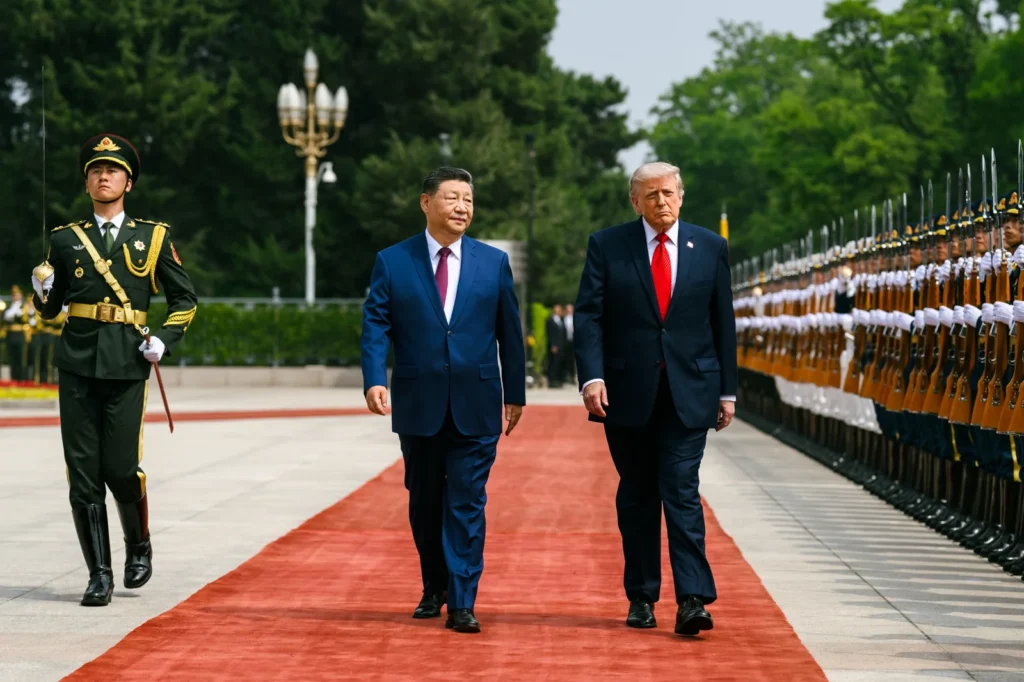
President Trump visited China between May 13th and 15th, 2026. In his meetings with Trump President Xi Jinping said:
“The world is at a crossroads, marked by turbulence and uncertainty. Taiwan is the most important issue in U.S.-China relations. If mishandled the two nations could collide or come into conflict, pushing the entire U.S.-China relationship into a highly perilous situation. The question for the two countries is whether they can work together to meet challenges and bring greater stability to the world. The world is asking whether the two countries can transcend the Thucydides Trap and forge a new model for relations between major powers. Can we, in the interest of the well-being of our two peoples and future of humanity, build a brighter future together for our bilateral relations?”
The profane violence of the second Trump presidency has brought the global community to the edge of the abyss. Faced with existential challenges to the human species, the international relations drama of 2025 to 2026 presents an opportunity for the Global North to turn away from the long-established pattern of zero-sum international relations, turn away from militarism, and instead use the collective wisdom of the human species to solve common problems. Within that cooperative framework, NATO-in-Europe and NATO-in-Asia would disappear, global military spending would decline radically, and there would be no place for nuclear weapons. Cooperation across national borders, including science, technology, culture and business, would enable the human species to surmount its existential challenges and work together to build a ‘community with a common destiny for all mankind’ (renlei mingyun gongtong ti) in order to serve the interests of ‘all under heaven’ (tian xia wei gong). The Owl of Minerva waits until the dusk arrives before it takes to the wing.


