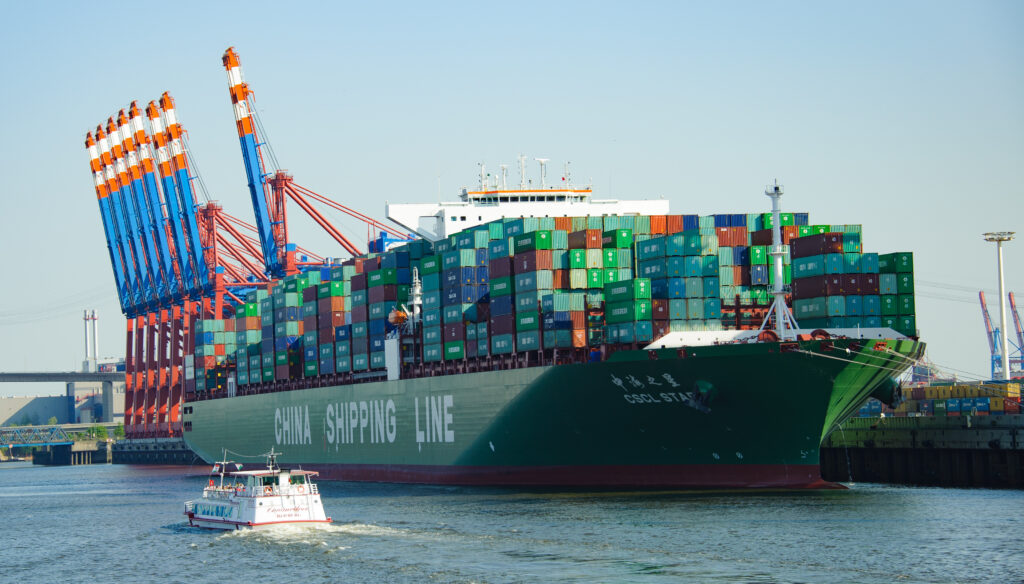

This 36th issue of Horizons is dedicated to one of the most significant partnerships in determining the future of the world’s economic order and international relations—that between Europe and China. Traditionally characterized by the potential for mutual economic gains, EU-China relations are heading towards an era of unprecedented strategic uncertainty. Trade imbalances, tensions around overcapacity, fears of strategic dependency, and growing competition between the U.S. and China pose serious questions regarding Europe’s position in an ever more divided world. Central to this debate is the key question: how does Europe ensure its economic security without compromising its openness and dependence?
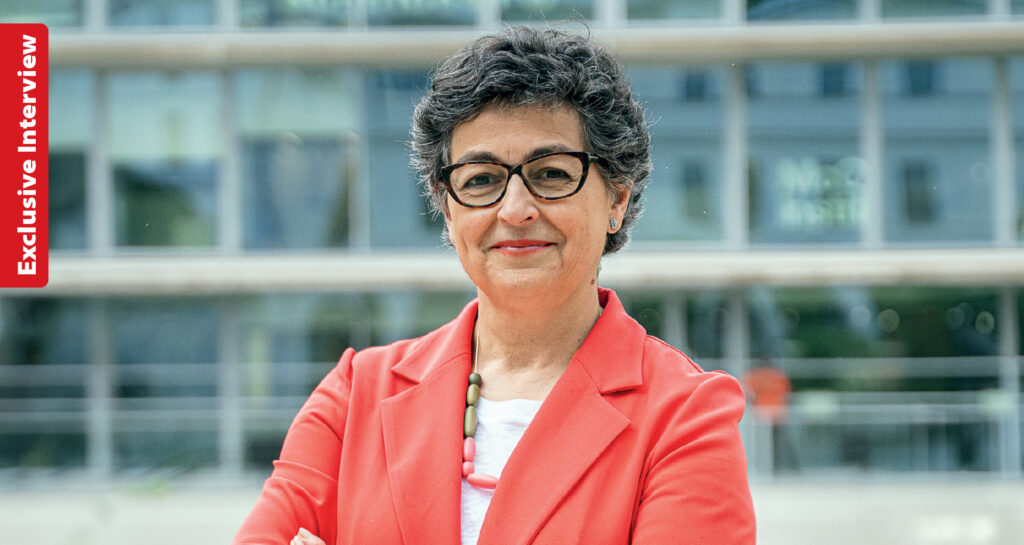
Given this context, Horizons feels honored to present an exclusive interview with Arancha González Laya, former Spanish Minister for Foreign Affairs and Dean of the Paris School of International Affairs at Sciences Po. Having a vast experience as a diplomat and international expert on trade and economic governance, González Laya provides a perspective from decades of European policymaking, international negotiations, and world trade.
In this conversation with our Editor-in-Chief Vuk Jeremić, González Laya analyzes the evolving dynamic between cooperation, competition, and systemic rivalry in Europe’s dealings with China. Contrary to the idea that de-risking is solely aimed at China, she argues that “everybody is playing the game of de-risking” but stresses that Europe’s strategic autonomy will always be contingent on how well integrated Europe is.
From the structural imbalances present in Chinese manufacturing to the rules-based international trading system and Europe’s strategic autonomy, her analysis provides a wide reading of the challenges that lie ahead. Most importantly, she contends that the EU has the capacity to define its own destiny and that its relationship with China need not be a zero-sum game.
For years, the European Union has described China simultaneously as a partner, an economic competitor, and a systemic rival. You yourself have argued that China is an inescapable partner, while also stressing that Europe needs to carve out its own strategic space. Does that three-part formula still capture the relationship, or has the balance shifted in the meantime?
I think the three-part structure is still relevant for the European Union. Given China’s size and its systemic importance—to the global economy, to global CO2 emissions, to the stability of finance across the world—this triptych remains valid: China as a partner, China as a competitor, and China as a rival. The only question today is how much each of these parts represents. How much and in which areas is it a partner? How much and in which areas is it a competitor? Clearly the competition part is accelerating. And where is it a systemic rival? It’s all in the proportions and the proportions have probably changed since this was adopted as EU policy in 2019.
China’s rise over the past decades, and in the last decade in particular, has coincided with a far more difficult international environment for Europe: greater U.S.-China rivalry, war in Ukraine, the erosion of multilateral rules, and the growing use of trade, technology, and supply chains as instruments of power. In your opinion, has Europe been too slow to recognize that the nature of power itself has changed, and that economic openness can no longer be separated from geopolitical vulnerability?
I think Europe has understood that. But let’s also be clear: for all the talk we hear about the world deglobalizing, the world is not deglobalizing. The intensity of exchange across the world remains extremely high. Take last year: turmoil on the tariff front, on the Ukraine front, on energy markets. Trade has continued to grow faster than global GDP. Of course, security is a greater concern today, because many more players are ready to jump over the rules of the game, to exercise power in the economy as well, and to turn what is a win-win game into a zero-sum game. But that does not detract from the fact that openness and the global economy remain the preferred model for every country.
What is changing in this still-globalized economy is who trades with whom. The intensity of trade relations is certainly shrinking between the U.S. and China, and it is increasing between the U.S. and other countries that have become connector economies. So let us not throw the baby out with the bathwater. The global economy remains relatively open, despite the U.S. decision to impose tariffs on the rest of the world. Trading partners’ preferences have changed. The EU itself is showing a greater inclination to open trade relations with other partners: Mercosur, India, Australia, the Philippines. And clearly there are structural problems between the European Union and China that probably require greater attention—and perhaps a reduction in the intensity of trade relations moving forward, if the situation is not addressed at the macroeconomic level.
Interesting that you say that, because I was recently examining some trade data, and Chinese exports to Europe are continuing to rise. The EU’s goods trade deficit with China reached roughly €360 billion in 2025. We will see what the number is in 2026. When Europeans speak about overcapacity and unfair competition, how do you distinguish Europe’s legitimate trade concerns from its own competitiveness challenges, which European leaders and policymakers themselves talk about?
Let’s start with the facts. The European Union has a positive overall trade balance with the world, so it’s not that the EU is structurally uncompetitive. If it were, it would not have the positive trade balance that it has. But it has a negative and growing trade balance with one trading partner: China. So, the question, seen from Europe—and of course China will make its own calculation—is whether this is the result of natural forces. Is it because China is more competitive, simply better at playing to its comparative advantages? Is it because the EU is structurally uncompetitive vis-à-vis China—since vis-à-vis the rest of the world, it clearly is not? Or are other elements coming into the equation? I think there are three other elements that cannot be taken out of this conversation.
It is important to assess how China builds its comparative advantages. Partly, it’s about scale, innovation, ingenuity and hard work, and this has to be recognized—we would do well to recognize it. But partly it has to do with three other factors. The first is state support for key industrial sectors. The second is an undervalued currency that boosts China’s capacity to export to the rest of the world. The third is overcapacity—a structural imbalance in the Chinese economy between how much China produces, which is probably over one-third of global manufacturing capacity, and how much it absorbs and consumes itself. The combination of these three elements creates an artificial “comparative advantage” that plays over and above the natural forces of innovation, creativity, ingenuity, hard work, and the rest. These three factors cannot be ignored, because they are what explains today both the continued increase of Chinese exports to the European Union and the continuous decrease of European exports to China, which is an outlier compared with the rest of the world.
On overcapacity in particular, the usual reply is: what about Germany’s overcapacity when it comes to cars? Germany produces far more cars than it consumes. Or what about Italian fashion? Italy produces much more fashion than it consumes and exports it abroad. People wonder why, from Europe’s perspective, the logic of overcapacity applies to China, while Europe does not see itself as an overcapacity actor vis-à-vis the markets with which, as you said, it has a surplus.
First, I would say this is not just a European issue. It is shared by many countries around the world. And this is probably the first time in history that we have this situation in terms of size and scale. Neither Germany nor Italy poses, in size and scale, the same question that China poses to the rest of the world. Again, China accounts for over 33 percent of global industrial capacity, and in five years that is estimated to reach 40 percent. Never before has a country been in that situation at the aggregate level, with the combination of factors I have described. I do not think you can say this of Germany or Italy or Brazil or India or Mexico, or any other country in the world. It’s a unique situation, which is why it’s proving difficult to address.
The easiest avenue would be for China to address this structural imbalance in its economy: a huge capacity to produce, with very subdued consumption at home. It’s not for the rest of the world to fix this. It is in the hands of the Chinese authorities, and the easiest path would be for them to take decisions that close that gap. But in the meantime, these decisions are not being taken, and the gap is not being closed.
This has produced the language of de-risking—a very popular term in Brussels, though not so popular in China, where it is not seen as a friendly term. In Europe, it’s de-risking rather than decoupling. But de-risking can mean very different things in practice. In your opinion, which dependencies on China are genuine strategic vulnerabilities that Europe should reduce and which forms of interdependence should it be trying to preserve?
First, let me be very clear. The EU does not have a de-risking policy vis-à-vis China. The EU has a de-risking policy, period—vis-à-vis China, vis-à-vis the U.S., vis-à-vis any country on which the EU has an excessive dependency for assets that are strategic to its economy. That’s how it defines it. It is not de-risking from one country in particular. We have also discovered the risks of excessive dependence on Russia, on the U.S., and on other countries. The point is that in an economy where international trade and interdependence can be weaponized, you have to protect yourself against this weaponization. You do this by deepening your own market, which the EU is doing, but also by building resilience against weaponization. That, essentially, is what de-risking means.
By the way, let us not forget that other countries are doing the same. China is de-risking from the global economy too. The game of de-risking was not invented by the European Union. When China said a few years ago that it would pursue “dual circulation”—and let’s leave aside whether it has worked or not—that was another way of saying, “We want to de-risk from excessive dependence on the rest of the world.” Let us not kid ourselves. Everyone is playing the game of de-risking, because nobody wants to be trapped in an excessive dependence that others can weaponize.
This leads me to a broader philosophical question, especially for someone like you who has spent a big part of your career in trade. Do you think the WTO-centered trading system can still discipline economic coercion, state-backed competition, and the weaponization you described? Or do all of us, including Europe, need instruments of economic security that inevitably sit uneasily with the multilateral model Europe helped create?
First, what I see around the world is a preference for a rules-based system, especially because many players in the international economy are small, and for them rules are a protective mechanism—a shield against weaponization and unilateral behavior. If you ask countries, they will tell you they prefer a rules-based international economic order, or international trading order. But I also think countries are increasingly having to face the challenge of the weaponization of interdependence.
Having said that, the rules of the World Trade Organization give you latitude to develop instruments of economic security and to build shields against weaponization. Let’s not forget that there is Article XX, with general exceptions you can use if your objective is to protect your national security or protect the environment. There are many reasons and many spaces that WTO rules offer you to protect yourself against weaponization. So that avenue is there; there is no contradiction. What you have to do is carve out those instruments in accordance with certain rules. I think this would be the preferred avenue, because it gives countries flexibility to protect themselves—to protect, not to practice protectionism—but also to do so in a transparent manner, which is a guarantee that others will also exercise some level of restraint.
Let’s move into the realm of geopolitics and realism for a second. You have argued that Europe should not have to seek Washington’s permission to pursue strategic autonomy. But given how closely Europe’s security remains tied to the United States—in the context of the war in Ukraine, but also in general—how much room does Europe have to shape its own China policy if China becomes an absolute priority, even an obsession, for its transatlantic partner? In other words, what capabilities would help turn strategic autonomy into something concrete that Europe can pursue without having to ask anybody how to go about it?
Well, I reject the premise of the question. Every nation is pursuing its own interest: the U.S., the European Union, China, Russia, India. Obviously, the EU is free to choose its path, and it will be as free as its willingness to deepen its own integration, which is what gives the European Union the real ability to exercise this freedom of choice. It’s a function of how strong the European Union is. The more it integrates—the more it deepens its energy markets, its capital markets, its internal market, and its technology markets—the freer it will be to make its own choices.
Of course, this does not mean acting against others. The EU’s preferred choice is to continue to collaborate and partner closely with the United States, with which it shares a military alliance, NATO. I do not see the two as contradictory. But the EU also has to be ready to define its own policy and its own path in those instances where its partner, the U.S., pursues its own path—and frankly, at the moment, the U.S. is pursuing its own path vis-à-vis China and Russia. Given that, I do not see why the EU should not build on its three-pronged policy toward China: partner, competitor, and rival. This is how the EU looks at China, and I think this is how it should continue to look at China, with or without the U.S.—though preferably with the U.S.
You mentioned that the deeper the integration, the easier things become—not just vis-à-vis China, but in general. But in reality, the EU is still 27 Member States, with very different levels of economic exposure to China and different political instincts and traditions. I understand your argument that the more united and integrated Europe is, the easier it will be. But do you think all of Europe’s relations with China should be handled in an integrated way—just Europe talking to China? Or is there still room for certain areas to remain within the realm of national politics and the national foreign policies of the 27 Member States?
No. The EU is this strange animal that has pooled its weight in many areas. In trade, for example, the EU is one. There are 27 mouths, but there is one negotiator, one strategy and one set of results. But there are other areas where the 27 are free to act independently—trade promotion, for example. Each country is free to promote its own exports of goods or services to any partner around the world. But there are common policies, which are integrated, and the more they are integrated and the more we remove obstacles within the European market, the more beneficial it will be to the EU as a whole. This is normal for the EU. It’s just that in some policy areas—take energy or defense—the level of integration has been lower than in goods, services, or trade, where it is very high.
Your experience at the International Trade Centre gives you a perspective beyond the U.S.-Europe-China triangle. In other parts of the world—Africa, Latin America, the Middle East, and elsewhere—China and Europe increasingly encounter one another as investors, infrastructure providers, and sources of development finance. Is this a competition for influence in the making, or one that already exists? Or is there still meaningful space for European and Chinese interests to coexist, or even cooperate, in third countries?
There is space for everything. EU Member States and China are cooperating on protecting the oceans, something they care about, and on supporting countries in adapting to climate change. But they are very clearly also competing. They are competing for resources with different offers, with the EU learning to speak the language of the countries with which it wants to sign agreements—on raw materials, for example—or to collaborate on artificial intelligence and its governance. There has always been space for both, and my sense is that there will continue to be.
In this very plural world, with lots of countries with different aspirations but with a desire for agency, I can tell you that countries do not want to be put in a position where they have to choose. They want to be able to partner with others and they will look at the added value of each partnership. Seen from Europe, it is all about what the EU can bring to the table that is distinct, that is different, and that would make its partners choose the European Union over other countries. This is the question we ask ourselves in Europe and try to answer every day.
My last question is about your new book, Solos en el mundo, not yet available in English but soon to be published. In it, you imagine a Europe that, by 2049, has failed to acquire the power necessary to shape its own environment. I would like to turn that scenario around. Suppose Europe succeeded, and part of that success was a rebalancing of its relationship with China. What would it take for that to happen—not just in terms of what Europe should avoid, but in terms of what it should actively try to build with China as part of the success story of 2049?
I have written a book about the geopolitical solitude of Europe. It’s focused on giving Europe a greater sense of its weaknesses but also its strengths, and in particular on motivating Europe to build more and more on those strengths. It starts in a provocative manner—not with a prognosis, not with a wish, but with a dystopia: what would Europe be in 2049 if it does not make the right choices today, does not take the right roads today?
I wanted to show that, as a construction, Europe is based on the willingness of Europeans to move forward. If the 400 million Europeans want to move forward, we are very strong. But if they are not ready to move forward, if they are divided, then we will be weak and others will write our future. That is what I wanted to imagine: to give Europeans an appetite to fight for their own future, including a future with China that does not end up as a zero-sum game or in confrontation, but rather builds a new stability into the relationship between the two. Obviously, this will not depend only on Europe; it will also depend on China. But the elements are there to build this possible future, starting now—preferably through dialogue, agreement, and negotiation rather than through confrontation.