A bridge is useful only when people trust it enough to walk across. Engineers put most of their effort into the parts nobody sees: the foundations, the load calculations, and the inspections that keep a structure safe for decades. Finance works the same way. Capital moves to where there are projects worth funding, but only along routes investors trust.
That is the main problem in climate finance today. The world has the money, and Asia, more than any other region, has the need. What is missing is the connection between them: enough channels to carry capital, at scale and at reasonable cost, from the institutions and investors that hold it to the power grids, transport systems, factories, and coastlines that need it.
The figures are stark. The International Monetary Fund estimates that developing Asia needs at least $1.1 trillion a year for climate mitigation and adaptation. Actual investment is about $333 billion, which leaves an annual shortfall of around $800 billion. Public budgets cannot close a gap this large. Concessional finance from development banks cannot close it either. Most of the money will have to come from private capital markets and private capital needs the right infrastructure to flow.
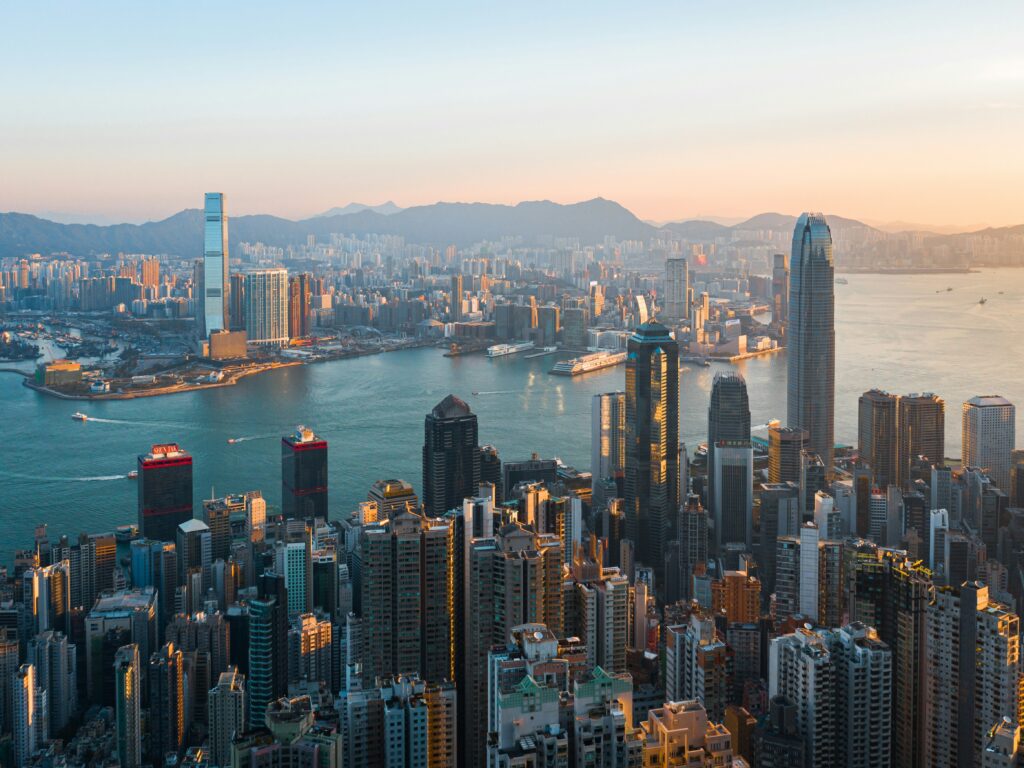
Hong Kong’s aim is to be that infrastructure. In this article, I will explain why Hong Kong is well placed to play this role; what we have built so far; and what we are building now and in future to build that bridge. Our goal is not just to be a busy marketplace for green labels. Instead, we are a dependable bridge that links the Mainland of China with global markets, Asia with the rest of the world, and the economies of the Global South with the long-term investors who can fund their transition.
The Geography of Capital
There is an old saying in finance that money has no nationality. In practice, capital follows clear paths. It moves toward legal certainty, convertible currencies, deep and liquid markets, credible regulators, and skilled professionals. It avoids places where contracts are hard to enforce, information is poor, or the rules may change without warning.
Hong Kong has offered the favorable conditions for capital flows. Under the “one country, two systems” principle, we have a common law legal system, free movement of capital, freely convertible currency, a simple and low tax regime, as well as regulators who work closely with international standard-setters. We are also part of China, which is the world’s largest investor in renewable energy, largest manufacturer of clean technology and a central force in the global energy transition. Hong Kong is also one of the world’s top three global financial centers, the world’s largest cross-border wealth management center, and the leading offshore Renminbi (RMB) business hub.
This combination is unusual. Hong Kong is the only place where international investors can operate fully within a familiar common law, international framework while staying closely connected to the mainland economy and its fast-growing green industries. In the other direction, mainland issuers, banks, and companies can reach global investors via Hong Kong, under international rules and in international currencies. This two-way access is the core of our role as a bridge.
Climate finance needs this connection badly. Many projects that matter most for global emissions are in emerging Asia: coal-reliant power systems that need to move to renewables, heavy industries that need to cut emissions, and fast-growing cities that need low-carbon transport and buildings that can withstand climate risks. Much of the capital that could fund them sits in pension funds, insurers, sovereign wealth funds, and asset managers in North America, Europe, and the Middle East. Hong Kong sits between the two, and what we do best is to make the crossing efficient, transparent, and trusted.
A Market with Real Depth
A bridge must carry real traffic. Over the past several years, Hong Kong’s sustainable finance market has grown from a promising niche into one of the largest in the world. In 2025, green and sustainable debt issued in Hong Kong exceeded $76 billion. Green and sustainable bonds arranged in Hong Kong reached around $38 billion, or about 40 percent of Asia’s international issuance, according to the International Capital Market Association. This made Hong Kong the region’s largest arranging hub for these bonds for the eighth year in a row. These numbers matter because they show that issuers from across the region choose Hong Kong as the place to raise green capital.
The Hong Kong Special Administrative Region (HKSAR) Government has helped lead this growth. Through the Government Sustainable Bond Programme (formerly the Green Bond Programme) the HKSAR Government has issued green bonds in Hong Kong dollars, RMB, U.S. dollars and euros. They cover a range of maturities and have been offered to both institutional and retail investors. By the end of September 2026, issuance had reached about $35.6 billion equivalent, and the proceeds had funded more than 120 government projects in green buildings, waste management and resource recovery, and energy efficiency, etc. Apart from funding Hong Kong’s own decarbonization, our green bond issuance also sets benchmarks in pricing, structure and disclosure that other issuers in the region can follow.
We have also used public funds to lower the cost of entry for others. The Green and Sustainable Finance Grant Scheme, launched in 2021, subsidizes eligible issuers for bond issuance and external review costs. As of early-October 2026, it had supported more than 710 green and sustainable debt instruments with total issuance of more than $200 billion. For a first-time issuer from an emerging market, these subsidies can turn a hesitant inquiry into a completed transaction.
One milestone this year stands out. In May 2026, the Ministry of Finance of the People’s Republic of China issued RMB sovereign green bonds in Hong Kong for the first time. The RMB6 billion offering was 10.4 times oversubscribed. This shows both our country’s confidence in Hong Kong as its international financial gateway and global investors’ appetite for high-quality green assets in RMB. It also builds out a green RMB yield curve that other issuers can price against, which is essential infrastructure for a deeper market.
The Architecture of Trust
Market size alone is not enough. Sustainable finance in particular depends on credibility. An investor who buys a green bond is paying for an environmental outcome as well as a financial return. If the label cannot be trusted, the market fails. Greenwashing, whether deliberate or the result of unclear standards, is the biggest threat to the whole sustainable finance project.
For this reason, much of Hong Kong’s recent work has gone into the parts of the bridge that investors do not see: the definitions, disclosures and assurance that turn claims into verifiable facts.
Disclosure Aligned With Global Standards
In December 2024, the Government published the Roadmap on Sustainability Disclosure in Hong Kong. It set a clear path for large publicly accountable entities to fully adopt the International Sustainability Standards Board (ISSB) Standards no later than 2028. In June 2025, the IFRS Foundation confirmed Hong Kong as among the first jurisdictions in the world to target full adoption of these global benchmarks. We chose full alignment over a local variant on purpose. A bridge is useless if its two ends use different measurements. If Hong Kong-listed companies report sustainability information to the same standards used by investors in other jurisdictions, their disclosures can be compared directly, and the cost of global capital falls for them.
Disclosure without assurance only shifts the trust problem elsewhere. Our Accounting and Financial Reporting Council conducted a public consultation in late 2025 to early 2026 on a regulatory framework for sustainability assurance in Hong Kong. Our aim is for sustainability information to receive the same professional scrutiny as financial statements. The Hong Kong Institute of Certified Public Accountants is now an official training partner of the IFRS Foundation, which will help build the local expertise these standards require.
We are also mindful of the smaller companies in global supply chains. They increasingly receive data requests from large customers and lenders but often lack the resources to respond. Our Green and Sustainable Finance Cross-Agency Steering Group, in collaboration with CDP, a global non-profit organization that runs an independent environmental disclosure system for companies, cities, states, and regions to manage their environmental impacts, has developed a free Non-listed Company Sustainability Questionnaire. It includes a calculator for Scope 1 and Scope 2 greenhouse gas emissions and can be adjusted to each company’s level of readiness.
This kind of practical tool matters a great deal, as the transition will succeed only if it includes small and medium-sized enterprises, not just large corporations. In addition, the Hong Kong Quality Assurance Agency launched in July this year the “Advancing a Sustainability Disclosure Ecosystem in the Financial Industry” initiative. This initiative offers financial institutions a structured, credible and scalable framework for collecting and verifying sustainability data from their clients, investees, and business partners, by leveraging the Agency’s data disclosure and assurance program.
A Taxonomy for the Transition
Disclosure tells investors what a company is doing. A taxonomy tells them whether a particular activity counts as green. The Hong Kong Monetary Authority (HKMA) published the first phase of the Hong Kong Taxonomy for Sustainable Finance in 2024 and has expanded it steadily since. Phase 2A, released in January 2026, increased the number of covered economic activities from 12 to 25 across six sectors. It also introduced transition elements and added a new environmental objective on climate change adaptation.
In September 2026, at the start of Hong Kong Green Week, the HKMA opened consultation on the Phase 2B prototype. It would raise the number of activities to 39. New additions include enabling technologies such as battery manufacturing and recycling and the manufacture of low-carbon technologies. Phase 2B prototype also sets out transition pathways for hard-to-abate sectors such as air transport and iron and steel. It introduces 24 adaptation measures, initially focused on shoreline protection and flood management, together with a process-based approach that guards against “maladaptation,” meaning measures that protect one place by shifting risk to its neighbors.
We designed the taxonomy to be interoperable with the mainland’s green taxonomy and with the Common Ground Taxonomy developed by the mainland and the European Union. A borrower in Guangdong or Jakarta and an investor in Frankfurt or Abu Dhabi should be able to use Hong Kong’s framework without translating between incompatible systems. Interoperability is what makes this framework work as a bridge rather than a wall.
Innovation on the Bridge
A modern bridge must also be built for the traffic of the future. Hong Kong is combining two of the strongest forces in finance today, sustainability and digitalization, so that each strengthens the other.
The HKSAR Government issued its first tokenized green bond in 2023. In November 2025, our third digital green bond issuance, worth about HK$10 billion (or about $1.27 billion), became the world’s first digital bond to settle using tokenized central bank money, in the form of e-CNY and e-HKD. In September 2026, we went further. We priced around HK$20 billion (or about $2.55 billion) of digital green bonds in four currencies, the largest digital bond issuance in the world. The Hong Kong dollar tranche also used tokenized deposits in its settlement. The issuance adopted the International Capital Market Association’s Bond Data Taxonomy Version 2.0, which supports consistent data and end-to-end automation over the life of the bond.
This work is about more than technical novelty. Tokenization can lower issuance costs, speed up settlement, and reduce counterparty risk. For sustainable finance, it opens the possibility of tracing the use of proceeds and environmental impact data on a single trusted ledger. When an investor can verify in close to real time that the money went to the stated project and that the project delivered its promised emissions reductions, the space for greenwashing narrows sharply. The HKMA’s Digital Bond Grant Scheme supports other issuers who want to follow this path.
Carbon markets are the second area of innovation. In October 2022, Hong Kong Exchanges and Clearing Limited (HKEX) launched Core Climate, an international marketplace for voluntary carbon credits and the only one that settles in both Hong Kong dollars and RMB. By March 2026, it had more than 130 registered participants, credits from over 60 projects across Asia, South America, and Africa certified under leading international standards, and cumulative transaction volume above one million tons. Under Project Ensemble, the HKMA and HKEX have tested tokenized carbon credit transactions to improve traceability and prevent double counting.
The next step is to connect markets. In September 2025, HKEX signed a memorandum of understanding with the Guangzhou Emissions Exchange, the Shenzhen Green Exchange, and the Macao International Carbon Emission Exchange. They are working on a pilot for cross-boundary carbon trade settlement within the Greater Bay Area, to be completed in 2026. Core Climate and the Guangzhou Power Exchange Centre are preparing pilot trading of national renewable energy Green Electricity Certificates in Hong Kong. Core Climate is also exploring certificates for sustainable aviation fuel and green hydrogen, and widening cooperation with Brazil, Malaysia, and Kazakhstan on cross-border carbon trading.
From Good Ideas to Bankable Projects
Investors and practitioners across the region keep raising the same frustration. There is no shortage of capital looking for green opportunities, and no shortage of green technologies. What is scarce is the step between them: projects in emerging markets that are prepared, structured, and documented well enough for an investment committee to approve. Many good projects never reach financial close because nobody pays for the early-stage work of feasibility studies, risk allocation, contract design, and financial structuring that turns an idea into an investable asset.
The Green Accelerator, launched by the Hong Kong Green Finance Association during the Hong Kong Green Week 2026, aims to fix this bottleneck. The Accelerator is a Hong Kong-based, non-profit platform supported by philanthropic capital and developed together with mainland and international multilateral financial institutions. It provides systematic pre-finance support and project structuring so that green projects in emerging markets and developing economies can meet the investment criteria of multilateral development banks, sovereign wealth funds, and commercial lenders.
The timing is right. Rapid falls in the cost of solar modules, batteries and other clean technologies mean that many projects which needed subsidies only a few years ago can now stand on their own commercial merits. The Accelerator’s job is to help these projects reach investors faster, and to make sure green ideas with potential will become real power plants, transport systems, and resilient infrastructure. It also creates new work for Hong Kong’s lawyers, accountants, engineers, consultants, and financiers, whose skills in structuring complex cross-border transactions are exactly what project preparation needs. In this sense, the Green Accelerator plays an important role in the next stage of Hong Kong’s bridging role. We will connect capital with projects and we will also help build the projects that capital can fund.
Sharing the Risk of a Warmer World
Cutting emissions is only half the task. The climate is already changing, and Asia’s coastal cities, river deltas, and farming regions face more frequent and more severe typhoons, floods, and other natural disasters. Hong Kong knows these risks first-hand from super typhoons and record rainstorms in recent years. Yet much of the economic loss from disasters in the Asia region is still uninsured. When disaster strikes, governments, businesses, and households often have to bear the cost themselves, and public budgets are diverted from development to recovery. Closing this protection gap is as much a part of sustainable finance as funding a solar farm.
Catastrophe bonds are one of the most effective tools for this. They transfer extreme disaster risks from insurers, reinsurers, and governments to capital market investors, who receive an attractive return in exchange for covering losses if a defined event occurs. For investors, these bonds offer returns largely unrelated to the economic cycle. For those seeking protection, they add funding capacity beyond the traditional reinsurance market, and they pay out quickly when it matters most.
Hong Kong has built a dedicated platform for this market. In 2021, we introduced a bespoke regulatory regime for special purpose insurers issuing insurance-linked securities, with streamlined authorization and reporting. At the same time, we launched the Pilot Insurance-linked Securities Grant Scheme, which can cover up to the full upfront cost of an eligible issuance in Hong Kong, subject to a cap. As of end-September 2026, seven catastrophe bonds worth close to $800 million have been issued in Hong Kong. Sponsors of the bonds range from mainland reinsurers to the World Bank, and the bonds cover typhoon and earthquake risks in the mainland, Japan, India, Chile, Jamaica, and the United States. In 2023, the World Bank’s $350 million catastrophe bond protecting Chile against earthquakes became the first catastrophe bond ever listed on HKEX. Another World Bank bond, covering storm risk for Jamaica, followed in 2024. These transactions show what Hong Kong can do as a bridge: Asian capital and expertise supporting resilience in Latin America and the Caribbean.
We intend to build on this foundation. The grant scheme has been extended to 2028 and we have lowered the minimum investment threshold so that more sophisticated investors can take part. As announced in the 2026 Policy Address, we will explore legislation for a protected cell company structure to reduce the cost of issuing insurance-linked securities and setting up captive insurers. Just this October, Hong Kong saw the inaugural issuance of insurance-linked securities (ILS) in the form of “sidecar.” This will enable us to unleash the synergy effect of multi-layered risk transfer and pooling mechanisms through ILS and other tools, thus consolidating our strategic role as a regional and global catastrophe and specialty risk management hub. We will also review investor restrictions to bring more activity to the market. The Insurance Authority has set up a Climate Insurance Laboratory with insurers, universities and other stakeholders to improve the analysis of climate risk data and encourage innovative products, including parametric insurance. Our goal is to make Hong Kong the natural home for Asia’s catastrophe risk transfer, and a leading international risk management center that helps communities recover faster when disaster strikes.
The People Who Build Bridges
Every bridge depends on skilled people. Sustainable finance requires a new mix of skills: bankers who understand transition plans, auditors who can provide assurance on emissions data, lawyers who can structure sustainability-linked instruments, and analysts who can judge climate risk.
Since 2022, our Pilot Green and Sustainable Finance Capacity Building Support Scheme has subsidized practitioners, graduates, and students to take recognized training. More than 11,000 applications had been approved across over 120 eligible programs. Our talent admission schemes are attracting specialists from around the world, and our universities are expanding teaching and research in climate science, green technology, and sustainable finance.
We also invest in dialogue. Hong Kong Green Week, coordinated by the HKMA, has quickly become one of Asia’s leading sustainability gatherings. The 2026 edition brought together more than 15,000 participants across around 60 events, hosted by over 100 local and international organizations from the public and private sectors. In July 2026, Hong Kong hosted the Asia Climate Summit for the first time, organized by the International Emissions Trading Association. The 20th Asian Financial Forum, to be held in Hong Kong in January 2027, will also offer an excellent opportunity for international participants from Asia and beyond to continue this conversation and identify practical avenues for cooperation. Bridges are built from relationships as well as institutions, and Hong Kong aims to be a place where policymakers, investors, project developers, and scientists from East and West can meet and work out solutions together.
Building the Bridge
Asia’s climate finance gap is one of the largest economic challenges of our time. It is also one of the largest investment opportunities. The trillions of dollars needed every year will reshape energy systems, industries, and cities across the world’s most populous region. Whether that capital flows quickly and fairly, and to the places where it will cut the most emissions and protect the most people, will depend largely on the strength of the financial infrastructure connecting savers and projects.
Hong Kong is working to build that infrastructure. We have the market depth: Asia’s largest arranging hub for green and sustainable bonds, a sovereign and quasi-sovereign green bond benchmark curve across four currencies, and the venue the Ministry of Finance chose for its first RMB sovereign green bonds. We are building the foundations of trust: ISSB-aligned disclosure, an expanding and interoperable taxonomy, a regime for sustainability assurance, and practical guidance for transition finance. We are building for the future with record-setting digital green bonds, a growing international carbon marketplace, and new environmental products. Through the Green Accelerator, we are helping to create the pipeline of bankable projects that the region needs. And we have links in many directions, to the mainland, to Southeast and Central Asia, to the Middle East, and to global investors everywhere.
A bridge is judged by what crosses it. Our measure of success is not the number of green labels issued in Hong Kong. It is the wind turbines built in Vietnam, the steel mills cleaned up in the mainland, the flood defenses strengthened along Asia’s coasts, and the long-term savings of families everywhere invested in a more sustainable world. That is the bridge Hong Kong is building, and we invite partners around the world to help build it and to use it.