
On December 30th, 2025, 27 warships from China’s People’s Liberation Army Navy (PLAN) and coastguard, along with 71 military aircraft, began China’s third and largest ever military exercise around Taiwan. Over the next two days, Operation ‘Justice Mission 2025’ simulated a blockade around the entire island alongside strikes against land-based and maritime targets. The PLAN also showcased for the first time its new amphibious assault ship, which can simultaneously launch attack helicopters, landing craft and amphibious tanks and armored vehicles. This came in response to the Trump administration’s approval of an $11.1 billion package of U.S. weapons sales to Taipei on December 17th, its largest ever. Beijing wanted to send an unmistakable signal to Washington and to America’s Pacific allies that there would be little they could do to prevent China from using the military option to take possession of the island if leaders in Beijing ever conclude this is necessary.
Why did this exercise feature so prominently on news sites across the world? For some, it fitted the appealing narrative of a plucky democratic island nation of 25 million people resisting the revanchist designs of their authoritarian neighbor with its population of 1.4 billion—a modern-day story of David versus Goliath. For others, it marked the next, serious step in the inexorable push by President Xi Jinping and the Chinese Communist Party (CCP) leadership to break the central link in the ‘first island chain’ of American allies arrayed along China’s coastline. This chain runs from South Korea and Japan in the north, down Japan’s Ryuku Islands, through Taiwan and across the northern Philippines. If China seized Taiwan, it would shift the balance of military power decisively in China’s favor across the entire Asia-Pacific region.
But for many observers, the significance of the Chinese threat to Taiwan is more material. The island accounts for 95 percent of the production of the world’s most advanced semiconductors, upon which companies, consumers and entire economies depend, including Apple, the groundbreaking manufacturer of the iPhone, among other leading-edge devices. A prolonged blockade of the island or a full-scale invasion that led to the destruction of its Silicon Valley would have devastating consequences for global growth. Which raises an important question. How did we arrive at a situation where the smooth functioning of the global economy relies on the safety of an island sitting atop one of the world’s most dangerous geopolitical and geological fault lines?
What Could Possibly go Wrong?
The simple answer is that until recently, few people thought this would pose a problem. After the end of the Cold War between the West and the Soviet Union in 1990, governments in the developed world—from North America, through Europe, and East Asia—were convinced of the superiority and dominance of the liberal market model supported by the United States. They encouraged and enabled their companies to manufacture their products where the inputs, especially labor, were cheapest. The founding of the World Trade Organization (WTO) in 1995 led to a series of multilateral agreements on more open government procurement, trade facilitation and trade in information technology products. In parallel, new, WTO-compliant regional and bilateral trade agreements further reduced tariff barriers to cost-effective global production. The spread of technology and manufacturing techniques that accompanied Western companies’ international investments reduced the impact of the remaining non-tariff barriers.
The most dramatic and consequential step in this process involved China’s accession to the WTO in 2001, after 15 years of tough negotiation. And the example of Apple’s rise to become one of the most valuable technology companies illustrates the dramatic way in which access to its high-quality but low-cost labor turbo-charged global methods of production for large multinational businesses.
From 2001, Apple started producing its iPods in China, in partnership with the Taiwanese company Foxconn, which had established several assembly factories along with local supply chains there. When Apple launched its iPhone in 2007, it built its entire operation around this Taiwan-China connection. Apple designed its iPhones in California but purchased from the Taiwanese chip manufacturer TSMC the necessary advanced processor chips to drive the phones’ smart software and applications. TSMC had wisely invested in the capacity to fabricate high-end chips at home in 1987, using advanced laser-powered etching devices imported from ASML, one of the world’s two leading chip-manufacturing companies, based in the Netherlands. TSMC sent their chips to Foxconn on the Chinese mainland, which was responsible for assembling the iPhones. Here, workers inside vast manufacturing complexes, one of which can employ over two hundred thousand workers at peak demand in round-the-clock shifts, incorporated displays from Japan and hundreds of subcomponents sourced from China and other countries into the hand-held devices. Apple then shipped the completed iPhones from China to the U.S. market and to its other international customers. By 2023, 93 percent of all iPhones were assembled in China.
This supply chain assumed that an open trading system underwritten by dominant U.S. military power and a U.S. commitment to open markets would persist indefinitely. It also assumed that the CCP would never use military force to unify Taiwan with the Chinese mainland, despite the centrality of unification to the CCP’s security strategy and to the party’s domestic political legitimacy. What’s more, it gambled on China continuing to be a willing stakeholder in and contributor to a global economic system that it does not itself dominate.
These assumptions demonstrated willful ignorance on the part of successive administrations in the United States and among its allies. The deepening economic, military, technological and political contest between the U.S. and China—which, as I argued in my last book The New Cold War, has all the hallmarks of a new Cold War—is now inescapable and unbridgeable. The CCP leadership understood this long before its democratic counterparts. It started by stealing as much U.S. technology as possible from the 1980s onwards, and then, from at least 2015, when it announced its ‘Made in China 2025’ plan, investing to reduce its dependence on U.S. inputs and technology. The Cold War qualities of the U.S.-China contest have become ever more apparent and tangible after the more nationally assertive Xi Jinping took on the mantle of CCP general secretary in 2012 and then China’s presidency in 2013, and after Donald Trump’s first administration adapted U.S. policy to confront China’s rise in 2017.
Global over-reliance on Taiwanese fabrication of the world’s most advanced semiconductors is just one of the clearest examples of how the post-1945 process of U.S.-led market opening and the post-Cold War order based on U.S.-led market integration have run their course. Rather than building economic growth and technological progress upon foundations of mutually reinforcing interdependence, America helped build extreme overdependencies, which now need to be unwound.
Waking up to the China Shock
Seen from this perspective, it is less surprising that the United States has become the central protagonist in dismantling one of the biggest achievements of its own economic order: namely, to integrate China into the U.S. market.
It is not just advanced semiconductors made in Taiwan that sit on today’s U.S.-China geopolitical fault line. Since China’s entry into the WTO, the U.S. has become reliant on a range of Chinese imports, from the basic to the highly sophisticated, which are being sourced from the country that is its strategic rival in a global contest that will last for decades to come. U.S. dependence on China for processed rare earths and other critical minerals is now one of the most visible risks to U.S. national security. In 2025, according to the International Energy Agency, China mined 60 percent of the world’s rare earth supply and refined over 90 percent of the world’s processed rare earth materials, such as dysprosium, neodymium, praseodymium and terbium, which are crucial for the manufacture of high-performance magnets. The U.S. is as dependent on imports of these minerals as any other country. As a result, a top-of-the-line fifth-generation U.S. F-35 fighter jet, designed to retain U.S. air superiority over all rivals, including China, contains 920 pounds of critical minerals, the bulk of which are likely sourced from China. The same dependence runs across all key U.S. weapons platforms, from tank turret stabilizers, to drone motors, to missile guidance systems.
The U.S. is also heavily dependent on Chinese companies for the production of key pharmaceuticals, including the active pharmaceutical ingredients (APIs) upon which all medicines depend. As of late 2025, China accounted for roughly 50 percent of global production of APIs, and the U.S. imported 40 percent of its supply from China. The belief that Chinese authorities manipulated supply chains for personal protective equipment and APIs to service their own market first during the COVID-19 pandemic has left deep political scars in the United States, especially among U.S. legislators, who are determined to write laws that will force U.S. pharmaceutical companies to reduce this dependence.
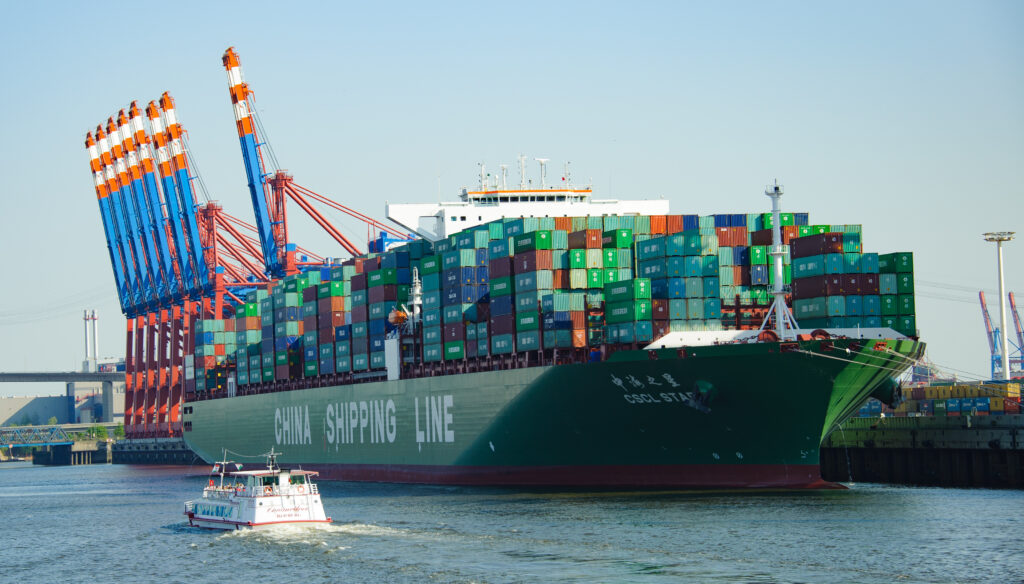
Another dramatic example of how economic manufacturing in an area central to U.S. national security has tilted away from the United States and towards China because of economic globalization has been China’s rapid rise to dominate global shipbuilding. In 2024, China accounted for 53 percent of the global commercial shipbuilding market, compared to only 0.1 percent for the United States. U.S. shipbuilding collapsed both domestically and as a proportion of global production in the 1980s, after the Reagan administration removed the subsidies that helped it construct its ‘600-Ship Navy.’ Only Japan and South Korea vie today with China in this critical sector, accounting for 13 percent and 29 percent of the global market respectively.
The impact on the global military balance of power has been stark. By 2024, China’s PLAN boasted 234 warships, including large submarines, to America’s 219. Moreover, about 70 percent of China’s warships were launched after 2010, including its three aircraft carriers, compared to just a quarter of America’s. China’s emergence as the world’s shipbuilding powerhouse has also given it a huge Coast Guard fleet, with over 150 Coast Guard vessels weighing more than 1,000 tons, many of them repurposed military vessels. As the United States begins a period of modernizing its naval assets, its military shipbuilding program faces severe backlogs, while its commercial shipbuilding is down to completing just five ships a year.
Dependence on China for products important to America’s national well-being and critical infrastructure, which also included items such as base stations for 4G telecommunications or the cellular modules that are central to the emerging ‘Internet of Things,’ is now deemed to be a national security risk. As a result, there has been bipartisan support for steadily tightening export and import controls on high-technology trade with China through the Trump and Biden administrations. This now involves a range of tools, such as putting Chinese technology companies on the U.S. ‘Entity List,’ meaning U.S. exporters must obtain a license before exporting to them any items on the administration’s list of restricted advanced technologies; regular review by the Committee on Foreign Investment in the U.S. of proposed Chinese acquisitions of U.S. technology companies; visa restrictions on Chinese students and scientists wanting to research and study in the U.S.; and government restrictions on outward-bound U.S. investment.
These steps also reflect the widespread conviction in Washington that China’s rapid march up the global manufacturing and technological ladder has been fueled not just by its WTO accession, but by large-scale state subsidies for Chinese companies, which can then go on to achieve global scale within China’s protected market, as well as by the state-sponsored theft or forced transfer of U.S. intellectual property. Taken together, the CCP’s actions confirm for U.S. policymakers its determination that China should reach technological and military-industrial parity with the United States and then overtake it as quickly as possible.
Rethinking the Risks of Open Trade
Another question about the sustainability of the old American-led economic order centers on how much longer the global economy can rely for its smooth functioning on the purchasing appetite of a relatively small number of consumers in one country.
By 2025, U.S. citizens represented a little over 4 percent of the global population but accounted for 30 percent of global economic consumption and nearly 14 percent of world imports. Given that the United States also has by far the world’s largest economy, its high share of consumption is not surprising. But the U.S. has also run a current-account deficit each year since 1990, standing at over 4 percent of GDP at the end of 2024, reflecting its relatively low rates of private and public saving, including its growing public debt.
In theory, this arrangement between the U.S. and its major trading partners could persist indefinitely, so long as surplus-generating countries remain willing to reinvest a large proportion of their trade surpluses into U.S. financial markets, as they have done to date. But this disregards the way in which the socioeconomic impacts of these trade imbalances have, in turn, unbalanced U.S. domestic politics. Well-paid manufacturing jobs have been lost in the U.S. because China and other new entrants to the global supply chain, like Malaysia, Mexico, Thailand and Vietnam, are selling back to America at cheaper prices much of what Americans used to make for themselves. The hollowing-out of the U.S. manufacturing base and the growing inequities that this engendered within America between the winners and losers of globalization was a primary contributor to Donald Trump’s election win in 2016 and created the base for his re-election eight years later. It also animated the choice of Joe Biden as Trump’s Democratic challenger in 2020, along with his trade-skeptical ‘foreign policy for the middle class’ and his subsidies to bring clean energy and green technology manufacturing onshore after he entered the White House in 2021.
A principal objective of each U.S. administration since 2017, therefore, has been to rebalance America’s international economic relations in favor of the domestic economy instead of the global economy, and to support companies that invest in local rather than global production. In this context, how can Ireland hope to continue running huge trade surpluses in goods with the United States ($87 billion in 2024) when the main reason for those surpluses is that Ireland’s exceptionally low corporate tax rate allows U.S. companies, such as Apple, Johnson & Johnson and Pfizer, to manufacture their goods far more cheaply there than in the United States and then export them back to America? Since Ireland and America’s other principal trading partners have been unwilling to undertake domestic reforms that might increase the share of domestic consumption in their economies—and thereby their capacity to absorb more U.S. imports—it was inevitable that at some point the U.S. would take the autarkic route of incentivizing companies to build more things for Americans in America.
To his own thinking, and to those who support him, Donald Trump’s genius was to zero in on the fact that, instead of being a weakness, America’s large trade deficits give the United States leverage to drive this rebalancing. And Trump’s ability to act on this understanding came from his willingness to throw the global trade rulebook that his predecessors had written out of the window—with the timely acquiescence of formerly pro-trade Republicans in Congress—and turn the tables on America’s trading partners, including its allies.
The slew of trade-related executive orders that Trump signed at the start of his second term exposed a cascade of remarkable international imbalances. In 2024, Canada and Mexico sent 77 and 75 percent of their exports respectively to the U.S. market alone. This was equivalent to 25 percent of Canada’s GDP in 2024 and 28 percent of Mexico’s. For its part, the U.S. sent only 17 percent of its exports to each of its two closest neighbors, accounting for under 2 percent of U.S. GDP. Little wonder that Donald Trump talks of Canada as America’s 51st state, and that Canadian prime minister Mark Carney must constantly moderate his criticism of the U.S. president’s bullying actions. Or that the recently elected government of Claudia Sheinbaum in Mexico is having to accept the return of migrants turned away by U.S. authorities at their border. With Donald Trump back in the White House, the rest of the world is on notice that economic dependence on America will be as risky for them as America now perceives its dependence on China.
Trump’s actions have also lifted the veil on other important imbalances that proliferated during the U.S.-led period of global market opening. The closure of the Strait of Hormuz after the U.S.-Israel air attacks on Iran in March 2026 showed how unsafe it is for Japan to rely on the Gulf states for 95 percent of its crude oil imports, or for Pakistan to import almost all its gas needs from liquefied natural gas (LNG) shipments that pass through the Strait.
In a similar vein, how safe is it for Brazil to be sending 27 percent of its exports to China, nearly three times as much as to the U.S., which is its second largest trading partner? Or for countries like Angola, the Democratic Republic of Congo (DRC) and South Africa to depend so heavily on China as the destination for their mineral exports, especially as this trade is reliant on preferential Chinese duties, which Beijing could always adjust in the future? To the extent that they have alternative markets they can sell into, and China does not have ready alternatives it can buy from, these African countries can consider this a healthy interdependence. Yet for most of these countries, the size of China’s import market is irreplaceable, while the concentration of these exporters’ trade in a small number of basic commodities gives China strong leverage in their bilateral relationships.
Unstitching Contradictory Security and Economic Interdependencies
Commercial dependencies on China are especially risky for those countries that are U.S. security allies and could be forced to pick sides in the event of a security escalation between the two superpowers. Australia is a case in point. It is a member of the ‘Five Eyes’ intelligence-sharing network along with the U.S., UK, Canada and New Zealand; a member since 2021 of the Australia, UK, U.S. (AUKUS) defense, industrial and technological partnership; and a member of the ‘Quad’ alongside the U.S., Japan and India. Each of these partnerships is designed to check China’s growing strategic power in the Asia-Pacific region.
And yet China accounts for 37 percent of Australia’s exports, with a far higher concentration, between 50 and 80 percent, in specific sectors, such as wool, barley and iron ore. Australians are in a similar position to Germany in the lead-up to Russia’s full-scale invasion of Ukraine in February 2022. Their economic health relies on sustaining a good relationship with their principal geopolitical competitor. They can only hope that U.S.-China relations remain stable, and that this reliance will continue being perceived as mutually beneficial in Beijing.
Europeans have learned the hard way about such wishful thinking and the danger of an economically interdependent relationship with a strategic rival. Prior to President Putin’s 2022 invasion of Ukraine, Russia accounted for over 40 percent of European pipeline gas imports—generally at prices much cheaper than Europe’s then nascent imports of LNG. Following the invasion, Europeans impressively reduced their pipeline gas and oil imports from Russia, although they continue to import large quantities of Russian LNG and to import Russian oil, only now as diesel and other products that have been refined (or, more accurately, laundered) in other countries.
Unfortunately, cutting their heavy reliance on Russian gas and oil imports has led to a threefold increase in European energy prices and the decision by several major industrial European companies to move their energy-intensive manufacturing to cheaper locations. And breaking their reliance on Russian energy in a price-competitive way without creating new dependencies is proving very difficult.
An important alternative for many European governments is to roll out planned renewable energy generation more quickly. But the cheapest and most plentiful supplies of renewable energy systems—in the shape of solar panels, wind turbines, large-scale battery storage and batteries for electric vehicles (EVs)—currently come from China. Meaning that European countries now risk transferring their past overdependence on Russia for cheap fossil fuel imports to overdependence on China for renewable energy imports.
Another alternative is the United States. Donald Trump has put his country forward as the most reliable source of oil and gas supplies for U.S. allies. But this simply reveals another structural imbalance facing Europe. How far can they rely on the United States for their energy when it is led by a president who sees America’s alliances as a burden rather than a means to enhance U.S. security? Why, he seems to ask, should a strong country be nice to weaker ones a priori? Just because a former U.S. president, Harry Truman, signed and the U.S. Congress ratified a treaty in 1949 pledging to come to other NATO members’ assistance if they are under attack should not impede him from threatening and imposing costs on these same allies that are as steep as for any other countries with which he has a grievance. In fact, American allies’ continuing dependence on U.S. security guarantees gives him more leverage to pursue U.S. self-interest with them than with America’s rivals. Unsurprisingly, therefore, there is growing European concern about transferring Europe’s need for energy imports too far in America’s direction, lest Trump or a future U.S. administration use this new European dependence as its own additional source of political leverage.
This brings to the fore a more fundamental concern about the future of European security. Europeans cannot be sure what will remain of the Atlantic Alliance once Trump is no longer president. But it is untenable to assume that the United States will want to continue being the largest single contributor to European security under the framework of an alliance that was established 75 years ago, in very different circumstances. Then, Europe was on its knees after the devastation of World War II. Now, the European Union is the second wealthiest economic market in the world. By not addressing their national and collective defense shortfalls earlier, despite constant U.S. urging, Europeans have handed the Trump administration the leverage with which to pressure them on whatever issue is top of his mind on a given day. And this leverage will persist so long as Europeans are unable to address their principal security objectives—including Ukraine’s survival as a sovereign state and deterring further Russian revanchism—without continued access to critical U.S. military capabilities.
There are many reasons to mourn the passing of the relative stability of the Pax Americana. But these examples show that there is another way of looking at the geopolitical and geo-economic disruption currently under way. The old order bred complacency among America’s allies and other countries. They assumed or hoped it would continue indefinitely, even though 80 years was a very good run in the history of world orders. However, as the costs of the Pax Americana now seem to outweigh its benefits for a large proportion of Americans, change is not only inevitable; it is necessary.
The problem is that the structural imbalances that arose over the course of the eight decades of the U.S.-led international order have left medium-sized and smaller countries unprepared for the return of an era of great power dominance. In contrast, Trump seems to believe that if the United States sets aside the self-imposed burdens and restrictions of running its own order, it will emerge stronger than before. For his part, Xi Jinping made clear in a speech on July 1st, 2026, to mark the 105th anniversary of the founding of the Chinese Communist Party that the end of an American-led order gives China a chance to increase its global influence. And Putin is acting as if the post-American order should be far more accommodating to Russian interests. In short, a world where America relinquishes its leadership role could still be a world that it and today’s other two great powers continue to dominate. In fact, the big three—the United States, China and Russia—are well placed to turn the current dependency of other countries on their national attributes into subservience and fear of their strengths into diffidence.