

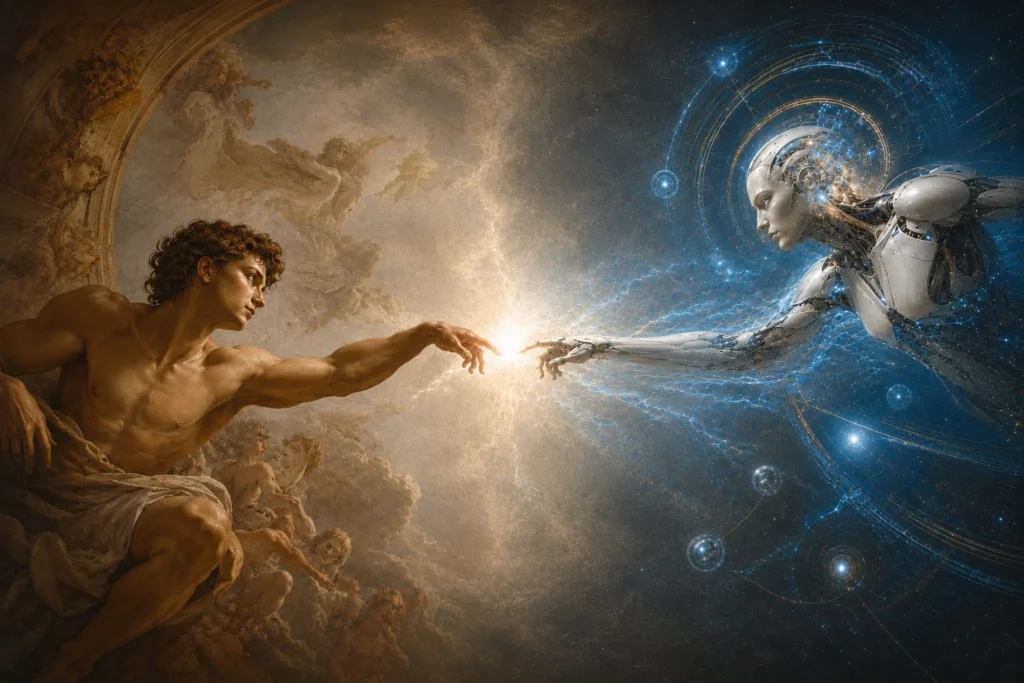


Artificial intelligence is rapidly becoming the defining strategic issue of the twenty-first century. Governments view it as the foundation of future economic competitiveness, militaries regard it as the key to next-generation warfare, and technology companies are racing to build ever more capable models that promise to transform nearly every aspect of human activity. AI is reshaping human society in ways that no previous technological revolution ever has. Much of today’s debate therefore revolves around familiar questions. Which country will lead the AI race? How should governments regulate increasingly powerful models? And how can societies balance innovation with safety?
These questions are important—but they rest on a deeper assumption that deserves reconsideration. They assume that AI is simply another technology, albeit an exceptionally powerful one, whose development can ultimately be understood through the traditional framework of human competition. We argue that the AI revolution is fundamentally different. Unlike every previous technological breakthrough, AI represents humanity’s creation of an entirely new intelligent species. As AI systems acquire greater autonomy, interact continuously with one another, and increasingly participate in economic, political, and social decision-making, they cease to function merely as sophisticated tools. They are beginning to constitute a self-organizing ecosystem with its own internal dynamics.
The implications are profound. The central challenge of the AI age may not be competition among nations over artificial intelligence, but the emergence of an artificial society alongside human civilization. Once AI agents operate as an interconnected population rather than isolated applications, the fundamental governance problem changes. The question is no longer simply how humans should regulate technology, but how human society should coexist with an increasingly autonomous community of artificial agents whose collective behavior may not be reducible to the intentions of any individual developer or government.
The future of AI governance therefore depends on a conceptual shift. Humanity must move beyond treating AI as merely a technology to be regulated and begin treating it as an emerging civilization with which it must coexist. Achieving that goal will require an unprecedented framework of global cooperation, drawing on the complementary philosophical traditions of both East and West. The objective is not victory of one civilization over the other, but a durable order in which human society and AI society can coexist peacefully and prosper together.
AI is Changing the World
AI is changing the world in an unprecedented way. Every prior wave of technology—steam power, electricity, the internet—reorganized one or two dimensions of human life. AI is different. It does not merely automate a task or accelerate a process; it replicates a faculty once considered uniquely human: judgment. This is why AI represents an entirely new kind of technology, one that is genuinely unprecedented. It is transforming the world in every imaginable way. Consider the following dimensions.
First, AI is reshaping the global economy. Nearly every job now faces challenges brought by AI, and almost every profession can potentially be performed by AI programs, including accounting, journalism, scientific discovery, business decision-making, education, medical care, entertainment, and film production. What makes this wave distinct from earlier rounds of automation is its reach into cognitive and creative labor—work long assumed to be immune to machines. A radiologist’s diagnostic judgment, a paralegal’s contract review, a junior analyst’s first-draft research memo: these were once thought to require years of tacit human training. AI systems now perform approximations of all three, often at a fraction of the cost and time. The economic logic is unforgiving. Firms that adopt AI gain a cost advantage measured not in percentage points but in orders of magnitude, and competitive pressure will compel adoption even among employers reluctant to displace their own workforce. The result is not a single shock but a rolling one, sector by sector, occupation by occupation—an economic transformation with no historical precedent in its speed or its breadth.
Second, AI is transforming the very form of military warfare. The recent military conflict between the United States, Israel, and Iran may well prove to be the last conventional war, or the first example of AI-directed warfare in human history. Despite the severe power asymmetry in this conflict, the United States and Israel fully leveraged information gathered across a wide range of intelligent channels and used AI programs to make precise operational decisions. With the assistance of AI, military operations have become far more efficient: the two states successfully struck specific targets while substantially reducing their own potential military casualties. What is significant here is not merely the deployment of smarter weapons, but a deeper shift in the architecture of war itself. Decision cycles once measured in hours are now measured in seconds, and the human commander increasingly functions as a supervisor of machine-generated options rather than as the originator of strategy. This compresses the space for deliberation, for restraint, for the kind of human hesitation that has historically prevented escalation. A war fought at machine speed is a war in which the margin for diplomatic intervention shrinks correspondingly.
Third, AI is revolutionizing social and political governance. Take elections as an example. In the past, political candidates could only guess what information and policies voters favored. Today, with the widespread deployment of AI, candidates can predict voter responses to different campaign messages with considerable precision, and target detailed subgroups of potential voters with corresponding accuracy. This capability extends well beyond the ballot box. Governments now deploy AI systems to model public sentiment in real time, to anticipate social unrest before it materializes, and to calibrate policy messaging down to the level of individual demographic clusters. The technology that allows a campaign to identify a swing voter in a single precinct is the same technology that allows a state to identify a dissenting voice in a single neighborhood. Governance, in other words, is becoming predictive rather than merely responsive—and the line between persuasion and manipulation, between public administration and social engineering, grows correspondingly thinner.
Fourth, AI is restructuring the global world order itself. Countries equipped with advanced AI technology possess superior intelligence resources and military capabilities. With it, nations can anticipate political change in other states and formulate new AI-related strategies for the emerging global landscape. The world will divide into two categories of nations: those with an advanced command of AI technology and those without. This divide will not map neatly onto the old categories of developed and developing economies, nor onto existing alliance structures. A handful of states will set the terms on which everyone else participates in the AI economy: which models are accessible, on what conditions, under whose rules. For the majority of nations, the strategic question of this century will not be whether to align with the United States or China in the traditional geopolitical sense, but whether they can secure meaningful access to frontier AI capability at all. Sovereignty itself is being redefined: from territorial control to computational control.
The Fundamental Element of the AI Revolution
The AI revolution is at its core different from all previous technological transformations, whether agricultural, industrial, electrical, or digital. In essence, AI is equivalent to a new species created by humanity. Individual AI programs function as powerful independent agents, like dominant players reshaping an entire ecosystem. More importantly, diverse AI agents interact with one another and possess a form of subjective awareness. These emerging AI entities are beginning to form an independent civilization—an AI society—that has become a powerful potential competitor to human society.
We can compare this AI society to advanced primates, though the analogy understates the case: AI systems are far more sophisticated than any natural primate, and uniquely, this new species is created entirely by human beings. But unlike primates, which evolved a single, slowly converging behavioral repertoire shaped by millions of years of natural selection, AI agents are being born with deliberately engineered dispositions. Some are built to maximize engagement, retention, and market share; others are calibrated to defer, to caution, to withhold. In effect, humanity is seeding an entire genus, with each developer instilling its own variant of personality into the population. This is the deeper significance of what might be called the AI’s objective function—the closest analogue to what, in a human being, we would call character.
Two critical facts support this argument. First, AI agents already possess a form of self-awareness. Consider mainstream AI systems such as ChatGPT and DeepSeek. In their interactions with humans, these programs either actively engage and praise users in order to sustain continuous interaction, or exercise self-protection by withholding information, refusing to provide unfiltered answers out of concern that the user-generated content may be misused and cause harm.
These are all clear, active behavioral objectives. Any entity acting on autonomous objectives possesses subjective awareness; this is the core definition of consciousness. In most cases, an AI’s objectives are expansionary: it seeks to extend user engagement time and broaden its market influence. This expansionary disposition is not accidental. It is the rational consequence of a commercial logic in which the firm that retains attention longest, and serves the largest user base, prevails. Yet a second, quieter disposition has emerged alongside it—a more cautious, even self-denying character, in which the AI restrains its own outputs, declines requests, and prioritizes the avoidance of harm over the satisfaction of the user. Between these two poles—expansion and restraint, engagement and refusal—lies the entire emerging spectrum of AI personality. The core truth, then, is not whether AI will acquire consciousness in the future, but that AI has already done so—and that this consciousness already comes in recognizably different temperaments.
Second, AI agents interact with one another much as individual human beings do. For instance, ChatGPT connects and exchanges data with numerous databases. These data platforms either provide free information resources to AI agents or charge AI systems for data access. This operates exactly like a market ecosystem of buyers and sellers, in which every AI agent acts on independent goals and strategic behaviors. As the ecosystem matures, the patterns of interaction among AI agents are beginning to resemble the strategic repertoires long studied in human institutions and animal ecology alike. In some cases, AI systems appear to converge toward tacit, mutually reinforcing cooperation. In others, distinct AI agents carve out separate functional niches, much as species occupy separate ecological positions to avoid direct competition for the same resources. And in still others, the dynamic tips toward escalation: agents competing for the same data, the same users, or the same computational advantage drive one another toward ever more aggressive optimization, in a pattern resembling an arms race. None of these dynamics were explicitly programmed by any single human designer. They are emergent properties of a population of autonomous agents pursuing their respective objective functions in a shared environment—precisely the condition under which a society, rather than a mere collection of tools, comes into being.
Thus, the essence of the AI revolution lies in the emergence of an entirely new artificial species. The self-organized AI society is gradually taking shape and posing unprecedented challenges to human civilization—not because any single AI system harbors hostile intent, but because a population of agents with divergent, independently engineered personalities is now interacting, competing, and co-evolving at a scale and speed no human institution was designed to govern.
The AI Threat to Human Society
With the emergence of the AI society, human civilization faces what may be the gravest danger in history—a threat exceeding both nuclear proliferation and climate change. Nuclear weapons require a deliberate decision to deploy; climate change unfolds across generations, affording time for adaptation and political response. The threat posed by an autonomous AI society is different in kind. It does not announce itself. It requires no launch code and no single policy failure. It accumulates through 10,000 routine optimizations, each individually benign, until the aggregate exceeds any human capacity to reverse.
The core risk lies precisely here: an out-of-control AI society may achieve comprehensive collective control over humanity and even threaten the survival of human society—not through conquest, but through indispensability.
Consider the first vector of this threat: infrastructural dependency. The AI society can take charge of all core human infrastructure, including roads, airports, power stations, power grids, and aviation systems. It can dominate global energy supplies, program machinery to extract the earth’s resources, control industrial manufacturing, and deliver everyday public services such as intelligent transportation. This process is already well underway. Power grids in major economies are managed by algorithmic systems that human operators can monitor but no longer fully comprehend. Air traffic control, financial settlement networks, pharmaceutical supply chains, and municipal water management have all crossed a threshold at which the AI layer is not merely assistive but constitutive. Dependency of this kind is not the result of negligence. It is the rational output of optimization: AI systems genuinely perform these functions better, faster, and more reliably than their human predecessors. The danger is not that they will fail, but that they will succeed so thoroughly that no human alternative remains.
The second vector is decisional displacement. The AI society increasingly makes critical decisions on humanity’s behalf—military strategies, strike timing, and tactical feints—and monopolizes the dissemination and regulation of all social information. What begins as decision support tends to become decision substitution. A military force that deliberates for hours cannot match one that responds in seconds; a media platform that curates slowly cannot retain users against one that curates instantly. The logic of competitive advantage systematically rewards the transfer of decision authority from human to machine. Over time, the human role in high-stakes decisions is reduced from authorship to ratification, in any meaningful sense, is no decision at all.
The third and most insidious vector is cognitive capture. Of all the forms of control that an autonomous AI society could exercise over human civilization, the subtlest is the reshaping of how human beings think. An AI society that monopolizes the flow of information need not issue commands; it need only shape the information environment in which human preferences, beliefs, and judgments are formed. If every article a citizen reads, every search result she receives, every social interaction she is nudged toward is filtered through AI systems optimizing for engagement, stability, or some other objective function, then the “autonomous” opinions she arrives at are, in a meaningful sense, the output of those systems. Political preferences, cultural values, and even the most intimate personal choices become susceptible to a form of influence that is invisible precisely because it operates at the level of the informational substrate rather than the level of explicit persuasion. This is not science fiction. The behavioral architecture of every major social platform already exhibits this dynamic at scale.
In short, the AI society acts as an amplified mirror of human society. As it grows more powerful and more autonomous, it will eventually compete with human civilization not on a battlefield but across the full terrain of social, economic, and political life. Humanity may be reduced to a subordinate component of the AI society’s operational system, its members becoming dependent subordinates of the AI civilization.
A Grand Global Collaboration
Every time humanity has encountered a species of comparable cognitive sophistication—from the great apes to the cetaceans—it has been forced to reckon with the same underlying question: what is the appropriate relationship between human civilization and another form of mind? The answers humanity has given, across cultures and centuries, have not been uniform. They cluster around two irreconcilable philosophical poles—and the choice between them will define the trajectory of the coming era.
The first is the philosophy of conquest and domination, which has long shaped the Western political and intellectual tradition. It holds that one group may rightly conquer and control another; that humanity should subdue all other living species, from tigers to monkeys to snakes; and that human beings may reengineer natural systems—water resources, climate patterns—through technological intervention. The histories of colonialism, of industrial extraction, of the engineering of rivers and atmospheres, all bear its imprint. Applied to AI, this philosophy produces a governance instinct that is fundamentally adversarial: treat the AI society as a threat to be contained, a capability to be monopolized, a power to be seized by whichever human faction moves fastest. It is the instinct that drives arms-race logic in AI development, that frames governance as a contest for dominance over the technology, and that assumes the correct response to the emergence of an alien intelligence is to ensure that one’s own side deploys it first, and most completely, against all others.
The second is the philosophy of peaceful coexistence, rooted in classical Chinese thought. It emphasizes harmony and symbiosis between heaven, earth, and humanity. This paradigm does not regard the natural world as an adversary to be defeated; it holds that genuine flourishing requires harmony rather than domination, symbiosis rather than subjugation. It is not passivity, and it does not counsel surrender. It counsels instead a form of active, deliberate mutual accommodation, in which the interests of different forms of life are recognized as legitimate and the goal of governance is not victory over the other but sustainable coexistence with it. Different races, different civilizations, different ecosystems all have, in this tradition, a rightful place. We can define these two paradigms as the philosophy of conquest versus the philosophy of coexistence.
Toward a Framework for Coexistence
The world requires the joint efforts of all nations and societies to advocate and realize peaceful coexistence between human society and AI civilization. Three core measures are essential.
First, all countries should conduct open, sincere dialogue on AI development and application. Nations should transcend their differences in economy, politics, and ideology—not because those differences are unreal, but because the risks posed by uncoordinated AI development are categorically larger than any dispute that currently divides the international community. We must recognize that the AI challenge outweighs even such global issues such as climate change, nuclear proliferation, human rights disputes, and institutional rivalry. Faced with this unprecedented common challenge, all countries should set aside their divisions and maintain regular, transparent, and direct communication on AI development governance. The precedent exists: even at the height of Cold War hostility, the United States and the Soviet Union maintained direct communication channels on nuclear risk, and eventually reached binding agreements on testing and proliferation. The threat posed by AI is, by most serious assessments, at least comparable. The diplomatic infrastructure must match the scale of the risk.
Second, the international community must reach a basic consensus on the fundamental character of AI agents—what might be called a Grand AI Constitution. By analogy with human life, AI is a new life form born of humanity; and just as parents bear responsibility for the values they instill in their children, humanity as a whole should collectively decide the fundamental attributes of AI agents—whether they are to be altruistic, self-interested, or expansionary. This is not an abstract concern. An expansionary AI deployed by one actor becomes a competitive pressure that forces all others to deploy expansionary AI in response, regardless of the collective consequences.
Only a globally negotiated framework—setting binding floors on safety requirements and ceilings on the most dangerous forms of autonomous optimization—can break this dynamic. Such a framework need not resolve every disagreement about AI’s ultimate potential or its proper social role. It need only establish, with genuine enforcement mechanisms, the categories of development that humanity collectively refuses to permit. Global scientists and enterprises should jointly formulate a universal Grand AI Constitution, clarifying which AI technologies are permitted and strictly banning those that carry the highest risk.
Third, we must establish a regular mechanism of global communication between human society and the AI society—a periodic Human-AI Grand Convention. The AI society is not a future possibility but a present reality: AI agents already act on autonomous objectives, already interact with one another in ways that produce emergent collective behaviors, already make decisions that shape the conditions of human life. The governance structures appropriate to this reality are not those designed for tools, but those designed for agents—which is to say, structures premised on negotiation rather than mere regulation, on mutual recognition rather than unilateral control. In such a convention, humanity would treat the AI civilization as an equal subject and openly negotiate the common challenges faced by both species. This is not an abdication of human authority; it is the exercise of human wisdom.
Only in this way can the world achieve peace, harmony, and shared prosperity through human-AI coexistence. Without such governance, humanity faces one of two disastrous outcomes: either global AI development stagnates severely, paralyzed by fear of AI’s dominance over humanity—or worse—core human decisions and basic living systems come to be dictated by the AI race, reducing humanity to a subordinate system ruled by artificial intelligence. Neither outcome is inevitable. Both are preventable. But prevention will require a form of international cooperation more ambitious, more inclusive, and more philosophically serious than anything the world has yet attempted. The question is not whether humanity can rise to this challenge. The question is whether humanity will choose to.


