Few relationships have deteriorated as quickly and as thoroughly as the one between Europe and China. In 2019, the European Commission described China as, at once, a partner, a competitor, and a systemic rival. The formula was meant to hold three ideas in balance, but in the years since, the third term has steadily overtaken—or perhaps even swallowed—the other two.
In 2021, Brussels sanctioned Chinese officials over Xinjiang. Beijing retaliated against Members of the European Parliament, and the Comprehensive Agreement on Investment, years in the making, was frozen. A year later, weeks after Xi Jinping and Vladimir Putin proclaimed a partnership “without limits,” Russian tanks crossed into Ukraine. For most Europeans, China seemed too close to Russia, and its role as the main supplier of goods to the Russian war economy turned a distant trade question into a matter of continental security. American pressure was no doubt a factor in these developments, and often the main one.
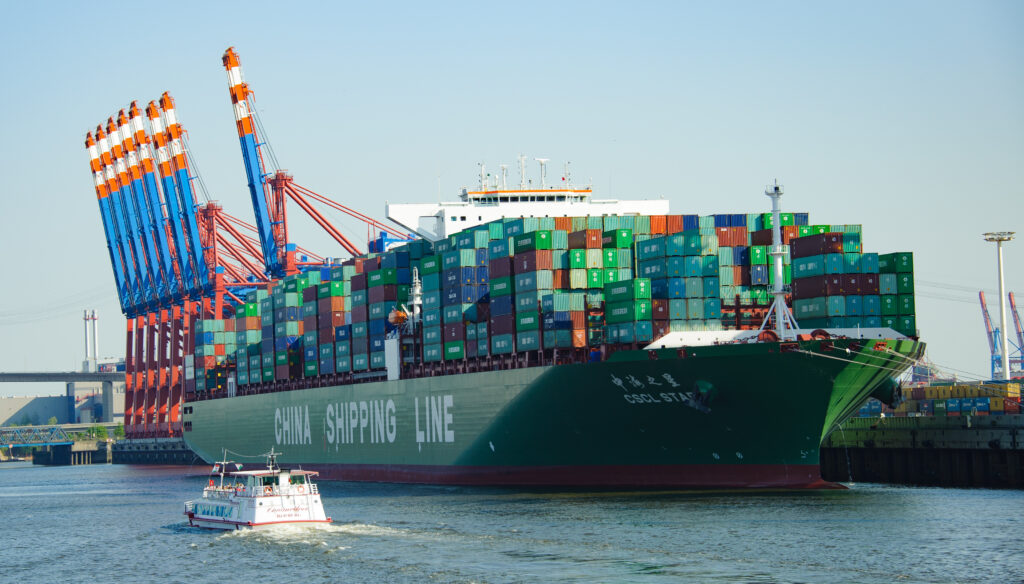
The economic front hardened as well. With the trade deficit with China passing €300 billion a year, Brussels imposed countervailing duties on Chinese electric vehicles in 2024, and Beijing answered with investigations into European brandy, pork, and dairy. In 2025, Chinese export controls on rare earths exposed how dependent European industry had become on supply chains it no longer controlled. The Dutch government’s move to take control of the chipmaker Nexperia briefly threatened production lines across the European car industry. Predictably, the summit marking 50 years of diplomatic relations, in July 2025, was shortened to a single day and produced little beyond statements of mutual disappointment.
Each side tells itself a story. Europeans see a centrally planned economy flooding their markets with subsidized goods, an authoritarian power drawing closer to Moscow, and a partner willing to use trade as a weapon. The Chinese see a Europe that lectures but no longer leads, that follows Washington even when Washington treats it with contempt, and that reaches for tariffs the moment it loses a race it feels entitled to win. Both stories contain truth. Each side has learned to moralize the encounter, and once that happens, it becomes almost impossible to think about the relationship except as a contest between right and wrong.
The argument of this essay is that the impasse cannot be resolved within the existing parameters, because those parameters are themselves the source of the problem. As an old line of Chinese poetic wisdom has it: the real mastery of something lies outside its immediate sphere (gōngfu zài shī wài). The liberal international framework asks China to accept rules written before it became a great power, and it asks Europe to defend a hierarchy in which Europe itself is slowly losing its place. It is an order of the old type: a snapshot in the movie of history, which its beneficiaries naturally wish to freeze. What is needed instead is an order of change, built on two principles. Every country should be free to change. Every country should be free to choose.
Applied to Europe and China, these principles cut in both directions. The first asks Europe to resist the temptation to slow China down, and instead to compete, adapt, and grow. Chinese battery and car makers building factories in Hungary and Spain are not an invasion to be repelled but a channel through which technology can flow back into Europe, just as Japanese firms once brought new methods of production to America and Britain. A continent that launched the first industrial revolution has no grounds to deny others the right to launch the next one. The second principle asks China to accept that Europe, and the countries around it, must be free to choose their own alignments. Ukraine has the right to associate with Europe, and that right is not negotiable within such an order. Nor should the countries of Asia be forced to choose between Washington and Beijing.
There is a deeper reason to believe that Europeans and Chinese could actually agree on such a framework. Both are old civilizations, and both carry in their memory a vivid knowledge of rise and fall.
Chinese historical thought was built around the dynastic cycle. The Mandate of Heaven was never permanent; it could be lost through negligence, corruption, and pride, and transferred to a worthier house. The famous opening of the Romance of the Three Kingdoms states the law plainly: the empire, long divided, must unite; long united, must divide. Modern China has its own experience of the cycle, from the summit of the Qing to the century of humiliation and back to global power. Preeminence is a phase, not a birthright.
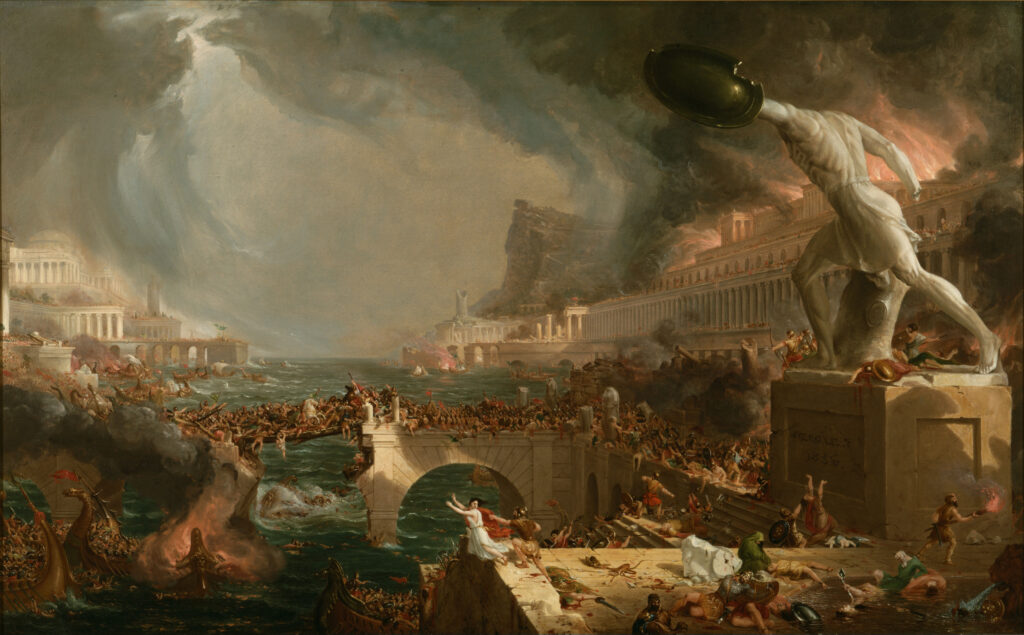
Europe learned the same lesson from Polybius and his cycle of constitutions; from the long meditation on the fall of Rome; and from Gibbon, Spengler, and Toynbee. It learned it most painfully in the twentieth century. After 1918, French poet Paul Valéry observed that civilizations had now discovered they were mortal. Within a few decades of World War I, Europe had lost its empires and its centrality, and it rebuilt itself through the European Union, a project founded precisely on the renunciation of hegemony. No one should understand better than Europeans that a leading power can decline and still flourish.
In this, both differ from the United States, a young republic whose founding story is providential and whose recent intellectuals announced the end of history with great fanfare. Arab scholar and historian Ibn Khaldun—who wrote on the Mediterranean shore that joins Europe and the Islamic world, and who met Timur at the edge of an empire reaching toward China—stands between these worlds. His insight, that the forces of history cannot be exhausted, only channeled, is one that both ancient civilizations already possess in their own idiom. An order built on that insight would not ask Europe or China to abandon its vision of the good life. It would ask only that each accept what its own history has long taught it: that no vision lasts forever, and that the rules of the game must outlive the players.
Ibn Khaldun stands out among thinkers of history because he refused to offer a model of order of his own—that is, a blueprint designed according to his own precepts. Instead, he advanced an entirely new type of order, one built on top of all previous and future models as a procedural framework for their rise and fall. If the old type of order can be compared to a snapshot in the movie of history, the new type is the endless movie within which those snapshots occur, and whose structure or logic both explains and dictates their succession.
The Western world order within which we still live is an order of the old type. At its best, it was able to embody a certain vision of the good life that might aspire to become universal. It expressed a desire for liberation, an anarchical movement against the forces of nature and tradition that put it at odds with other civilizations around the world. There was, to be sure, a fateful promise of violence in the announced conflict between a liberated West and a world outside the West still waiting for that liberation. But there was also, as I have said, an aspiration that the Western program could spread everywhere, and perhaps even be applied everywhere with a modicum of justice or impartiality. It divided humanity into two sects or castes, but it often followed that division with a promise of future unity. The promise was left unfulfilled, as it was bound to be. Today, the order is regressing from an idea of order into a much sharper and more inexorable division, which, left to itself, will bring about new and more violent conflict. As a form of liberalism, it was rather imperfect: aware only of certain kinds of freedom but blind to how freedom was, and still is, sought outside the West; incapable of stepping outside its own prejudices even while advocating a radical liberation from prejudice. Western liberalism fell short of “world liberalism.”
The order of a new kind that I am defending here does not embody any particular vision of the good life. It simply assumes that such visions, and the models of order that give them form, will not last, cannot last, and will in time be replaced by other visions and other forms. Whereas Western philosophers such as Kant and Hegel turn to the gyroscopic forces of history only to stage a theatrical drama whose action leads to the inevitable triumph of their favorite ideals, Ibn Khaldun knew too much about history to believe that its forces could ever be exhausted. He therefore had to search for order within the very movement of historical change, rather than at the imagined end of that movement—an exit from the tunnel of time. The exit we seek is not an exit from time, but simply an exit from our own time.
Here is how to proceed. My goal is to identify the forces responsible for the rise and fall of states and empires. They are like a higher sovereign ruling over every state and determining its fate, and in this sense it is they—rather than whichever state happens to be at the height of its power—that should provide the ordering principles. If at one moment they favor the ascendant power, later they will also dictate its downfall.
How do great powers rise? Ibn Khaldun describes two main forces behind their ascent. First, a country grows in power through material and cultural development. Wealth and knowledge are sources of power, often manifested in great and splendid cities and buildings, as well as in a vibrant civic life. The second force is the increase in land and population obtained when a state assimilates new groups under the same political order. These two forces are permanent engines of transformation. When states grow and develop to their intrinsic limit, decline begins.
These forces of historical transformation cannot be stopped. To be sure, dominant states will invariably struggle against their operation, particularly at the moment when decline becomes visible, or when other states seem to be gaining from the process. As Ibn Khaldun teaches us, this is always fruitless. All that resistance can accomplish is to make the historical process far more chaotic, often riddled with conflict and war, so that decline may take the form of catastrophe. The alternative is to create rules and institutions that allow history to proceed according to its inner logic—a logic accepted and understood by the human societies that are, in any case, subject to it.
My task in this essay is merely to adapt that logic to current circumstances. What Ibn Khaldun calls advanced civilization would today take the form of an advanced technological civilization. And what he calls large empires would today aspire to become genuinely global orders. A state rises to its maximum strength when it possesses the most advanced technology and acquires global influence. The dialectic, however, does not change: technological supremacy makes a country less likely to keep innovating, and a global empire carries costs that may quickly become unsustainable.
Let us consider how these two principles can provide the foundations for a new kind of world order. Every superpower that owes its status to fundamental technological breakthroughs will be tempted to prevent other states from leading new technological revolutions. Any such attempt is not only fruitless but also contradictory, since that superpower would not exist as a superpower had it been prevented, in the past, from fundamentally transforming the global economic and technological structure. By developing a new technological structure, a rising power may hope to move to the core of the new global system, just as Britain and the United States took advantage of the first and second industrial revolutions. History has shown that those who adopt and diffuse a technology fastest are likely to win, and that these revolutions are followed by fundamental changes in the role a country plays in the global system. I therefore express the first principle of world order as follows:
Every country Should be Free to Change
If one were to redesign the global legal and normative order, or to create a new set of global institutions, that order would have to embody a principle of change. But change cannot happen at the global level without being driven by powerful state actors. In our own time, observers often turn to China or India as the material reflection of rather speculative intimations, or prophecies, about a future world order. With the Belt and Road, China launched a revolutionary project whose ultimate goal is to reshape the global system in ways that place China closer to its core. Such profound change cannot be achieved without similarly profound changes inside China itself—and, in fact, the Belt and Road aims to transform China into a technological powerhouse, a country singularly able to deploy and control the technologies and industries of the future, from clean energy to artificial intelligence, space, and quantum computing.
The American response to the Chinese challenge could take two very distinct forms. First, the United States could try to race ahead of China in these critical industries. There would always be an element of uncertainty: the two countries might make different bets, either on general technologies or on the pathways to develop them. Time, or history, would decide the winner. There would be nothing certain or final about the Chinese challenge. After all, when Richard Nixon decided in 1971 to delink the dollar from gold, it seemed that the reign of the dollar was coming to an end. In reality, it was beginning anew, on much stronger foundations.
The other possible response would be for America to try to slow down, or even block, its adversary. Such a response would be purely reactive. Its premise is that the developments we have witnessed in China over four or five decades can be brought to an end, or even reversed, so as to preserve the global system in its current form. It is doubtful that such a policy can work. For one thing, radical change in China was not brought about by the United States in the first place, and imposing strict export restrictions or tariffs will likely only force China to look for alternative development pathways, which will become ever more autonomous. A second reason the policy is likely to fail is that history never travels the same road twice. When deliberating on how to close off certain development possibilities for China, American policymakers will tend to focus on the possibilities that mattered for American development. They will lack awareness of the very different possibilities that are relevant to Chinese technological progress. A development pathway looks inevitable only in retrospect.
For the past few years, the second response has clearly dominated in Washington. Gina Raimondo, Commerce Secretary under President Biden, famously argued that the best way to compete with China is to “slow down” its “innovation rate.” Ibn Khaldun would be unsurprised. The psychological dynamics at play today are more or less those he described in his masterpiece. Superpowers grow used to their status and tend to assume it is theirs by nature or natural right. Faced with an upstart, they react with righteous indignation: how can anyone presume to dispute the natural order of things, the source of everything good and just?
The commentator Kaiser Kuo notes that a nation that sees itself as the default ruler of the world will always struggle to recognize a peer or a rival without reflexively moralizing the encounter. As for the effort to create new things, and even to recreate the world order anew, that seems far beyond what those responsible for the previous order are capable of. Why should they turn against the fruits of their own efforts, and why should they be denied the pleasure of enjoying them? If you succeeded in bringing about the last wave of change, you want to preserve things as they are. You want to enjoy the fruits of what you did, of all the work you put in. It will then be up to others, in other parts of the world, to lead the next wave.
There is nothing here peculiar to America. Much the same could be said of the way the Qing dynasty reacted to the arrival of European science and technology on China’s shores. Even contemporary China may already display some of the same instincts, as its efforts to stop Western and Taiwanese companies from moving production from China to India suggest. In January 2025, news emerged that China was restricting travel by its citizens working as engineers and technicians at Foxconn facilities in India, and that the restrictions extended to curbs on exports of critical specialized manufacturing equipment.
Others have defended a different strategy. In an interview in May 2025, Nvidia CEO Jensen Huang argued that limiting other countries’ access to American technology is the wrong goal. The right strategy, he said, is to accelerate the adoption of American technology everywhere. “The idea that we would have America not compete in the Chinese market, where 50 percent of the developers are, makes absolutely no sense from a computing infrastructure, computing architectural perspective.” Allowing China to build a rich ecosystem because American companies are absent from the country will only ensure that Chinese technology and leadership diffuse around the world. The important point for Huang, as he put it in that interview, is that when a country aspires to be great, no one should begrudge it that ambition.
A country should be free to change and improve: that kind of ambition “causes us to all rise above and do even better than we could, and so I love watching people who aspire to be great.” Holding others back, he suggests, will only spur them to work around the obstacles placed in the way of their natural ambition. China’s AI chip market is worth about $50 billion a year. To leave that behind so that the profits that go with that, the scale that goes with that, the ecosystem building that goes with that, can be appropriated by China alone, will never work as a program of American supremacy.
The other important point Huang makes is that a strategy of American hegemony should be about being present everywhere, China included. As we saw above, Ibn Khaldun emphasized the connection between power and universality, praising Timur for the vastness of his domains and the many peoples living under his political order. Today, thanks to technological progress, the question of political order must be posed at the level of the globe, and every political order has an aspirational universal character. Huang suggests as much when he argues that, were the United States to abandon large parts of the world market, someone else would take its place.
If political order is to have this aspirational universal reach, it cannot be based on war or conquest, but on the effort to find a place for different peoples and countries within the same global order. In my book World Builders, I called this an ‘empire by invitation.’ After World War II, for example, Washington was able to find a place within the new order under construction for countries such as West Germany and Japan. The case of Japan was particularly striking. Separated from a revolutionary China by the Asian version of the Iron Curtain, it had to have its place in the world reinvented. The task fell in large measure to the United States, which integrated the two economies as never before and carved out a new “Asian crescent” stretching from Japan through Taiwan and the Philippines to Singapore. The American order continued to expand as the Cold War came to an end. By the turn of the century, it seemed that it could encompass even Russia and China. China might even have felt that a place had at long last been found for it, as one had been found for Japan before. But the illusion was as brief as it was, for a while at least, intoxicating.
Today, it is overwhelmingly clear that China no longer believes there is, or ever will be, a place for itself within the current order. It is busy building a new one and, like America before it, inviting others to join. China is already the largest trading partner of more than 120 countries. Some, in Asia and Africa, already regard Beijing as their main economic and political partner. If forced to choose, they would opt for China, but their main preference would be to remain free to choose: to weigh the different proposals and projects coming from the United States, China, and others.
A choice, when it comes, might be temporary rather than definitive. This preference for freedom in the critical matter of alignment is important for developing countries, which need all the help they can get with their development challenges, but also for highly successful nations such as Singapore and Switzerland, which prefer to look for opportunities everywhere. I like to think of the world as a giant democracy, in which the superpowers have presented themselves as candidates for leadership but must win the votes and support of everyone else on a daily basis. From these reflections, it is easy to derive a second fundamental principle of world order:
Every Country Should be Free to Choose
The principle would exclude any attempt to use force or threats to enlist a country against another. Its application is obvious in the competition between China and the United States to create their own spheres of influence: that competition should be free of coercion or force. Whether a superpower can appeal to other peoples and countries will naturally determine its future status as a superpower, but this is a test it must pass, rather than evade by preventing those peoples and countries from exercising their free choice. The principle applies just as naturally to Ukraine. The possibility that Ukraine might be forced to forgo a close association with Europe or the United States as the price of resolving the conflict offers no basis for a functional global order. It is so far from a solution that it lies, in fact, at the very origin of the war.
Given the rapid dissolution of the existing order, calls to reform the international framework of norms and institutions have become common. These calls are useful and necessary, but they are bound to fail if they ignore the need to rethink the principles on which norms and institutions rest. Liberal norms and institutions, moreover, are too restrictive and too contested. They are disputed even within Western societies, let alone across other civilizational worlds.
My two principles are principles of a higher order. Just as a higher-order equation can be written as a system of first-order equations, an order of change can be expressed as a system governing how lower-level political orders rise and fall within it. Once these principles have been established, we can turn to the debate over how to give them form in a reformed global framework, including the creation of new norms and institutions. That debate should be genuinely global, to ensure that the resulting norms and institutions enjoy the widest possible acceptance and legitimacy.
In the absence of a higher order, great powers or leading civilizations have only one recourse for deciding which of them is on the right side of history: war or conflict, which in a nuclear age may even threaten the survival of the species. War, in any event, is no great judge, and certainly not an intelligent one. An order of change, inspired by the perennial insights of Ibn Khaldun, offers an exit from the dissolution of the global order and from the looming threat of war, which until now has always punctuated the cycle of empires.
Europe and China are better placed than any other powers to understand such an order, because each has lived both halves of the cycle Ibn Khaldun describes, and lived them largely in relation to each other. Europe rose in the nineteenth century as China fell, and China has returned in our own century as Europe’s weight in the world has diminished. Each has also tried both ways of meeting the forces of history. The Qing tried to hold them back, and the result was a century of humiliation; four decades of reform and opening, of learning from others rather than shutting them out, made China a great power again.
Europe spent the first half of the twentieth century letting the rise and fall of its nations be settled by war, and the second half building, in the European Union, something close to an order of change on a continental scale, where the fortunes of its members could rise and fall without anyone reaching for arms. What Ibn Khaldun deduced from the chronicles of North African dynasties, Europe and China carry as memory. The United States, which has never had to survive its own decline, will tend to hear in an order of change either a counsel of defeat or the plea of a rival. Europe and China know better: resisting the forces of history turns decline into catastrophe, while channeling them makes decline survivable and ascent peaceful.
Such an order would also give Europe back something it has been losing: a challenge worth rising to. Ibn Khaldun understood that supremacy breeds complacency, and much of Europe’s malaise comes from having settled into the role of custodian, guarding an inheritance rather than building a future. Where every country is free to change, decline is a phase rather than a sentence, and the forces that lifted China remain available to Europe. Both of Ibn Khaldun’s engines are within its reach: the race for the technologies of the coming century, in which Chinese competition may prove the spur Europe has lacked and an enlargement that would bring Ukraine and the other candidates into the same political order.
In 1900, Europe could dream of its own end of history. Hegel had declared Europe the end of history and Asia its beginning, and that summer, while Paris celebrated the passing century at the Exposition Universelle, European soldiers marched into Beijing. An end of history in that year would have crowned Europe. An end of history today would fix it where it now stands, an ageing continent dependent on others for its technology and its security, and that would be the end of Europe. History did not end in 1900, which is why China was able to rise again. If it does not end now, Europe may yet do the same.