
Europe and China are bound together by an awkward fact: each has become too important to the other to be treated as an ordinary partner. Europe needs Chinese industrial capacity for its energy transition, from batteries and solar panels to the processing of critical minerals. China needs European markets, European investment, and the commercial standing that comes with a durable place in the world’s largest integrated economy.
In Brussels, that dependence has acquired a new name: risk. European governments have begun to worry that supply chains once celebrated as efficient may leave them exposed in a crisis, and that commercial ties can become instruments of pressure when they are concentrated in too few hands. In Beijing, European investment screening, export controls, and the language of de-risking carry a different meaning. They suggest that access to Europe’s market may increasingly depend on accepting conditions set in Brussels—and, more broadly, by the Western security agenda.
Neither side is imagining the danger. China has become central to industries that Europe cannot easily replace. Europe, for its part, retains a market, a regulatory reach, and a technological base that China cannot dismiss. Each has begun to wonder whether the other’s importance will eventually become a means of discipline. The dispute over electric vehicles and supply chains is therefore about more than commerce: it concerns the political terms on which two very different powers can remain connected.
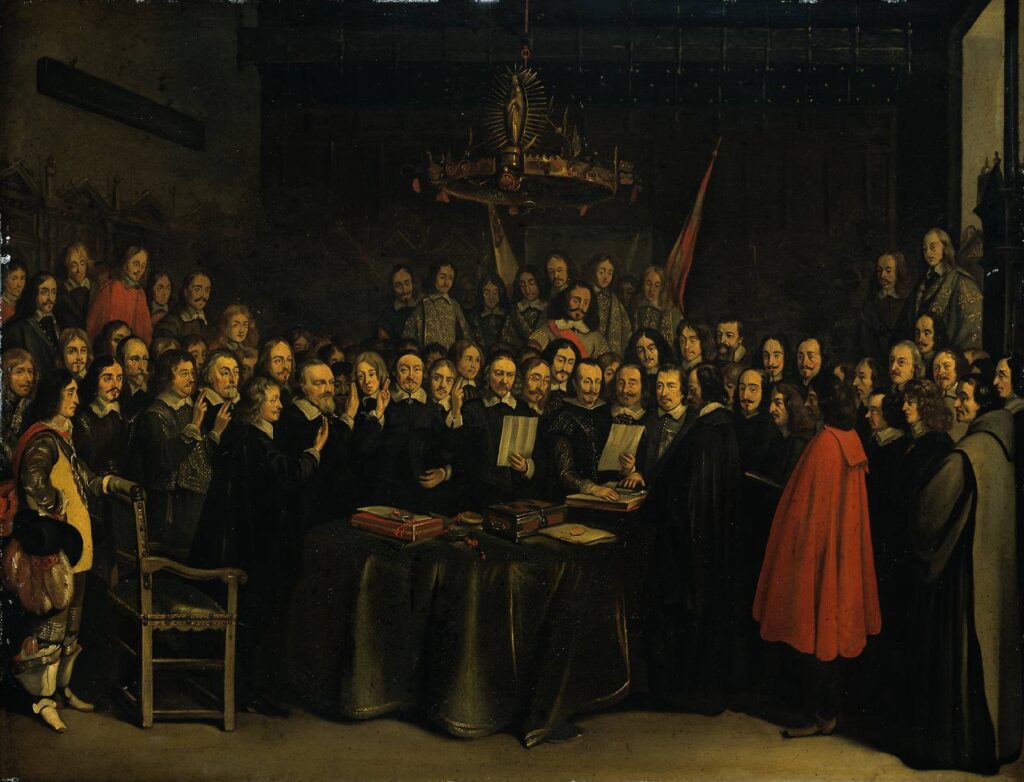
The problem is older than the present tensions. For centuries, international order has oscillated between the attraction of a center and the desire to escape one. The Roman Empire held together an immense and varied world through roads, law, currency, taxation, and force. Its cities and provinces retained their languages, customs, and local elites, but they lived within a system whose security depended on an authority based elsewhere. Westphalia offered a different promise. States would govern their own territories, deal with one another through diplomacy and treaty, and recognize no ruler above them. Peace might be uncertain, but independence would not be a favor granted by a distant center. The contrast is, of course, too neat: Rome negotiated constantly with local powers, and early modern Europe was full of empires, interventions, and unequal bargains. Still, it has endured, because it expresses a political choice that has never gone away. Order could be made more secure by concentrating power. It could also be made more tolerable by limiting how far any one power could reach.
The order that emerged after 1945 tried to live with both impulses. The United Nations spoke in the name of sovereign equality while giving the great powers a privileged place in the maintenance of peace. The wider architecture of the postwar world rested on a similar accommodation. American military power, financial depth, and market access underwrote institutions that presented themselves as universal in purpose, and their rules helped make trade, diplomacy, and cooperation more predictable across a divided world. But Washington never accepted that those rules constrained it as they constrained everyone else. It invoked international law and multilateral procedure when they supported American aims and set them aside when they did not. A history of unilateral intervention, extraterritorial sanctions, and the use of financial and technological access as instruments of pressure left a lasting impression: law survived, but its force depended heavily on who was subject to it. The international system became one in which rules and discretion were unequally distributed.
China’s rise has unsettled that arrangement, but it has not resolved the problem at its heart. Beijing has created new channels for trade, investment, infrastructure, and technological cooperation beyond the older Western core. Europe remains one of the world’s great regulatory and commercial powers. Both have become centers in a system more crowded than the one that followed the Cold War and neither can plausibly organize it alone. Europe cannot insulate itself from China without paying a severe economic and political price. China cannot secure a lasting place in Europe by asking Europeans to ignore the risks created by concentrated dependence. The work ahead lies in building forms of cooperation that allow both sides to remain connected without making either one captive to the other’s power.
The Shape of International Order
States in such a world had little reason to imagine that sovereignty alone could protect them. With no higher authority above them, capability became the first measure of security. Realists saw order as the precarious result of unequal power. A dominant power could stabilize an unruly system by doing what weaker states could not: keeping sea lanes open, defending allies, organizing collective action. The price of such stability was always present in the background: those who relied on the provider of order had to live with its power.
Liberal institutionalists, critical of this pessimistic view, placed their faith in a different part of the postwar settlement. Institutions could make promises credible, expose violations, establish procedures, and give weaker governments a place from which to press their claims. They could turn raw advantage into rule-bound cooperation. That hope remains one of the great achievements of postwar political thought. But it also assumes that the availability of procedures can compensate for an imbalance that may be rooted in the material life of states. A country can have legal standing and still lack an alternative market for its goods, another supplier of critical inputs, or another security partner capable of bearing the same risks.
Institutional rules do not make power less consequential when it works quietly; they simply make it harder to identify. Dependence can be produced through ordinary contracts, logistics, and investment decisions, each sensible in isolation. Over time, such arrangements can leave a state with a narrowing range of politically survivable choices. The rules remain in place, but the weaker party approaches them knowing that the relationship cannot easily be disturbed. A legal right becomes less valuable when exercising it risks economic dislocation or strategic isolation. No threat need be issued: governments learn the price of challenging an indispensable partner long before that partner has to state it.
An order held together by such ties does not depend on force alone. It also depends on how those inside it come to understand their circumstances. A relationship that once appeared contingent can acquire the aura of necessity. Officials begin to treat a particular market, lender, supplier, or security partner as the only realistic option. Alternatives come to look reckless, expensive, or impractical—not always because they have been carefully weighed and rejected, but because the relationship itself has made them difficult to imagine. Authority becomes durable when it is woven into expectations as well as institutions.
The world that has emerged since the end of the Cold War has complicated the issue further. There is no longer a credible expectation that one state will organize every major domain of global life. The United States remains extraordinarily powerful, but China has become central to manufacturing, trade, infrastructure, and green technology. Europe can regulate access to one of the world’s largest markets. India, the Gulf states, Brazil, Indonesia, and Turkey increasingly work the spaces between the larger powers. Amitav Acharya’s image of a multiplex world captures this crowded landscape better than the old expectation that one hegemon will inevitably replace another.
Yet a world with more centers is not necessarily one in which smaller states have more freedom. The proliferation of centers can scatter dependence across several systems at once. A state may diversify its financing while becoming more dependent on a single technological ecosystem. It may reduce its exposure to one supplier while becoming beholden to another market. It may gain diplomatic options while seeing its industrial future shaped by standards written elsewhere.
Order can emerge without any single state setting out to build it. Trade, infrastructure, investment, diplomatic exchange, and technological cooperation create habits of coordination among political communities that share neither an ideology nor a constitutional system. Each enters the relationship for its own reasons. A port may serve one government’s development plans, another’s commercial ambitions, and a third’s search for strategic access. Agreement on the larger meaning of the relationship can remain elusive without preventing the relationship from deepening.
Much of the emerging order has grown through bilateral arrangements that adapt to local circumstances and gradually intersect. A wider pattern takes shape through the routes that carry goods, the financial channels that sustain investment, the technologies that become standard, and the diplomatic habits that make later cooperation easier.
As these ties spread, some actors come to occupy positions that others cannot readily bypass. They provide the capital, industrial capacity, technology, market access, or diplomatic connections on which others rely. Their centrality may arise through demand and repeated exchange rather than conquest; it still shapes the choices available to those around them. A similar reservation applies to accounts that place moral restraint at the heart of leadership. A powerful state may provide goods that others value, avoid overt coercion, and cultivate a reputation for consideration. Such conduct can make hierarchy more acceptable and more durable. Yet the provider of public goods may also decide what counts as a public good, what obligations follow from its provision, and when those obligations have been met.
Power may be dispersed across several centers, order may grow through practical ties, and leadership may be tempered by restraint. None of this ensures that those tied to a central actor can reopen the relationship once dependence has accumulated. A world without a hegemon can still produce centers too important to challenge.
Europe and China now confront one another across this landscape. Europe worries about a relationship in which Chinese industrial and technological scale becomes leverage. China worries about a relationship in which European market access and regulatory authority become instruments of political conditionality. The task is to find a form of interdependence in which cooperation can deepen without requiring either side to live under terms it cannot later reopen.
Plural Confluent Governance
Europe and China have spent the past several years arguing over the risks created by their economic relationship. Europeans fear that dependence on Chinese industry could become a political liability. Chinese officials hear European talk of de-risking as notice that commercial relations will be tolerated only on terms set elsewhere. The dispute has often been framed as a choice between trust and caution, engagement and separation. Neither description is adequate. The relationship has become difficult because the two sides need one another in ways neither can fully control.
That is not unusual in international politics. Orders are rarely built by countries that first agree on what the world should look like. They emerge because governments have things to build, goods to sell, technologies to acquire, crises to manage, and borders to keep quiet. A railway links producers to markets. A port brings investment and traffic. A common technical standard makes trade easier. Each agreement serves a particular purpose, negotiated by particular parties under particular conditions. Yet the agreements do not remain separate for long. A port changes the value of a railway; a railway changes the geography of trade; trade creates demand for finance, insurance, customs arrangements, and technical compatibility. These arrangements generate constituencies that prefer continuity to disruption. Officials begin to meet because firms, local authorities, and investors have already created problems that require common management. What emerges is more than a collection of bilateral bargains, even though no one has written a constitution for it.
Plural confluent governance describes this way of making order. It begins with particular relationships rather than a universal doctrine. Its participants do not need to share a political model or a theory of legitimacy. They may not even tell the same story about the relationship they have entered: one side may call an investment development, another market access, a third strategic insurance. The relationship can endure because it has practical value, not because its participants have agreed on first principles.
For Europe and China, this should be a familiar idea. Their relationship did not deepen because Brussels and Beijing settled their differences over the state, markets, sovereignty, or political rights. It deepened because European consumers, firms, cities, and governments found uses for Chinese goods, capital, and industrial capacity, while Chinese companies and institutions found value in Europe’s market, technology, research base, and commercial institutions. The connection grew through thousands of decisions made for different reasons; its political significance came later. Political difference can remain sharp while practical cooperation expands. A relationship may be strongest where both sides have stopped trying to remake the other and have learned instead to work around the differences that will not disappear.
Practical success brings its own risks. Connections that begin as useful can become difficult to alter. A supplier becomes indispensable. A technology becomes embedded. A market grows too important to lose. A financing relationship becomes too large to challenge. None of this requires an imperial project or even an intention to dominate: power can grow out of usefulness. The danger appears when a relationship no longer contains a realistic way of changing its terms. A government may have entered an agreement willingly, found it beneficial, and still discover that the costs of reopening it have become prohibitive. Its industrial base may have adjusted to a particular source of inputs. Its firms may be tied to a market that cannot be replaced. Its officials may know that pressing a dispute will invite retaliation they cannot absorb. The agreement remains formally voluntary, but the political freedom once associated with consent has drained away.
A country, institution, or network may acquire a central place because it supplies something others genuinely need. There is nothing inherently illegitimate about that. Major powers will be central in some fields, and smaller states will rely on them. The political character of the relationship lies in whether reliance leaves those on the receiving end with a future beyond the terms currently on offer.
Revocable centrality is the name for that condition. It does not mean that every relationship must be easy to leave. Deep cooperation creates commitments, and commitments always make departure costly. Nor does it imply that every participant will have equal influence. It asks that the party with fewer resources retain the ability to object, renegotiate, diversify, and seek redress before the only remaining choice is between submission and rupture. That ability rests on more than law. Contracts should be open to scrutiny; disputes should not be decided solely by the stronger party; agreements should contain avenues for review as conditions change. But procedures alone cannot carry the burden. A country that lacks other sources of finance, technology, market access, or political support will rarely bargain on equal terms, whatever rights appear on paper. Alternatives make dissent credible. Procedures make it possible to use that credibility without turning every disagreement into a crisis.
Plural confluent governance does not promise to remove power from international politics. It offers a way to judge whether power remains compatible with a durable form of cooperation. Centrality can be valuable when it connects, provides, and coordinates. It becomes hegemonic when it closes off the capacity of those around it to shape the relationship on which they rely.
Cooperation in a Plural World
Europe and China describe their relationship in increasingly anxious language. In Brussels, the concern centers on dependency: Europe’s industrial future rests heavily on Chinese production, processing capacity, and technologies central to the energy transition. In Beijing, the concern is conditionality: Europe’s market, regulations, and economic-security measures can appear to determine who participates in European prosperity and on what political terms. Neither concern is invented.
Europe has reason to reduce excessive concentrations in sectors it cannot quickly replace. Greater capacity at home, more varied sources of supply, and wider industrial partnerships would give European governments room to manage disputes without treating each commercial disagreement as a test of strategic survival. De-risking has value when it addresses a clearly identified vulnerability while preserving the possibility of continued exchange. It loses that value when every form of Chinese competition is recast as a security threat, or when regulatory requirements become barriers that Chinese firms can meet only through political accommodation.
Europe must also confront a source of friction that the language of de-risking often obscures. The European Union regularly ties its external economic relations to wider expectations about governance, legal alignment, and political values. Those commitments are integral to the European project, but they can create the impression that access to Europe is available only through gradual incorporation into a European political and regulatory space. That impression sharpens when Brussels reacts uneasily to Member States or accession countries that cultivate substantial ties with China. Hungary’s Chinese-backed industrial investments and Serbia’s engagement with Chinese infrastructure, trade, and technology have often been treated in European debate as indicators of geopolitical alignment rather than as efforts to widen economic options.
The problem is not that Europe should abandon its standards or stop defending its interests. It is that cooperation becomes brittle when regulatory alignment is treated as evidence of political fidelity, and diversification is read as strategic defection. Member States and candidate countries need room to develop economic relationships with China—as well as with the United States, the Gulf states, India, and others—without every choice being folded into a larger contest over geopolitical allegiance. A Union confident in its own attractiveness should be able to tolerate that plurality.
China, too, has an interest in showing that its own language of cooperation can be sustained in practice. Beijing has presented the Belt and Road Initiative and its newer global initiatives as forms of cooperation that do not require political conformity or submission to a distant center. Those claims will be judged less by their language than by the experience of those who enter into relationships with China. The point is not that China should give up the developmental benefits created by its scale. It is that those advantages will be more durable if countries that rely on them can reduce particular vulnerabilities without being forced to reduce the relationship as a whole.
China’s position in critical minerals shows how quickly cooperation can acquire a political edge. Europe depends heavily on Chinese processing and on the rare earth magnets that flow from it. Beijing has not cut Europe off. It has continued to supply European firms, even as it has used export licenses to manage access to materials that few others can provide. That approach gives China both a reason to keep trade open and a means of reminding others how difficult it would be to do without it. The task for Europe is to reduce that vulnerability without treating every Chinese supplier as a threat. The task for China is to show that its industrial centrality can remain a source of mutual advantage rather than become a permanent shadow over the relationship.
Europe and China are not fated to choose between a Roman order, in which one center turns indispensability into authority over the periphery, and a Westphalian retreat, in which each side tries to protect itself by limiting its reliance on the other. The first promises coordination at the cost of subordination. The second preserves independence but can leave common problems unattended. There is another possibility. Europe and China can remain deeply connected while accepting that neither should be able to turn its importance to the other into a claim to decide the terms of the relationship. The EU-China relationship will endure only if its benefits do not come at the cost of either side’s freedom to alter its terms.
Neither side will become unimportant to the other. Europe will remain a market and regulatory power that Chinese firms cannot ignore. China will remain an industrial power Europe cannot readily replace. What is important is that both can question, revise, and, where necessary, rebalance the relationship without turning every disagreement into a wider political confrontation. If they can, Europe and China will not have settled their differences. They will have done something more difficult: built an order in which connection does not require submission.
Plural confluent governance offers a practical discipline for both sides. Europe should pursue resilience without turning economic caution into exclusion, and both sides should leave room for other partnerships without treating them as political affronts. Both should make their major economic relationships easier to inspect, challenge, and revise. And both should cultivate channels for addressing disagreements over investment, subsidies, technology, and market access before each becomes an argument about the entire political relationship.