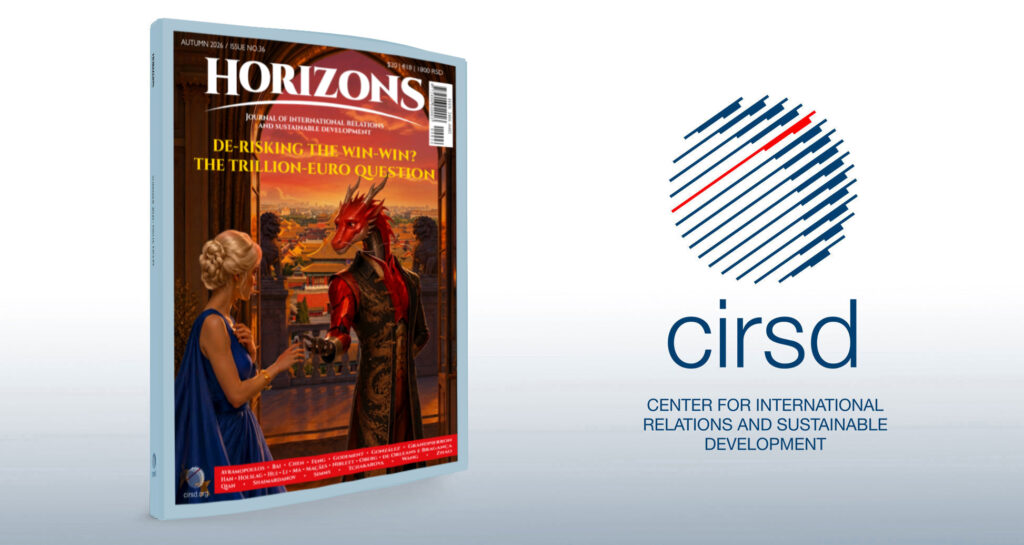
TWO buzzwords have come to dominate the discourse surrounding Europe–China relations. Brussels speaks of de-risking: reducing potentially dangerous dependencies without cutting ties. Beijing speaks of win-win: cooperation in which both sides come out better off. To Chinese ears, de-risking sounds like protectionism with diplomatic finesse. To European ears, win-win increasingly sounds like China winning twice. This issue of Horizons examines whether the two can be reconciled, and what happens to one of the world’s most consequential commercial partnerships if they cannot.
SOME of the stakes can be measured. Two-way trade in goods and services exceeded €880 billion in 2025 and is edging toward a trillion. Europe’s goods deficit with China reached roughly €360 billion that same year. A relationship that large cannot remain that lopsided for long.
THAT imbalance is a symptom of something deeper: the nature of exchange itself has changed. For decades, the bargain was complementary: European capital goods and premium manufactured products traded for Chinese consumer goods. Today, the two economies compete head-on in automobiles, batteries, machinery, and clean technology—the sectors that anchor European industry. Our contributors disagree on the causes of this “second China shock.” Some point to state subsidies, overcapacity, and weak household demand that pushes China’s surplus output onto world markets. Others blame Europe’s own high energy costs, fragmented capital markets, and regulatory burdens. Few dispute that tariffs can buy time but cannot replace competitiveness.
NOR is the contest purely economic. Rare-earth export controls, the dispute over the chipmaker Nexperia, and the world’s reliance on Taiwanese semiconductors have shown how quickly interdependence can turn into leverage. For several authors, China’s role in sustaining Russia’s war economy places a hard ceiling on European trust. Chinese contributors push back against the “New Cold War” narrative. They argue that the two ends of Eurasia have no fundamental geopolitical conflicts of interest and are converging on multilateralism and climate action just as Washington retreats from both.
BETWEEN these poles, a more practical agenda takes shape. De-risking need not mean subtraction alone. It can also mean adding options: more suppliers, Eurasian corridors running through Central Asia, and financial bridges such as Hong Kong. Industrial policy could be disciplined by distinguishing between subsidies that help young industries learn and those that distort markets once those industries have matured. Chinese plants in Hungary and Spain could become channels for technology transfer rather than outposts to be resisted, and Brazil’s experience suggests that Chinese firms adapt when the rules are clear. In fields such as cancer research, cooperation under European standards may serve patients better than reflexive suspicion.
ALL of this unfolds inside a geopolitical triangle that Europe cannot control. Washington is increasingly transactional and Beijing increasingly confident, pushing Europe toward the pursuit of strategic autonomy it has long debated but only recently begun to build. In such a setting, neither buzzword seems entirely plausible. De-risking that builds no capability only preserves weakness, while win-win that ignores imbalance only breeds resentment. The trillion-euro question, then, is whether Europe and China can turn mutual dependence into a relationship balanced enough for both sides to call it fair.