

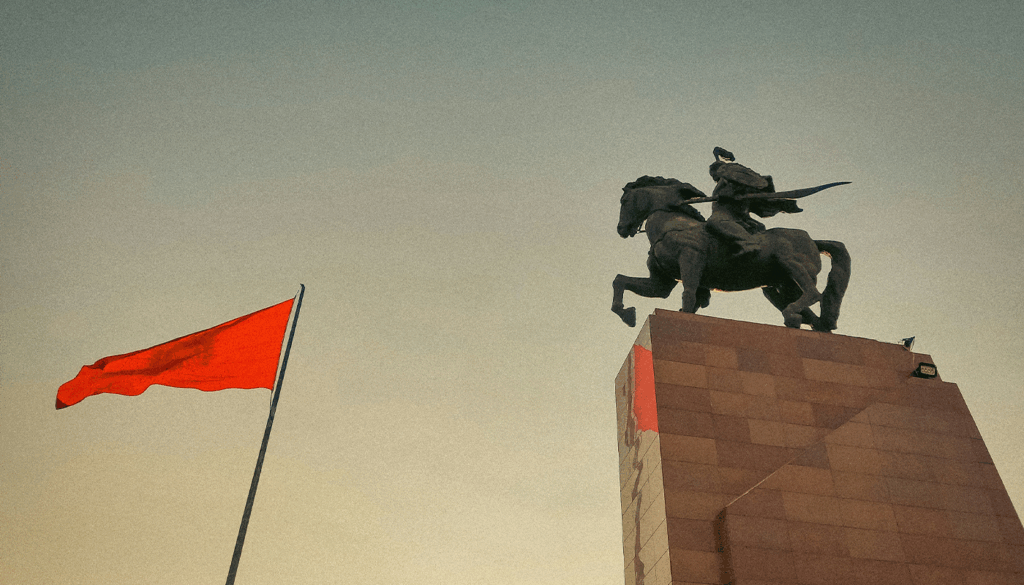
The Epic of Manas, the greatest spiritual heritage of the Kyrgyz people and the longest poem in the world, recounts the story of a hero who unites forty tribes to protect their homeland from external threats. For centuries, manaschi (bards) have preserved this narrative, which parallels other great epics and embodies themes of courage, unity, and collective resilience. That ancient saga is more than folklore; it is a touchstone of our national identity, a testament to the Kyrgyz spirit of resilience and the understanding that daunting challenges require partners, and sometimes powerful coalitions, to overcome.
That spirit helped make our land a vibrant artery of the Silk Road, where merchants, pilgrims and envoys met under open skies to trade goods and ideas, and Kyrgyz tribes provided security to caravans and visitors alike. That legacy endures to this day. Kyrgyzstan remains open to all who seek genuine partnership—a place for commerce and connection, built on principles of fairness, hospitality, genuine openness, and a desire to find common ground.
Three decades after achieving independence, Kyrgyzstan continues to prioritize sustainable development, domestic security, and the economic well-being of its citizens. Drawing from a history of fostering alliances—whether among tribes or nations—the Kyrgyz people have developed a commitment to international cooperation. As Central Asia reestablishes itself as a global crossroads, these values guide Kyrgyzstan’s interactions with both longstanding and emerging partners.
From its earliest days of sovereignty, Kyrgyzstan charted an independent course in foreign affairs. Rather than aligning exclusively with nations from any particular part of the world, the country has engaged pragmatically with partners from various regions, seeking areas of mutual interest to advance shared benefits. Landlocked though we are, we learned to build bridges in every direction. Over the past three decades, Kyrgyzstan has joined the United Nations and a host of international institutions. We speak to all potential partners in good faith, in the firm belief that dialogue and neutrality bolster our sovereignty far more than exclusivity or isolation.
Now, after more than three decades of independence, Kyrgyzstan is stepping out more confidently on the world stage. What role will we play in this young century defined by multipolarity? We are the inheritors of a proud history and the builders of a modern, confident state. We have laid the foundations of responsible government, established democratic institutions, earned a record of constructive diplomacy, and we are determined to strengthen it further. Kyrgyzstan’s journey from epic trials to statehood has shaped a country eager to reach out. We turn to our region and the wider world, confident that the spirit that united forty tribes centuries ago still guides us as we welcome new friends near and far.
A Region Asserting Its Presence
Kyrgyzstan today is part of a Central Asia that is more united and assertive than ever before. Our young nation and its neighbors have built strong sovereign institutions and are more frequently joining together to speak with a collective voice on collective issues. No longer tethered to any single great power, the region is navigating a new constellation of partnerships. The Central Asian republics have been recalibrating their foreign policies, asserting their sovereignty and embracing a multipolar future. This shift means Central Asia is increasingly charting its own course, engaging with all major powers while guarding its independence. The change is palpable across the steppe and high mountain passes. Countries once on the periphery of global affairs now see themselves as players in a multipolar world.
A key driver of this transformation has been growing regional cooperation. In the past, Central Asian leaders met rarely without outside sponsors, but since 2018, we have convened annual summits to advance common goals. The frequency of these gatherings and discussions about a formal “Community of Central Asian States” signal a desire to institutionalize the region’s collaboration. Kyrgyzstan has been at the forefront of this trend. In July 2022, on the shores of Lake Issyk-Kul, one of our country’s most beautiful natural resources, Kyrgyzstan hosted a landmark summit of Central Asian presidents that produced agreements on twenty-six initiatives for shared development from simplifying trade to cultural promotion. When the Central Asian family works together, it multiplies opportunities and strengthens our collective resilience.
The nations of Central Asia are discovering that unity brings strength in dealing with the world’s giants. We are well aware of the pressures of great-power politics. Our response has been clear: maintain dialogue with all, but dependence on none. This is often described as a “multi-vector” foreign policy: a strategy of balancing ties with multiple powers to preserve our own agency. In practice, this means Kyrgyzstan must remain engaged with traditional partners like Russia and our neighbors in China, while proactively seeking deeper engagement with new partners in Europe, the United States, and Southern Asia. We seek equilibrium. Balancing relationships with major powers and maintaining constructive ties with each has positioned Kyrgyzstan as a unique leader and an honest broker in the region.
Crucially, this balancing act is buttressed by stronger bonds among the Central Asian states themselves. The old stereotype of “Great Game” competition is giving way to a spirit of Central Asian solidarity. We see this in the C5+1 framework, where all five countries jointly engage with major partners like the United States. A landmark summit in Washington, D.C. in November 2025 was the first time the leaders of all Central Asian countries engaged with the U.S. president in America’s capital. The momentum generated by that summit will continue at the B5+1 business forum, hosted proudly by Kyrgyzstan this February in Bishkek, which links the five Central Asian economies and the U.S. private sector.
Step by step, barriers within Central Asia are falling. Long-festering border disputes have been resolved, including a historic settlement in the fertile Fergana Valley earlier this year. Cross-border travel is easing. Kyrgyz and Uzbek citizens can now visit each other’s countries using just a national ID. Trade among our economies has surged, doubling since 2017, and plans are underway to double it again. There is a sense in Bishkek, Astana, Tashkent, and beyond that we share common interests and challenges. Climate change threatens all of our glaciers and rivers. Each of our countries needs to produce more jobs and opportunities for younger generations. All of our economies would benefit from new sources of investment and more diverse industries. We can tackle those issues more effectively together.
In this spirit, Kyrgyzstan has emerged as a bridge-builder within Central Asia. We understand our neighbors’ concerns and strive to mediate and propose solutions. This year, for example, we coordinated closely with Kazakhstan and Uzbekistan to secure international support for a flagship regional hydropower project that will benefit all three countries. Water released from our Toktogul reservoir will generate hydroelectricity for our downstream neighbors, who in turn will supply us with power in winter. This win-win deal—water for energy—shows how practical cooperation can turn potential disputes into shared gains. Such initiatives strengthen trust and lay the groundwork for deeper integration.
Where are we now? We are a more confident Central Asia. Kyrgyzstan is both contributing to and benefiting from this confidence. In recent years, Central Asian presidents have stood side by side in talks with leaders from the United States, the European Union, India, Japan, and beyond, presenting a coherent regional vision. The ancient Silk Road ties that once knit our fates together are being rewoven in modern form: through railways, digital cables, energy grids, and cultural exchanges. We are aware of the powers that surround us, but we will never see ourselves as pawns on someone else’s chessboard. Instead, we are active players pursuing a shared regional destiny within a multipolar world.
A Reliable Global Partner in a Multipolar Era
Looking ahead, Kyrgyzstan sees itself as an open and reliable partner on the global stage. A country determined to contribute solutions to humanity’s shared challenges. If the first decades of our independence were about nation-building at home, the coming years will be about stepping confidently into the international arena. We live in an interdependent world that faces threats that no nation can tackle alone.
Climate change is melting our glaciers, testing water security far beyond our borders. Economic uncertainty and supply chain shifts are redefining alliances. In this context, Kyrgyzstan’s foreign policy vision for the next decade is clear: we will pursue a multi-vector diplomacy grounded in constructive neutrality, cooperating with all who seek progress and peace. We will be a bridge between East and West, North and South, leveraging our strategic geography at the heart of Eurasia to connect markets and peoples.
Our diplomacy is rooted in finding areas of common cause with our partners. We will identify transnational problems, learn from our partners, and leverage our unique resources, geography, and expertise. From connecting markets to ensuring water security and enabling sustainable economies; from digitalizing and educating to preserving cultural traditions and building ties through tourism. Interdependent issues require multilateral solutions.
Our strategic location has always been one of our greatest assets. Historically, the land of the Kyrgyz was the thoroughfare of Silk Road caravans; today, it can serve as a hub for new corridors of trade and transit. We are already working to turn this potential into reality. A prime example is the long-anticipated China–Kyrgyzstan–Uzbekistan railway, a project that is now moving forward with strong political will. When completed, this rail link will open a direct route from China to the Middle East and Europe via Central Asia, boosting regional connectivity and global commerce. It will complement the emerging Trans-Caspian “Middle Corridor” that ferries goods from Asia to Europe, supplementing global shipping routes and preventing chokepoints from emerging.
Kyrgyzstan intends to be a linchpin of these Eurasian transit networks. We are upgrading roads, modernizing our borders, and digitizing customs to make trade smooth and secure. We see ourselves as a corridor of opportunity—not landlocked, but land-linked—connecting the great economies of China, South Asia, and Central Asia with those of Europe and the Middle East.
Our country’s mineral wealth also creates opportunities for sustainable development and trade. Kyrgyzstan is home to several critical minerals and rare earth elements used in green technologies, including electric vehicles, batteries, wind turbines, and more. As countries look to adapt their trade strategies to meet growing demand for these resources, Kyrgyzstan is preparing to be an important new link in global supply chains. We have already signed a landmark agreement with the United Kingdom to cooperate on developing critical minerals and are open to cooperation with global partners. With the right investments and partnerships, Kyrgyzstan can become a key node in sustainable global supply chains for clean energy metals, renewable power, and climate-smart agriculture.
This is a new frontier of our international engagement: helping to power the world’s clean energy transition with our natural resources in a way that is mindful of the environment and our people’s wellbeing. Kyrgyzstan is determined to be a force for sustainability in our region and beyond. We are blessed with towering mountains and alpine lakes that are the source of life for millions downstream.
By championing sustainable management of these resources, we help secure the future for an entire region. Our development of the Kambarata-1 hydropower plant is one of Central Asia’s largest and most ambitious clean energy projects. In partnership with Uzbekistan and Kazakhstan, and with strong support from the European Union, World Bank, and other international institutions, we have attracted $5.6 billion in financing commitments and technical expertise to bring this project to fruition. European partners have called Kambarata-1 a “flagship regional project” for energy and water security, a model of green development through international cooperation. By harnessing our abundant hydropower, Kyrgyzstan will drive low-emissions growth at home while bolstering the region’s energy security, proving that sustainability can unite rather than divide countries.
The management of our water resources is an area where Kyrgyzstan is stepping up as a responsible international actor. The glaciers and high-altitude lakes of our Tien Shan range are a crucial water source for Central Asia’s great rivers, and we know that climate change will pose a threat. As the ice recedes, billions of cubic meters of water capacity could be lost. That’s why Kyrgyzstan has been vocal in global forums about protecting mountain ecosystems and developing cooperative water-sharing arrangements.
We are advancing modern irrigation techniques to make every drop count. This year, supported by the World Bank, we launched a major project to modernize irrigation canals in the Ferghana Valley, aiming to drastically cut water losses and boost agricultural yields. Agriculture still employs a large share of our population and consumes 90 percent of our water usage. By modernizing Soviet-era canals and introducing water-saving technologies, we will improve food security for Kyrgyzstan and our neighbors alike. Food and water security in Central Asia are intimately intertwined. We seek partnerships to build climate resilience, from planting climate-smart crops to pioneering artificial glaciers for seasonal water storage. Every effort contributes to regional stability. In our nomadic tradition, water is life and sharing it wisely is a sacred duty.
As we deepen these practical collaborations, Kyrgyzstan is also investing in its human capital and connectivity. We believe education and cultural exchange are bridges to shared progress, and we are working closely with European and global partners to empower the next generation of Kyrgyz and Central Asian leaders. European support is helping us reform curricula, expand vocational training, and promote academic exchanges. The Enhanced Partnership and Cooperation Agreement we signed with the EU in 2024 explicitly prioritizes cooperation in education, research, and innovation. Through programs like Erasmus+ and university linkages, more of our students and scholars are connecting with the world. Likewise, American institutions have long supported higher education in Kyrgyzstan—the American University of Central Asia in Bishkek is a beacon of liberal arts learning in our region.
In the twenty-first century, connectivity is digital. We recognize that economic opportunity and international partnership increasingly depend on bytes and bandwidth as much as roads and rail. So, Kyrgyzstan is rolling out nationwide fiber-optic networks and expanding affordable internet access to our remote mountain valleys. Secure digital infrastructure, including a government cloud platform and digital ID system, is being installed to improve services and attract IT investment. Our government has its own “Digital Kyrgyzstan” roadmap and we welcome cooperation with Western and Asian tech partners to realize it. This is about inclusion, transparency, and growth.
By digitizing public services, we reduce corruption and increase trust. By connecting remote schools and clinics, we improve quality of life and create new market opportunities. And by integrating with global digital networks, Kyrgyzstan can become a regional IT hub. We already host a thriving IT park in Bishkek with dozens of startups, and more of our young people are studying software development and e-commerce. As digital silk roads open up, we want to be on the map.
Finally, one cannot speak of Kyrgyzstan’s future on the world stage without mentioning tourism and culture. From the crystal waters of Lake Issyk-Kul to the ancient walnut forests of Arslanbob, from high-altitude pastures dotted with yurts to the bustling Osh Bazaar with its millennia of Silk Road history, Kyrgyzstan offers experiences that cannot be found anywhere else on Earth. We cherish this reputation and are working to enhance it.
Through community-based tourism programs, we connect visitors with local villagers who take immense pride in sharing their culture. Kyrgyzstan is actively finding new ways to support and showcase our enduring rural heritage, creating a unique tourism destination at the heart of Central Asia. These ties enrich our society and signal our openness to the world. Going forward, Kyrgyzstan will promote intercultural dialogue, inviting artists, students, and visitors from abroad to join us in exchange. In doing so, we build bonds that underpin lasting partnerships.
In the coming decade, Kyrgyzstan’s foreign policy will remain grounded in the principles of pragmatism and partnership. We will continue to engage in constructive dialogue in every forum: from the United Nations, where we have consistently supported international law and climate action, to regional organizations and multilateral forums between Central Asia and other great partners. We will uphold the values of an open society and work through international issues transparently and honestly, knowing that credibility is the currency of diplomacy.
In the Epic of Manas, the great hero united disparate tribes to defend their freedom against overwhelming odds. He did not do it by force alone, but by inspiring a shared purpose: by convincing proud, independent people that they were stronger standing together than standing apart. Kyrgyzstan carries that spirit onto the world stage. We extend our friendship and partnership to all nations willing to work together on our planet’s most pressing challenges. Whether it is turning the lights on with clean energy, feeding families with climate-smart agriculture, educating our youth for the digital economy, or inviting the world to experience our beautiful country, Kyrgyzstan is ready.
The coming years will see our country take on a bigger role in global conversations about sustainability, security, and connectivity. We do so humbly, aware of our size, but confident in our ability to contribute. Our conviction is that in this multipolar era, even a smaller nation can make an outsized difference if it stands on principle and finds innovative ways to cooperate.The story of Kyrgyzstan is just beginning, and as the country steps onto the global stage, its next chapter will be written with friends from every corner of the globe.


