


In 1643, the preacher Jeremy Whitaker warned his parishoners that “these days are days of shaking, and this shaking is universal.” That same year, a Spanish contemporary wrote, “This seems to be one of those epochs in which every nation is turned upside down, leading some great minds to suspect that we are approaching the end of the world.”
A similar apocalyptic mood haunts us today. The world as we know it is fading away; we are in a moment of vertigo. Climate change, demographic anxiety, and the rise of AI make us feel as if we are living in the end times.
Much like seventeenth-century Europe, various countries today seem merely separate theatres upon which the same great tragedy is simultaneously played out. It is performed in different languages, and in certain places the script differs, but the tragedy remains the same. The rise of national populism and the ascendance of strongmen look like global trends. People are mistrustful and angry; many tend to believe that burning the house down is the only way to roast the pig.
But is nationalism the name of the play? Do the rise of economic protectionism and the backlash against universalism signal the return of the nation-state?
Historians have interpreted the global crisis of the seventeenth century as a crisis of relations between the state and society—a struggle between the Courts and the Estates. The emergence of the nation-state was the exit from that crisis. By reflecting on that era, we realize that nations are not inherent but are constructed by states and nationalists, often requiring individuals to choose between competing nationalisms. Nation-states served as instruments for economic development but also for social cohesion. They created solidarities where none existed before.
Nation-states took different forms. Some brought democracy to the center of modern politics; others were repressive and even genocidal. “Making minorities history” was the battle cry of the newly born European nation-states in the wake of World War I. Ethnic homogeneity was the utopian dream of the nationalists.
Today, in many places around the world—especially in the West—we witness not the return of nationalism (which never really went away) but the rise of a politically infectious nostalgia: a longing for a lost home. This nostalgic wave represents the crisis of nationalism rather than its return.
In 1688, the Swiss physician Johannes Hofer coined the term “nostalgia” for a new disease. Its key symptom was a mood of melancholia derived from a longing to return to one’s own land—those afflicted often complained of hearing voices and seeing ghosts. Today, Europe is in the grip of a similar epidemic. A vast majority of Europeans believe the world was better yesterday (when there were more of us and when we were younger) than it is today, though they cannot agree on when that glorious yesterday occured. They fear their children will be worse off, yet feel powerless to prevent it. Those most nostalgic for the past are most likely to vote for anti-European parties. If home is a place that you understand and where you feel understood, we are living in a homeless world. The cosmopolitan’s utopia, in which one feels at home everywhere, has been supplanted by a fear that nobody is actually at home or native to their own land.
Herder believed that just as people need to eat and drink, they need to belong to a group. “To be human meant to be able to feel at home somewhere, with your kind.” In the twenty-first century, we know that “your kind” no longer simply means your ethnic tribe, but being at home still rhymes with being free. At home, you risk disagreeing with those in power and are prepared to sacrifice your life to defend your beliefs.
The loss of home is experienced as the loss of freedom, a state of universal vulnerability. The backlash against globalization has revealed the inability of nationalism and the nation-state to produce social cohesion. The passion for separation—for wrenching apart what had been laboriously stitched together—as well as a dogmatic unwillingness to recognize any remnant of common ground, drives both processes.
The paradoxical effect of three decades of globalization is that political space has been fragmented into mutually sealed-off fortresses aligned with barricaded identities, between which no serious communication is possible. The spread of social media is at the heart of this process. It best explains why it is so easy to find ourselves separated from the person standing right next to us, but it does not explain everything. The nation-state is no longer, in its democratic nor in its authoritarian form, able to bring social cohesion to society.
As American anthropologist Clifford Geertz predicted almost three decades ago, we find ourselves confronted with two critical questions: “What is a country if it is not a nation?” and “What is a culture if it is not a consensus?”
Immortal Individuals, Mortal Nations
If the global crisis of the seventeenth century was a crisis in the relations between society and the state, the current global crisis is a crisis in the relations between the individual and society—between the individual and the nation. The nation is no longer able to sustain “the partnership not only between those who are living, but between those who are living, those who are dead, and those who are to be born.”
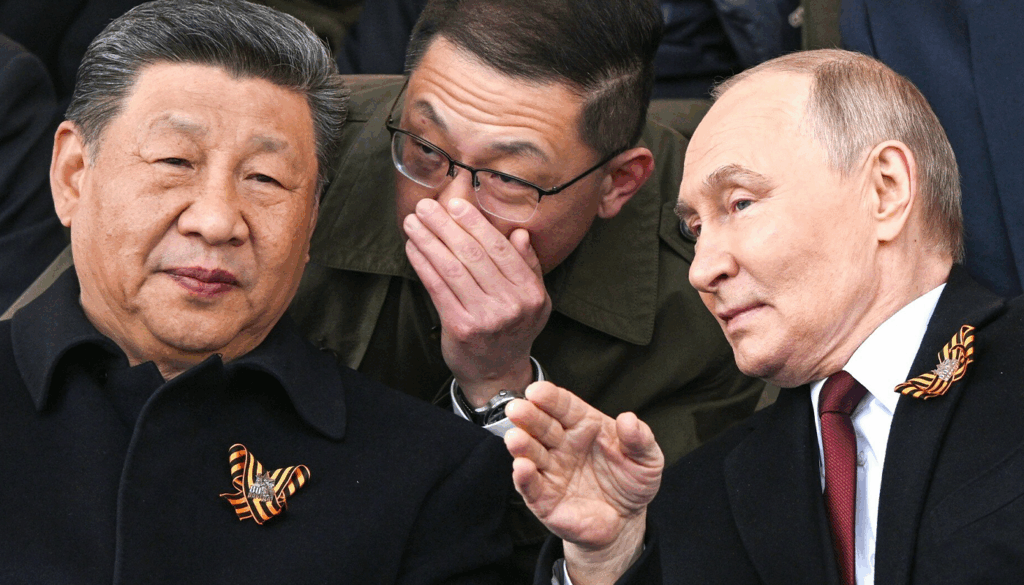
Russian President Vladimir Putin and Chinese President Xi Jinping were reportedly overheard discussing the question of immortality on the sidelines of this year’s military parade in Beijing. They discussed not the wars in Ukraine and Gaza, nor their potential successors, nor Trump’s tariffs, but organ transplants and new discoveries in biotechnology, which promise some quixotic hope for eternal youth.
Could it be that this strange conversation is more consequential for the future of our politics than the geopolitical power shift everyone talks about?
How does the hope for individual immortality relate to the fact that most people in the world live in societies where fertility is below replacement levels? And how do we explain the fact that fertility is declining and the population is shrinking in rich and poor states, in secular and religious societies, and in democracies and autocracies alike?
Historian Christopher Clark has observed that “as gravity bends light, so power bends time.” The exercise of power is rooted in a certain set of assumptions about how the past, present, and future are interconnected. Modern politics has hewed to a belief that individuals are mortal, whereas nations are immortal. We transcend our mortality through our belief in God, bearing children, and being part of a self-conscious cultural community—a nation—that will withstand the storms of history. A monument in a park inscribed with the names of those sacrificing their lives for the nation, or a poem that future generations will know by heart, was once our common idea of immortality. The success of the nation-state over the last four centuries is rooted not only in exercising legitimate violence over certain territories but also in transforming the social contract into an intergenerational contract.
As the Beijing conversation suggests, this is no longer the case. There is a growing sense that we are living in threshold times when the richest and the most powerful start to imagine themselves immortal—while many nations, under the pressure of lower birthrates and massive migration, begin to appear mortal. Can we still imagine that we will live on in the minds of future generations when the speed of ecological, technological, and cultural changes shatters our capacity to even conjecture how future humans will live? Can Bulgarian or Slovak political leaders be sure that anybody will study Bulgarian or Slovak history 100 years from now, when they witness the speed with which their populations are shrinking and their national cultures are eroding?
As French political thinker Olivier Roy has argued in his remarkable book “The Crisis of Culture,” what we are now witnessing is not the replacement of one dominant culture with another—as during the expansion of Christianity or Islam, or during the Renaissance or Enlightenment—but a progressive erosion of culture both as an anthropological reality and as a national canon. For him, national culture is like a native language: you speak it before you learn the grammar. It consists of those “self-evident” truths that we share without knowing it. This shared culture is vanishing under the pressure of rising migration and capitalism’s love for cheap labor, while artistic “high culture” has been degraded to “either a waste of time or one hobby among many.”
Not so long ago, to be French meant to have read Victor Hugo. Not anymore. Google Translate does not have a native language. President Trump, who for geopolitical reasons missed the Chinese-Russian immortality discussion in Beijing, may be the most powerful representative of this dramatic change in the time-power axis. Putin and Xi are still preoccupied with the immortality of nations. The Russian president romanticizes a lost imperial past and daydreams about Russia’s eventual demographic revival; Xi invokes dynastic continuity. Trump is different. In his speeches and interviews, he rarely discusses history; far less than the Russian and Chinese leaders is he clear about how he wants to be remembered by the next generation.
The sense is that Trump wants to live forever, but not in the hearts and minds of future generations. Rather, Trump’s immortality would be happily spent in Mar-a-Lago, and even better, in the White House. His political imagination seems not to extend beyond his tenure—as if history itself should end with him. He cares little about what will happen immediately after him. When discussing the risk of conflict with Taiwan, he repeats President Xi’s pledge not to do so when President Trump is in power. But what about when he is not in power?
It is difficult to escape the feeling that the future of our politics starts to resemble the world of Greek mythology, in which the intrigues of the immortals drive world history. Being liked by the immortals is all that mortals can hope for.
At the same time, Trump’s imperial narcissism signals the emergence of a kind of nationalism that is divorced from national history. Unlike the revolutionary nationalisms of the nineteenth century, twenty-first-century nationalism is hostile to any universalism. Nationalism is no longer a national project. It does not speak in the future tense. The crisis of culture has destroyed the historical link between generations. We cannot remember the times of our parents (it was before mobile phones) and we cannot imagine the world in which our children (if we have any) will live.
History has flattened. We do not believe that the past is historically a different time. The dead have been liberated from their historical moment. You can no longer be progressive in the context of your time; you are now either progressive or reactionary for all times. Everyone is conceived as a contemporary and is treated by the standards of today. Mozart’s “Don Giovanni” is as appalling in his sexual adventures as Harvey Weinstein. “The register of emotions is thus reduced to a collection of tokens.” The young act like the last generation, judging on the secularized version of Judgment Day.
Making Majorities History
“There is a basic puzzle surrounding rage about minorities in a globalized world,” writes Indian-American sociologist Arjun Appadurai. “The puzzle is about why the relatively small numbers that give the word minority its most simple meaning and usually implies political and military weakness do not prevent minorities from being objects of fear and rage.”
The answer Appadurai gives is that minorities do not allow majorities to feel like majorities. The very existence of minorities is a signal that one day you can become minority too. The small numbers have the tendency to grow, while the big numbers could easily decline. The higher fertility rates of minority groups are often a major factor in the genocidal policies of the majoritarian governments. The spread of democracy combined, with demographic decline and rising migration fuelled, has fueled fears that the historical majorities who founded nation-states could end up as tomorrow’s minorities.
Faced with this demographic vertigo, the threatened majority reaches for the state’s ultimate lever of control. In a democracy, the most existential collective right is the right to exclude. While democratic regimes rightly praise themselves for their capacity to include diverse social, ethnic, and religious groups in public life, democracy is preconditioned on the right of the democratic political community to decide who can and who cannot be a member. Democracy can exclude certain ideas from the public space; it can also exclude people.
Michael Walzer gives the classical form of this argument when he asserts that because distributive justice does not reach beyond political communities, a political community’s very composition cannot itself be the subject of justice. It is obviously unjust that some of us are born in Germany and others are born in poor and repressive countries, but it is not the moral obligation of the Germans to correct this injustice. As Walzer claims, those who are already the members of the community have the moral right to choose whom they want to include in accordance “with our understanding of what membership means in our community and what sort of community we want to have.” How you define the right to exclude is what distinguishes liberal from illiberal democracies.
It is tempting to view the rise of illiberalism as an old struggle between democracy and authoritarianism, and it is tempting to see the epidemic of nostalgia in the West as the return of nationalism. But in reality, the tragedy staged around the world today is the cultural decline of the nation-state. And “majorities-feeling-like-minorities” are the central protagonists of the play, at least in the West.


