

For decades, India has been a strident advocate for a “multipolar world,” championing the concept as a theoretical corrective to the hegemony of the United States and China. Today, however, New Delhi faces the distinct challenge of operationalizing that rhetoric within a global reality that has finally caught up to its ambitions. The government of Prime Minister Narendra Modi has publicly articulated the geopolitical and economic risks posed by an international system devoid of a hegemonic stabilizer. Yet, it also recognizes that this era of strategic flux offers unique opportunities for a “middle power” that, as of 2025, stands as the world’s fourth-largest economy.
“The journey of rebalancing in the world has reached a stage where we can start to discern the emergence of real multipolarity in the global order,” Indian Foreign Minister S. Jaishankar observed in a keynote foreign policy address in January 2025. “It represents a move away, not just from the domination of the West, but from the current structure of world affairs.”
India remains an anomaly among major powers: it is likely the only significant state that does not publish a national security doctrine or a formal defense strategy in the public domain. Its diplomats meticulously avoid the label of “great power,” preferring terms like “leading power” or “aspirational power.” Nevertheless, a coherent worldview has crystallized through the public and private interventions of its leadership, defined by four central tenets.
First, New Delhi accepts that the post-1945 order is being rapidly dismantled. This transformation is driven by two increasingly transactional superpowers—the United States and China—both of which now prefer to deal with nations on a bilateral, one-on-one basis rather than through multilateral regimes. Crucially, India assesses that the United States is no longer willing to serve as the unconditional “underwriter” of the contemporary system.
Second, the consequent rebalancing is most visible in the weaponization of high-end technology and critical supply chains. From semiconductors to solar modules, the economic arteries with the greatest transformational potential are being leveraged for geopolitical advantage. The fragmentation of these sectors does not map neatly onto past alliances, particularly as Washington dilutes its traditional security commitments, creating a landscape of “weaponized interdependence.”
Third, New Delhi believes it is uniquely positioned to navigate this period because global power centers have become more diffuse—in short, truly multipolar. A glance at the world’s twenty largest economies reveals a rank and file far more diverse than it was 30 years ago, populated by assertive middle powers and emerging economies. This diffusion of economic weight translates into a diffusion of agency, much of it non-Western. India is the prime exemplar of this shift. When it began its economic reforms in 1991, its GDP stood at $270 billion. Today, that figure exceeds $4 trillion, with the IMF forecasting a rise to $7.3 trillion within four years. The era of perpetual balance-of-payments crises, five-year plans to ration scarce capital, and deep-seated trade pessimism is a fading memory.
Fourth, India anticipates the emergence of new “strategic geometries” among this array of actors. While the dotted lines connecting nations to the two superpowers will remain, new vectors of cooperation are forming between governments that share specific interests but lack traditional strategic bonds. India’s priority in this game is to develop special relations with the “big hubs” around which its trade and investment revolve. In this fluid environment, traditional fault lines will not just be diluted; they will likely be blurred or buried entirely.
Nonalignment
Since its independence in 1947, India has consistently argued—rhetorically, at least—for an autonomous foreign policy. Yet, New Delhi has always recognized that given its severe economic limitations, such autonomy is best maintained in a world defined by multiple centers of power. In practice, the ideal of full autonomy often had to be compromised to meet the demands of reality. Behind a shifting screen of nomenclature—’nonalignment,’ ‘strategic autonomy,’ and ‘multi-alignment’—India has tactically gravitated toward one great power and then another, though never to the point of a formal alliance or the complete alienation of others. It was a quasi-ally of the United States in the early 1960s, a Soviet partner in the 1970s, and began a decisive pivot back toward Washington in the 2000s. Generally, these tactical shifts were driven by a singular calculation: how best to counter Pakistan and, latterly, China.
Less than two years after independence—a time when it remained a genuine supporter of a liberal internationalist order—India recognized that the Cold War had hardened. Developing a deep anxiety about becoming entangled in the U.S.-Soviet web, Jawaharlal Nehru joined with Egypt’s Gamal Abdel Nasser and Yugoslavia’s Josip Broz Tito to forge the Non-Aligned Movement (NAM), carving out a geopolitical space separate from superpower rivalry.
While the policy was partly discredited by India’s military defeat to China in 1962, it remained a potent tool for domestic political mobilization. By the 1970s, however, the geopolitical landscape shifted. The convergence of American and Chinese support for Pakistan during the 1971 war forced New Delhi to turn sharply toward the Soviet Union, effectively ending the pretense of equidistance. Eventually, the collapse of the Soviet Union in 1991 compelled India to confront the hard reality of its failed economic and foreign policies.
The “unipolar moment” that followed the Cold War proved exceptionally difficult for New Delhi. Confronting a fragile economy, India faced intense pressure from the United States to degrade its nuclear deterrent by signing the Nuclear Non-Proliferation Treaty (NPT) and the Comprehensive Test Ban Treaty (CTBT). At this juncture, the call for a “multipolar” world began to feature prominently in Indian policy discourse—less as a statement of reality than as a strategic aspiration. India stressed the concept of “strategic autonomy” and began to act upon it. It supported the creation or enhancement of several “minilateral” bodies designed to dilute U.S. hegemony, including the IBSA grouping (India, Brazil, and South Africa), the East Asia Summit (EAS), and the fledgling BRIC coalition (Brazil, Russia, India, and China).
Simultaneously, India responded to Washington’s push for nonproliferation by conducting nuclear tests in 1998 (Pokhran-II). While this act invited immediate Western sanctions, it paradoxically paved the way for New Delhi’s first in-depth strategic dialogue with Washington in decades. As documented by Strobe Talbott in “Engaging India,” the intense negotiations that followed the tests forced a reassessment in both capitals. As one diplomat noted at the time, “The discussion between us and the U.S. then led both sides to realize that they had more in common than they had realized.”
Multi-alignment
This interaction set India on a path of strategic engagement with the United States that surprised observers in both capitals. The convergence was driven by two structural realities: Washington’s nascent anxiety regarding the rise of China, and the unprecedented acceleration of the Indian economy. As noted, India’s GDP had increased nearly 15-fold since it began economic reforms in 1991, and remains today the world’s fastest-growing major economy. These developments led the United States to invest heavily in India’s rise—a policy that reached its initial apogee during the George W. Bush administration with the dismantling of nuclear and dual-use technology sanctions.
Atal Bihari Vajpayee, the first Prime Minister from the Bharatiya Janata Party (BJP), famously described the U.S. and India as “natural allies,” downplaying the lexicon of nonalignment in favor of strategic partnership. Under his successors, the Quadrilateral Security Dialogue (later renamed the Quad)—initially an ad hoc humanitarian response group—evolved into a robust technology coalition, signaling an early recognition of the strategic centrality of semiconductors, critical minerals, synthetic biology and other technologies.
Prime Minister Narendra Modi, the second BJP premier, initially viewed Washington with skepticism due to a decade-long Western visa ban imposed during his tenure as a state chief minister. However, Modi quickly identified the United States as an indispensable partner in his ambitious agenda to utilize technology to transform India’s economy and streamline its ossified bureaucratic apparatus. A strong ideological critic of the Nehruvian consensus, Modi further distanced New Delhi from the dogma of “nonalignment,” notably becoming the first Indian Prime Minister to have never physically attended a Non-Aligned Movement summit. Instead, his government orchestrated a decisive pivot toward a deeper, more active alignment with Washington.
As India shifted toward this profound engagement with the West, its diplomats coined the phrase “multi-alignment.” Unlike nonalignment, which implied keeping a safe distance from great powers, this policy allowed India to become entangled with multiple poles without formally declaring a camp. On the ground, however, the asymmetry was clear: India’s relationship with the U.S. advanced far beyond its ties with any other nation. New Delhi procured record volumes of American weaponry, aligned its policies to facilitate the U.S.’s emergence as its primary economic partner, and coordinated closely with Washington to counterbalance Chinese geopolitical maneuvers like the Belt and Road Initiative.
However, this tilt toward Washington hit a dead end with the resurgence of Donald Trump. While India had navigated the first Trump administration with relative dexterity, the second term proved far more volatile. By April 2025, the Modi government believed it had carved out a constructive space within the new administration’s worldview, a sentiment codified in the joint statement from the Trump-Modi bilateral summit in February and reinforced by Vice President J.D. Vance’s speech in India that April.
Superficially, the relationship seemed preserved by the glue of shared antagonism toward China and Washington’s acceptance of India as a partner that was “aligned but not allied.” The rupture, when it came, was triggered by Trump’s demand for a comprehensive bilateral trade agreement requiring India to dismantle swathes of its traditionally high barriers to agricultural and industrial goods.
Although the two sides launched negotiations in February 2025—making India the first country to engage the new administration on trade—the process quickly derailed. The failure was not one of policy, as a trade deal was technically concluded at the negotiating table at least four times throughout the year. Rather, the relationship ran aground on President Trump’s escalating personal demands. The breaking point was the U.S. role in the short-lived India-Pakistan conflict of May 2025. Trump insisted that his personal intervention had brought the hostilities to a close, a claim New Delhi publicly rejected. When Modi declined to endorse Trump for the Nobel Peace Prize—an accolade the President felt he was owed—the personal dynamic deteriorated rapidly.
At the same time, Trump’s pursuit of a Nobel for ending the Russia-Ukraine war led him to pressure India to cease its purchases of Russian oil. Merging this geopolitical grievance with his agricultural trade demands, the Trump administration imposed two punitive rounds of 25 percent tariffs on Indian exports. By the end of 2025, India faced the highest declared tariffs on its goods in the U.S. market of any country in the world.
New Delhi accepts that many of these frictions stem from the mercurial nature of the President. However, it has also concluded that a nascent isolationism is becoming the new foreign policy consensus in Washington at a pace that defies calculation. The Trump worldview—characterized by a retreat to the Western Hemisphere, a view of alliances as financial burdens, and a mercantilist approach to economics—has become mainstream Republican thinking, and is now being mirrored in the anti-establishment sentiment rising within the American Left. An isolationist America, by definition, cannot sustain long-term strategic postures in the Indo-Pacific.
Even in 2020, witnessing the early fissures between the U.S. and Europe, Foreign Minister S. Jaishankar wrote in “The India Way” that, “What we may therefore be seeing is an emerging multipolarity within the West.” India, he argued, must adjust its strategic posture accordingly. In a speech last year, he elaborated on this new reality: “We face a world where the United States departs from an established tradition of foreign policy and focuses on its own interests, rather than on shaping the world itself. Where the focus is more on the compulsions of competition rather than on the observance of regimes.”
Techno-polarity
The United States is permitting its sprawling alliance architecture to atrophy, or at least degrade to a point where security guarantees are provided only if they can be monetized. Conversely, there is no indication that China is abandoning its longstanding aversion to treaty alliances. Even regarding Pakistan—arguably its closest strategic partner—Beijing speaks only of an “all-weather friendship,” never a formal alliance. The poles of power once defined by security pacts seem destined for the footnotes of history.
A parallel decay is visible in global trade regimes. The decline of the World Trade Organization (WTO) is now definitive: its tribunal system is paralyzed, and the application of Most Favored Nation (MFN) status has become effectively optional. Both Washington and Beijing are increasingly willing to violate the letter and spirit of their trade commitments. The inevitable fallout is the weaponization of supply chains, whether it be the U.S. embargo on high-end semiconductor chips or China’s leverage over rare earths and permanent magnets.
In New Delhi, officials now articulate a vision of a new multipolarity—one defined not by treaties, but by strategic technologies, industrial capacities, and the critical inputs that sustain them. Foreign Minister S. Jaishankar crystallized this view in his January 2025 address: “We can start to discern the emergence of real multipolarity in the global order. It represents a move away, not just from the domination of the West, but from the current structure of world affairs. Technology is becoming a greater game-changer, impacting balances of power as much as it does the daily routine of our lives.”
He continued, noting that while the era of chips, AI, electric mobility, and green tech holds transformational possibilities, “the perennial games that nations play still continue unabated—perhaps becoming even more intense.”
India’s anxiety is specific and acute: it faces supply chain dependence on China in almost every major industrial sector, including those vital to its own economy, such as heavy engineering, electronics, electrical vehicles, solar modules and pharmaceuticals. Consequently, much of India’s present industrial policy possesses a hard geopolitical underpinning. Indian officials warn that “like the rest of the world, India too has to address the over-concentration in certain geographies of manufacturing and technology.” They view this task as “central to the comprehensive national power that [India] must continue to build.” When New Delhi speaks of a multipolar world today, it refers increasingly to a world of dangerous technological and industrial concentration.
Recognizing that technological autonomy is predicated on supply chain security—which, in turn, requires massive capital infusion—the Modi government has initiated a forward-leaning policy regarding free trade agreements (FTAs). It now insists on including chapters on investment, labor mobility, and technology in these understandings. As one official privately noted, “Trade policy today is largely supply chain policy.”
Shedding its traditional wariness of trade, the Modi government is pursuing a “geo-economic rebalancing.” India is on the hunt for partners in almost every facet of technology, from quantum computing and micro-satellites to synthetic biology and critical minerals. As the Foreign Minister repeatedly emphasizes, “It is vital that India not be left behind in the development of critical and emerging technologies. That means carefully analyzing and prioritizing partners.” This selection process will not be driven wholly by convenience; New Delhi has signaled that “those who share traits of pluralism, democracy, market economy, and rule of law have a natural convergence with us.”
Middle Power Cooperation
Another critical element of India’s reaction to the Trump administration’s transactionalism—combined with its enduring wariness of China—is the adoption of a distinct “middle power strategy.” As External Affairs Minister S. Jaishankar observed, “India also recognizes the role of middle powers. They are frequently in the lead on their own local issues, by themselves or in regional groupings. Consequently, a conscious effort is underway to bond with such nations, while also engaging more with regional formats.”
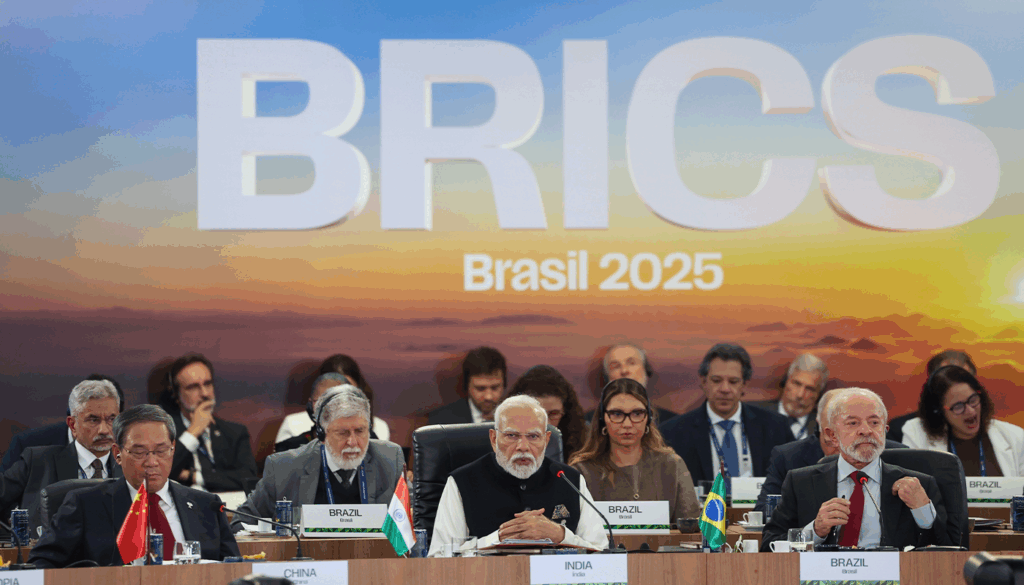
Prime Minister Modi outlined an early iteration of this thinking at the 2025 BRICS summit, urging members to consider “how BRICS can become a guide for the multipolar world in the times to come.” The agenda was ultimately abortive, reflecting the deepening internal fissure within the grouping: a reformist camp led by India and Brazil versus an anti-Western bloc driven by Russia and China. While the summit yielded little on the grand strategic front, it signaled India’s intent to seek functional cooperation in less politicized domains like economic resilience, scientific research, and supply chains.
More fruitfully, India is capitalizing on the strategic dividends of its “honeymoon years” with the United States. The Bush-era nuclear deal opened doors not only in Washington but also in the capitals of key U.S. allies—including Japan, the United Arab Emirates, Israel, Australia, and, more quietly, Taiwan. Initially, these relationships were subsets of the broader U.S.-India rapprochement. Today, however, they have developed independent “legs”—largely economic and strategic—of their own. Unsettled by the unpredictability of the Trump administration, these governments have become increasingly open to cultivating deep strategic ties with India on its own bilateral merits.
This middle power strategy is proving to be a vital supplement to India’s quest for secure, high-tech supply chains. The India-Japan Economic Security Initiative, signed in 2025, represents the first comprehensive template for this approach, covering semiconductors, solar modules, permanent magnets, and three other critical technologies. Japanese officials privately concede that the pact flowed directly from a shared assessment that both the U.S. and China had become “equally unreliable,” whereas India had demonstrated policy stability. Similar understandings regarding critical minerals had already been established with Australia, creating a web of resilience independent of the superpowers.
The “big prize” in this calibration is Europe—the world’s largest collection of middle powers. New Delhi views the European Union as “a major pole in the global order—and increasingly an autonomous one.” Historically, India viewed European governments as being too wedded to an “alliance culture” to function as independent poles or to accept India’s concept of multipolarity. Furthermore, friction persisted over Europe’s insistence on leveraging trade relations to enforce “values-based” standards on the environment, labor, and gender. Complicating matters further was the European struggle to accept that India could not afford to sever ties with Russia—a necessity driven not only by defense dependency but by the imperative to keep Moscow neutral in the Sino-Indian rivalry.
However, the geopolitical winds have shifted. The Trump administration’s indifference—if not outright hostility—toward the Atlantic Alliance proved decisive in forcing Brussels and Berlin to make the necessary intellectual leap. Equally impactful was China’s economic onslaught, with its state-driven export machine hollowing out Europe’s industrial base. By 2022, Brussels was prepared to resume FTA talks with New Delhi, stripped of much of the “values-based luggage” that had stalled previous negotiations.
India aims to use a concluded FTA with the EU—alongside earlier agreements with the European Free Trade Association (EFTA) and the United Kingdom—to anchor a comprehensive geo-economic relationship with the continent. Unlike previous failed attempts, such as the India-EU Trade and Technology Council, the current engagement is built on a new assumption: Brussels now accepts that investing in the India relationship means more than viewing it merely as an export market. It is no coincidence that New Delhi and Brussels recently signed a five-year defense and strategic agreement.
Beyond trade and defense, the partnership extends to shoring up the global climate regime as the United States deliberately undermines its component agreements. The Modi government has long been a staunch proponent of green transition at home. More recently it has begun seeking to export this sentiment with most of its “minilateral” initiatives—the International Solar Alliance, the Global Biofuels Alliance, and the Coalition for Disaster Resilient Infrastructure—focused on climate action.
India is now exploring similar middle power understandings with Canada and Australia. In each case, the objective is to select key strategic sectors and co-develop them to reduce dependence on both superpowers. These partnerships are not designed to isolate the U.S. or China, but to promote diversification, provide normative leverage against Washington and Beijing, and supply the necessary “ballast” for cooperation in international regulations and standards.
Change at Home and Abroad
Indian officials accept that operationalizing middle power cooperation will be an arduous undertaking. Emerging economies like India and Brazil often lack the institutional memory or capacity to execute the complex diplomatic and economic linking required to build independent supply chains. Conversely, developed middle powers find themselves hamstrung by deep integration with the American or Chinese economies, having allowed much of their strategic and industrial capacity to ossify or vanish entirely. Security cooperation proves even more elusive, given the strictly localized military projection capabilities of most middle powers.
India’s broad strategy to prepare for this “unilateral multipolarity”—where balance of power replaces international regimes—has a critical domestic dimension: radical economic reform. Stung by the pain inflicted by the cumulative 50 percent U.S. tariffs, the Modi government embarked on a sweeping round of economic liberalization in the autumn of 2025, a momentum expected to accelerate through 2026.
Simultaneously, New Delhi is positioning itself for a leadership role within the Global South—a “big tent” encompassing trillion-dollar emerging economies and the least developed countries alike. India has pivoted away from high-altitude rhetoric to positioning itself as a provider of practical solutions to the aspirational anxieties of the developing world—specifically, the fear of being marginalized in the green transition or left behind by the digital revolution.
The One Future Alliance, for instance, was established to export India’s successes in digital finance and public e-services to Africa and the Middle East. New Delhi has also institutionalized the Pacific Islands Forum and launched a vigorous outreach to Latin America, regions traditionally viewed as lying well outside its sphere of influence.
While the nature of this new world disorder is deeply disorienting to Europeans, it is far less jarring for a country that is a veteran practitioner of multi-alignment. “We have grown up with a world of multiple choices and, I would say, handling multiple relationships,” Foreign Minister Jaishankar noted. “So for us, such a situation would not be a new predicament.”
This worldview assumes a future where alliances weaken drastically, “coalitions of the willing” become the norm, and the balance of power serves as the global operating principle. It will be an era defined by the proliferation of “frenemies”—actors who emerge, as Jaishankar wrote in “The India Way,” “from allies who criticize each other or competitors compelled to make common cause.” India does not envisage a total global collapse, but rather a landscape of increased local conflict overlaid with strong imprints from the old order. Multipolarity will be the new norm, but New Delhi bets it can be stabilized if smaller poles lean toward one another.
In a speech in September 2025, Prime Minister Modi sharply criticized the “economic selfishness” of certain nations. The primary target was undoubtedly the U.S. tariff regime, but the critique was also aimed at China, which had quietly begun blocking technicians and firms involved in electronic components from traveling to India. These inputs were vital for companies like Apple and Foxconn, which were attempting to de-risk their ecosystems from the mainland.
By the time of the speech, India had already operationalized working groups with Japan, South Korea, and Taiwan to establish bilateral technology bridges, covering sectors from permanent magnets to shipbuilding. The focus then shifted west. The first quarter of 2026 has been defined by a “Pivot to Europe,” marked by the visits of German Chancellor Friedrich Merz and European Commission President Ursula von der Leyen in January, followed by French President Emmanuel Macron in February. Canadian Prime Minister Mark Carney is expected to visit in the first half of the year.
Ultimately, it is the economic agreements, defense deals, and capital flows resulting from these summits that will determine if middle powers can successfully weave a safety net against superpower unilateralism. It can comfortably be said that weaving this network will be the central tenet of Indian foreign policy for the years to come.


