

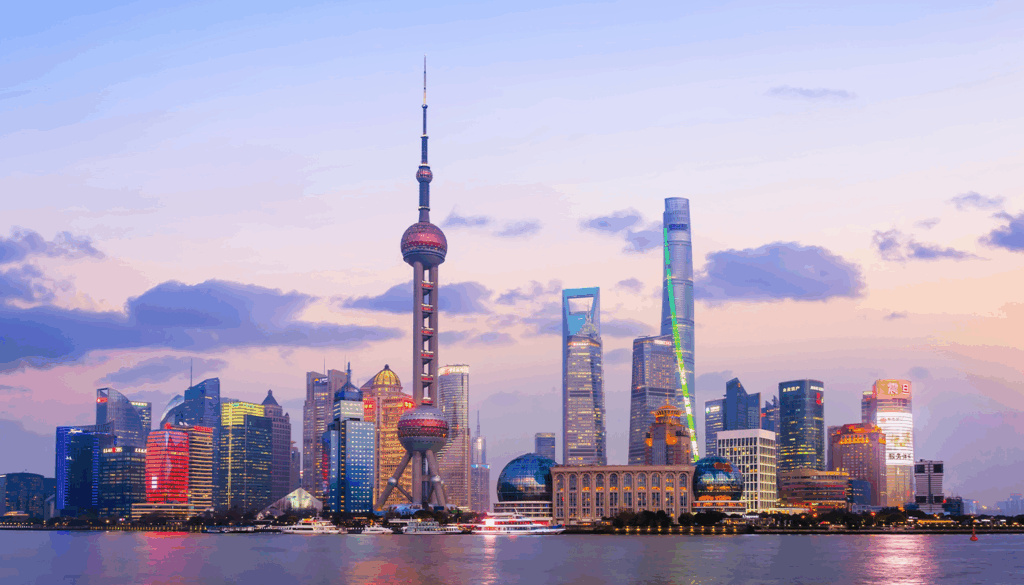
In 1925, the world’s geopolitical center of gravity was indisputably Europe—the epicenter of culture, power, and colonial authority. The United States, surging with industrial might and youthful optimism, clearly represented the future. Asia, large swathes of which had been ransacked and impoverished by colonial powers and rendered technologically stagnant, was viewed by the West as the past—a region of decayed civilizations and backward peoples. That was the architecture of global power a hundred years ago.
Today, these roles have not merely shifted; they have fundamentally inverted. The European Union now represents the past, struggling with stagnation and nostalgia. The United States, which is still the world’s single largest economy, represents the present. And Asia, vibrant and resurgent, represents the future. This is not a matter of conjecture but of quantifiable economic and structural trends that have been accelerating for decades.
In 2000, the combined GDP of the EU member states was eight times larger than that of China. This was a disparity so vast that the two economies seemed to inhabit different stratospheres. Yet, in just 25 years, that gap has been completely erased. Today, the economies of the EU and China are roughly the same size. The trajectory, however, is what matters most. Projections suggest that by 2050, the EU economy will be half the size of China’s. To witness an economy go from being one-eighth the size of a competitor to double its size within a single lifetime is to witness a tectonic shift in the fundamental structure of global power.
A similarly stark comparison can be found by juxtaposing the fortunes of India and the United Kingdom. A century ago, the British Empire was so dominant that a mere 100,000 Englishmen could effortlessly rule over a subcontinent of 300,000,000 Indians. The world has changed militarily—this would certainly be impossible today. But the economic reversal is even more profound. As recently as 2000, the British economy was still nearly four times larger than India’s. Today, India has overtaken its former colonial master. By 2050, India’s economy is projected to be four times larger than Britain’s. In a twist of deep historical irony, we are witnessing a complete inversion of the power dynamic that defined the nineteenth and twentieth centuries.
Why is this happening? What are the engines driving this massive accumulation of power in the East? Let me propose three primary drivers that may explain this phenomenon.
The first reason is that the world is simply returning to its normal state. The Western dominance of the last two centuries, which has come to be seen as the natural order of things, was in fact a major historical aberration. From the year 1 AD to approximately 1820 AD—a span of 1800 years—China and India were the two largest economies in the world. Asia was the economic center of the world for nearly two millennia. The industrial revolution and the rise of Western colonialism created a brief, albeit intense, interruption to this pattern. Therefore, the resurgence of China, India, and other Asian nations should not be viewed as a disruption, but as a return to the statistical mean.
The second reason for this shift is that Asian societies have proven to be exceptional students. A century ago, Europe ran the world because it possessed advanced science, technology, and organizational capabilities, which it chose to deploy through military power. Asian nations realized that to survive and thrive, they had to absorb these Western lessons. They have done so with remarkable efficiency. In some areas, they have even started to surpass the West. China, for example, has invested massive resources into research and development. In the critical metric of tier-one peer-reviewed academic papers—the gold standard of scientific innovation—China now produces more output than the United States. The mastery of the hard sciences, once the exclusive preserve of Western universities, has migrated Eastward.
Furthermore, Asians learned the lesson of free-market economics better than their teachers. For decades, the United States evangelized the virtues of open economies, liberalization, and free trade agreements, promising that these were the keys to prosperity. Asian nations took this advice to heart. They opened their markets, lowered barriers, and integrated into the global supply chain, resulting in spectacular growth. The great irony of 2025 is that while Asia has fully embraced these Western ideals, the United States has now turned its back on them.
It is the United States that now refuses to sign free trade agreements and raises tariffs, while Asian nations press forward with agreements like the Regional Comprehensive Economic Partnership (RCEP). This agreement, initiated by ASEAN and joined by China, Japan, South Korea, Australia, and New Zealand, creates the world’s largest free trade zone. Even when the United States increased tariffs, Asian nations have largely refused to retaliate in kind, choosing instead to defend the principles of free trade. This commitment to openness and integration will no doubt help to sustain Asia’s growth trajectory.
The sheer vitality of this growth is evident in Southeast Asia. ASEAN has a combined GDP that is only one-fifth that of the European Union. Yet, in the decade between 2010 and 2020, this region contributed more to global economic growth than the entire European Union combined. This is a testament to the dynamism that now characterizes the Asian economic landscape.
The third driver of this Asian resurgence is a profound explosion of cultural confidence. If one travels the globe today in search of optimism—looking for young people who genuinely believe their future will be brighter than their parents’ past—one finds it most abundantly in Asia. This optimism is not built on hollow hope but on lived experience. The transformation of life in Asia over a single generation is unprecedented in human history.
My own life in Singapore serves as a microcosm of this journey. When I was a child, Singapore’s per capita income was roughly $500, comparable to that of Ghana. I grew up in a house with no flush toilet. I was placed on a special feeding program because I was technically undernourished. I lived, by all definitions, in a Third World country. Today, that same island nation has a per capita income of approximately $90,000, higher than both the United States and the United Kingdom. To traverse the distance from Third World to First in one lifetime instills a deep, psychological resilience and confidence in a population. This cultural energy is a potent force that is driving the region forward.
However, Asia’s growth trajectory is not guaranteed. Nothing in history moves in a straight line; there are always fluctuations, risks, and potential derailments. Three specific challenges loom particularly large over the Asian Century.
The first and most dangerous risk is the intensifying geopolitical contest between the United States and China. This rivalry is driven by an ‘Iron Law’ of geopolitics: whenever the world’s leading emerging power threatens to overtake the world’s leading established power, the established power will almost inevitably try to suppress the challenger. As China’s rise threatens the United States’ position as the sole global hegemon, American efforts to contain China’s growth are, in a historical sense, perfectly predictable behavior. This struggle is likely to accelerate over the next 10 to 20 years. While the wiser path would be for the United States and China to find a modus vivendi and work together on global challenges, history suggests that wisdom is a rare commodity in great power politics. Washington will find it incredibly difficult to stop China’s rise, but its attempts to do so will generate significant friction and instability.
The second major risk is that of intra-Asian conflict, especially the fraught relationship between the two Asian giants, China and India. For the Asian century to fully materialize, these two civilizational powers must, at the very least, get along. Currently, the relationship is fraught with deep distrust. Relations hit a nadir five years ago following a violent clash in the Galwan Valley. While there have been tentative signs of improvement and stabilization in the last few months, the scar tissue remains. If China and India cannot manage their differences, the tension could act as a drag on the entire region’s growth.
The third risk is the specter of deglobalization. Most of the Asian ‘miracle’ economies were built on an export-oriented model, relying on the open markets of the West to absorb their goods. With the West turning toward protectionism and erecting barriers, this model is now under threat. However, this risk is becoming increasingly manageable as Asian economies mature. The region is no longer just a factory; it is becoming the world’s marketplace.
To understand the scale of this internal market, consider these statistics on the Asian middle class. The combined population of China, India, and ASEAN is roughly 3.5 billion people—40 percent of humanity. In 2000, only 150 million of those people enjoyed a middle-class standard of living. By 2020, that number had exploded tenfold to 1.5 billion. By 2030, it is projected to reach between 2.5 and 3 billion people. This domestic demand created by this massive, burgeoning middle class can insulate Asian economies from the vagaries of Western protectionism. The region is becoming more self-sustaining.
Despite the risks of geopolitical strife, regional tension, and trade barriers, the case for optimism, particularly regarding China, remains robust. This confidence can be summarized by what I call the ‘3M Theory’: Motivation, Momentum, and Meritocracy.
The first ‘M’ is Motivation. The Chinese people are driven by a powerful historical memory known as the ‘Century of Humiliation.’ From the Opium Wars of 1842 to the establishment of the People’s Republic in 1949, China was trampled by foreign powers, its sovereignty eroded and its people impoverished. There is a collective, unspoken resolve among the Chinese people and leadership that they will never again allow their nation to occupy such a position of weakness. This deep-seated desire to reclaim its national dignity provides China with formidable societal drive and resilience.
The second ‘M’ is Momentum. China has pivoted from being a producer of cheap goods to a leader in advanced manufacturing. In 2000, China’s share of global manufacturing was a mere 5 percent. Today, it hovers around 30 percent and could arguably reach 45 percent. Recent visits to Chinese factories reveal facilities that are among the most technologically advanced in the world, utilizing robotics and AI at an unprecedented scale. This forward-looking investment into the industries of the future will provide China with incredible industrial momentum in the years to come.
The final, and perhaps most critical ‘M,’ is Meritocracy. China has adopted a strong meritocratic system for selecting its leaders, whereas governance in many parts of the world has succumbed to populism or nepotism. One does not rise to high office in Beijing due to family connections or wealth alone. The system is designed to test and filter talent, ensuring that those who reach the highest levels of decision-making have proven their competence and accrued experience in governance over decades. Consequently, the quality of mind among China’s senior policymakers is exceptionally high. In the long run, organizations and nations that are managed by their most capable minds are the ones that succeed.
The twentieth century was the American century, and the nineteenth was the European century. Today, the momentum of history has decisively shifted toward the Asian century. The East is no longer just catching up to the West. It is leading the way into the future.


