


The twentieth century taught us to think about inequality in terms of wealth. The dividing lines that shaped politics and public debate were those between rich and poor, industrialized and developing, capital and labor. The country into which a child is born was the single largest determinant of the child’s future economic standing and wealth. As globalization accelerated, attention increasingly shifted toward inequality of opportunity—whether every child, regardless of race, gender or family income, had the chance to build a better future.
Those inequalities remain profound and relevant, but they are no longer sufficient to explain the world as it is today. A more fundamental divide has emerged—one that cuts across continents, cultures and economies. It is the divide between those fortunate enough to live inside functioning states and those trapped in places where conflict has shattered the basic relationship between citizen and government. Increasingly, the defining inequality of our age is not simply what people own, but where they are born. The greatest advantage in the twenty-first century is not inherited wealth, educational credentials, or access to technology. It is citizenship in a country capable of protecting its people, delivering essential services and resolving disputes without violence. Indeed, the country into which a child is born determines more than their future economic standing.
This inequality is easy to overlook precisely because, for most people living in stable societies, the institutions that sustain everyday life are almost invisible. We notice them only when they fail.
The world has never been wealthier. Advances in science and technology have extended life expectancy, transformed medicine and connected billions of people through digital networks. Global prosperity has expanded dramatically over the past generation. Yet for hundreds of millions of people, history appears to be moving in the opposite direction. In too many places, progress has been reversed not by economic recession or technological disruption, but by armed conflict and its enduring impacts on the civilian population.
Children growing up in fragile and conflict-affected settings are up to three times more likely to die before reaching their fifth birthday than children living in stable countries, according to the United Nations. The same children in fragile and conflict-affected states are around 10 times more likely to experience extreme poverty. Behind those statistics lie young lives fundamentally constrained before they have scarcely begun.
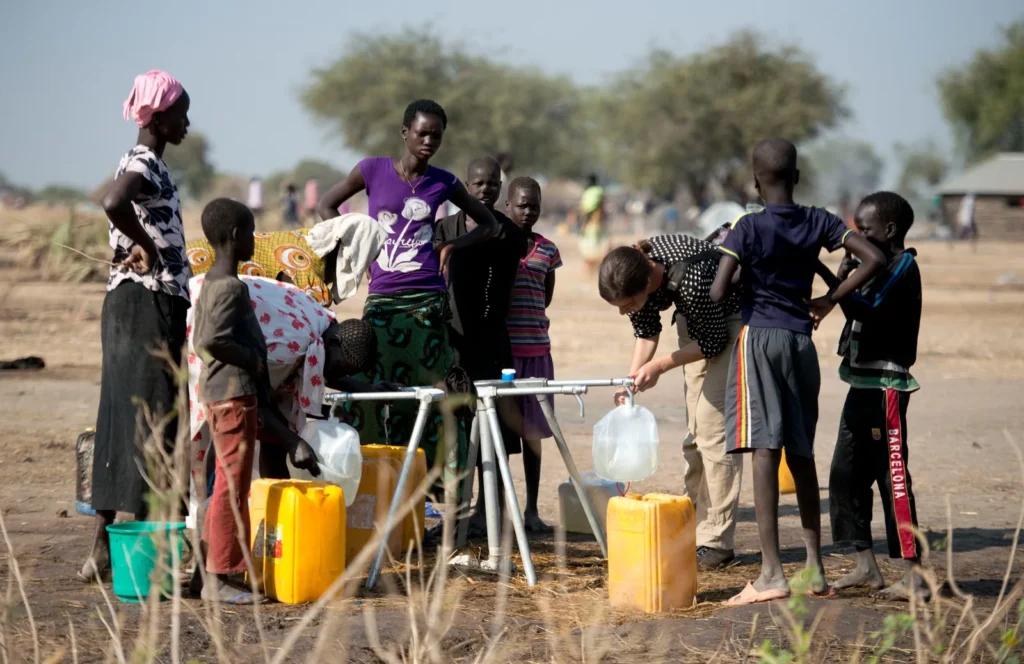
A child born today in Sudan does not simply begin life with lower income than a child born in Norway. That child is far more likely to miss years of schooling, to experience displacement, to go without essential vaccinations, to face chronic hunger, to lose parents or siblings to violence, and to grow up never having experienced the ordinary reliability of functioning public institutions. The gap is not merely economic. It encompasses health, education, security, political voice, personal freedom, and hope itself.
The accident of birthplace has become a default destiny for far too many people. This is not because conflict merely adds another hardship to poverty. Conflict transforms every aspect of human development simultaneously. It destroys the institutions upon which opportunity depends. It dismantles the systems that allow societies to solve problems peacefully, educate children, care for the sick and create economic opportunity. Conflict does not simply interrupt development. It unravels it.
Recognizing this shift matters because it changes how we understand inequality itself. The question is no longer only whether some countries are richer than others. It is whether millions of people have access to the most basic public good of all: a functioning state.
For much of the twentieth century, debates about inequality revolved around distribution. Who owned capital? Who had access to education? Which communities remained excluded from economic growth? These questions shaped domestic politics and international development alike. The questions remain important today but also presume that a functioning society exists and maintains a forum for debate of these very issues.
Conflict changes the equation by deepening every other form of inequality. When violence becomes persistent, every other form of inequality in a country deepens. Schools close or become military targets. Hospitals lose staff, medicines and electricity. Courts cease to function. Police disappear or become instruments of coercion rather than protection. Markets collapse as insecurity destroys investment and trade. Farmers cannot plant crops to support their families or feed their community. Businesses cannot insure themselves against uncertainty. Families stop planning for the future because survival consumes every waking hour and every last resource. Even trust begins to disappear. Communities fragment. Neighbors become suspicious. Social bonds that took generations to build can unravel with astonishing speed.
Poverty is Difficult. Conflict Weaponizes Poverty
This distinction matters because poverty can often be reduced through sustained economic growth, targeted investment and effective public policy. Conflict destroys the very institutions required to make those solutions possible. Development can be measured in years. Institutional collapse can occur in weeks.
Today humanitarian crises start in a relatively small number of countries experiencing protracted conflict, impacting nearly every civilian inside its borders and spilling over to many neighboring states and the region. Ultimately, the impact and consequence of conflict is global. The International Rescue Committee’s Emergency Watchlist has repeatedly demonstrated this striking landscape. Just 20 countries—home to roughly 12 percent of the world’s population—account for nearly 90 percent of people in humanitarian need. Year after year, many of the same countries reappear: Sudan, the Democratic Republic of Congo, Myanmar, Syria, Haiti, Gaza and others. Different conflicts with unique histories, politics and actors, but in totality, these conflicts produce remarkably similar and devastating outcomes for their civilians.
These countries account for disproportionate shares of global displacement, food insecurity, attacks on healthcare, violence against civilians and humanitarian need. The persistence of these crises is not evidence that the people who live there are somehow uniquely vulnerable or uniquely unfortunate. It is evidence that once institutions collapse, conflict becomes self-reinforcing and civilians are caught in the conflict.
Violence destroys governance. Weak governance allows further violence. Economic decline accelerates displacement. Displacement weakens local economies further. Patterns repeat and retrench. Humanitarian organizations work heroically to save lives, but they cannot restore the political agreements that make lasting recovery possible. This is one reason humanitarian crises appear increasingly permanent. Emergencies that were once expected to last months now persist for years or decades. Entire generations are growing up having known nothing except conflict. Childhood becomes defined not by possibility but by adaptation to instability, survival despite daily struggle.
If this is the defining inequality of our age, then it is worth asking what people living in stable societies possess that is so valuable. The answer is surprisingly ordinary. Every morning millions of people wake up, turn on the tap and expect clean water to flow. They send their children to school expecting teachers to arrive and for the students to learn safely. They assume that hospitals will function if illness strikes, electricity will continue to power homes and businesses, contracts will be enforced, flights will land safely, banks will open, food will appear on supermarket shelves, and the internet will connect them to the diverse resources and viewpoints of the wider world. None of these experiences attract much attention because, in stable societies, the activities are routine. Their very reliability renders them invisible.
Yet each seemingly mundane example depends upon institutions that have been built painstakingly over decades—sometimes centuries. Roads require maintenance. Water systems require engineers, pipes, and water treatment products. Courts require public confidence and rule of law. Public health depends upon trained professionals, functioning supply chains and accountable government. Markets flourish not because they emerge spontaneously, but because they rest upon predictable rules, enforceable laws, and physical security.
Functioning states are humanity’s greatest social technology. They organize cooperation among millions of people who will never meet one another. They transform individual effort into collective progress. Above all, functioning states provide the confidence that tomorrow will resemble today closely enough for people to invest, educate their children, build businesses and imagine a future better than the present. Conflict dismantles these foundations with frightening speed.
New Inequality: Neither Morally Acceptable nor Sustainable
The consequences of this new inequality do not stop at national borders. In an interconnected world, the distinction between domestic and international security is becoming increasingly artificial. Conflict that begins within one country’s borders rarely remains there. It spreads through displacement, disrupted trade, food insecurity, illicit finance, organized crime, violent extremism and regional instability. Climate change magnifies these pressures further, turning drought into displacement, displacement into political instability, and instability into wider regional or global insecurity.
Recent events have underscored how quickly local crises become global ones. Russia’s invasion of Ukraine reshaped global grain and energy markets within weeks. The recent conflict in the Middle East has affected shipping lanes, insurance markets, food and energy prices around the world. Civil war in Sudan has destabilized an already fragile region while creating the world’s largest displacement crisis. Pandemics remind us that pathogens do not recognize borders, while digital technology ensures that misinformation, financial shocks and political instability travel faster than ever before.
The globalization of markets has been accompanied by the globalization of risk. This is why the widening gap between stable and conflict-affected societies should concern citizens far beyond those directly caught in violence. It is not simply a humanitarian challenge. It is an economic concern, a security issue, and ultimately a question about the kind of international order capable of sustaining prosperity in an age of profound interdependence. Too often, however, our political imagination has failed to keep pace with this reality.
The modern information environment has transformed how conflict is experienced by those living safely elsewhere. War reaches us instantly through smartphones, livestreams and social media. Images of destruction circle the globe within minutes. For a brief period, the terrible images command our attention. We react emotionally, debate passionately and express solidarity. Then the next notification arrives—and our attention moves on. The families living through those conflicts do not have that luxury.
One of the defining risks of our age is not simply indifference but moral distance. Constant exposure to suffering can produce compassion and empathy, but it can also produce fatigue and dismissal. Emergencies become normalized. Displacement becomes expected. Humanitarian appeals become annual rituals rather than extraordinary responses to extraordinary events.
That fatigue represents one of several dangers in becoming accustomed to permanent emergency. When conflict becomes background noise, political urgency diminishes. At the same time, the conflict itself becomes more entrenched. Children continue to miss years of education. Health systems deteriorate further. Armed groups become more deeply embedded. The costs of physical reconstruction multiply with every passing year, while the costs to the human capital are exponential. This is playing out today in the Democratic Republic of the Congo, with the current Ebola outbreak, where the DRC’s children and their families are experiencing a disease outbreak after years of protracted conflict and subsequent impact to governance and health systems.
Humanitarian action saves lives, but only political action can change the trajectory of a conflict. In places like the DRC, humanitarian organizations play an indispensable role in preventing catastrophe, often operating under extraordinarily difficult conditions to keep people alive, address hunger, and contain disease outbreaks. But humanitarian action has limits. It can relieve suffering, but it cannot by itself stop the killing, negotiate peace agreements, build legitimate political institutions, or end wars.
Recognizing that distinction is essential because the greatest inequality of our age cannot be addressed through humanitarian assistance alone. It requires renewed political investment in preventing conflict, strengthening institutions and rebuilding the international cooperation that has weakened over recent decades.
An Agenda to Address the New Inequality
First, we should begin treating conflict prevention not as discretionary foreign assistance but as prudent economic and security policy.
Governments routinely invest enormous sums in responding to crises after institutions have collapsed. Humanitarian appeals grow larger each year. Peacekeeping missions become more expensive. Reconstruction takes decades. The financial and human costs of inaction consistently exceed the costs of prevention.
Preventing state failure is rarely dramatic. Success attracts fewer headlines than crisis response. Yet helping governments strengthen institutions before violence escalates is among the highest-return investments available to the international community. More broadly, the UN Office for Disaster Risk Reduction notes that every $1 investment in resilient infrastructure in low- and medium-income countries saves $4 in avoided losses and disruptions. In a stable, high-income country, that $1 investment saves $13 in future losses. Effective diplomacy, inclusive governance, accountable institutions, reliable infrastructure, and early action are not idealistic aspirations. They are practical forms of risk management.
Second, we must invest not only in emergencies but in people. Conflict does not erase human potential. It traps it. Education cannot wait until peace agreements are signed. Livelihoods cannot be postponed indefinitely. Local civil society organizations cannot be treated as peripheral actors when they are a critical part of the local community likely the first to respond and the last to leave. Refugees and displaced people should not spend years prohibited from working, contributing or rebuilding their own futures.
Too often, humanitarian systems inadvertently reinforce dependency because they are designed around short-term survival rather than long-term opportunity. Saving lives will always remain the first priority. But wherever possible, emergency investments should also strengthen education, health systems, local institutions, and economic resilience. The distinction between humanitarian relief and longer-term development is often less important than ensuring that every dollar spent today leaves communities stronger tomorrow.
Institutions matter because institutional support can multiply individual effort to an exponential impact. A functioning school educates thousands of children over its lifetime. A functioning court strengthens confidence throughout an economy. A functioning health system prevents epidemics before they spread. The most effective investments are those that enable societies gradually to solve their own problems rather than remain permanently dependent upon external assistance.
Third, we need a broader understanding of solidarity and cooperation. For much of the post-war era, international cooperation was often framed in moral terms: wealthier countries helping poorer ones. That moral imperative remains—albeit perhaps in a weakened status. But today’s interconnected world demands an additional argument: one that recognizes that supporting conflict-affected societies is not just charity. It is enlightened self-interest.
Every investment that reduces instability lowers future humanitarian costs. Every successful peace process reduces displacement pressures. Every functioning economy creates new markets rather than new emergencies. Every young person who finds education and employment is one less person vulnerable to recruitment by armed groups or criminal networks.
In this way, the interests of stable and conflict-affected societies are increasingly shared. This approach requires renewing confidence in international institutions precisely when they are under unprecedented strain. No single country, however powerful, can manage today’s interconnected risks alone. Equally, international organizations cannot succeed without sustained political leadership from Member States. Effective multilateralism is not an ideological preference. It is a practical necessity in a world where threats ignore national borders.
The central lesson is straightforward: The accident of birthplace should not determine the limits of a human life. Today it does exact that.
A child born in Norway inherits functioning institutions that provide security, education, healthcare and opportunity before a single personal choice is made. A child born in Sudan may inherit displacement, violence and institutional collapse through no fault of his or her own. Neither child chose where they would begin life. Yet that single circumstance increasingly shapes every opportunity that follows. This is the great new inequality of the twenty-first century.
It is tempting to regard this divide as inevitable—to assume that conflict has always existed and always will. History offers little reason to believe that war can be eliminated altogether. But history also teaches that institutions can be built, societies can recover and political choices matter. Countries that were once synonymous with conflict have become stable democracies. Others have moved in the opposite direction. The difference has never been determined by random fate alone. Rather, the difference is determined by been leadership, institutions, partnership and sustained political commitment.
The measure of our generation will not be whether conflict disappears. History offers no such promise. It will be whether we continue to accept that the accident of birthplace should determine the boundaries of a human life, or whether we strengthen the institutions and partnerships and engage political will that allow more people to live in safety and dignity around the globe.
The greatest inequality of our age is not inevitable into perpetuity. It is the product of continued human choices. That means different choices remain within our power. With investment and commitment, we can name, confront, and address that inequality, thereby better serving the children in Norway and Sudan—and millions of others in between.


