


When the concept of the Greater Middle East was being actively debated at the 2004 G8 summit at Sea Island, in the United States, the project drew broad criticism. Many saw it as an instrument for interfering in the domestic affairs of sovereign states in order to impose Western models of development—something that could, in turn, lead to greater instability and conflict. The “Arab Spring,” and the “hot military-political summer” that followed it and continues to this day, are proof of that.
Let me recall that, unlike the classical Middle East, the “greater” region encompasses more than 20 states across the Middle East, North Africa, the Caucasus, and Central and South Asia. The concept rested on four cornerstones: democratization through the promotion of Western democratic values, freedom of speech, and human rights; economic integration through the creation of a free-trade area and support for private enterprise and market reforms; education through efforts to combat illiteracy and modernize school curricula; and security through the fight against extremism and the construction of a sustainable regional security architecture. The realities that followed the 30th anniversary G8 summit, however, eclipsed all the worries and misgivings voiced there.
For years now, many analysts have argued that modern international relations have entered an era of a total game without rules—one in which, having begun a game of chess with your opponent, you realize after his next move that what he is holding is not a chess piece but a baseball bat. Some call this new era the “era of stable instability.” Others say that the perennial dispute over the primacy of values versus interests—traditional to any politics, foreign and domestic alike—has given way to the dominance of pure profit. It is no accident that the word “deal” is a constant in the lexicon of Trump and his team, having migrated from the construction sites of New York to the offices of the White House.
There is no point in defending the existing system of international organizations, which took shape during the Cold War. Even then it was not particularly effective, and after 1990 its real capabilities repeatedly failed the test: the OSCE proved unable to prevent or halt a single conflict in Europe, while UN structures such as UNRWA displayed overt support for one side of a conflict and saw their staff implicated in extremist activity.
The emergence of new international structures, both in the post-Soviet space and in other regions of the world, did not inspire excessive optimism, but it at least gave hope for a certain “system reboot” of international institutions. The G8 and the G20, APEC and ASEAN, the SCO and BRICS, along with a considerable number of regional and subregional organizations in Asia, Africa, and Latin America, looked like a kind of “trial run” in the search for a new style of interstate relations. Some things worked out for them; some did not. But none of their creators encroached upon the UN—that “sacred cow” of the post–World War II order. And then the thunder struck.
Donald Trump’s Board of Peace—which began its work after the signing of its Charter on January 22nd, 2026, and which, in his words, “could replace the UN”—made its Greater Middle Eastern debut with a big war. As an element of the “new international architecture,” as diplomats put it, it was hardly original in resorting to the “language of the guns”: in 2025, 2 SCO Member States, India and Pakistan, fought each other, and within the framework of the “Board of Peace’s big war,” 2 BRICS Member States, Iran and the UAE, were drawn into war. But in this Big War, Trump did demonstrate his uniqueness: the United States became the first host country of a FIFA World Cup to bomb the territory of one of the tournament’s participating nations while the competition was under way. And, of course, no one in history has ended the same war as many times as Donald Trump has ended his with Iran.
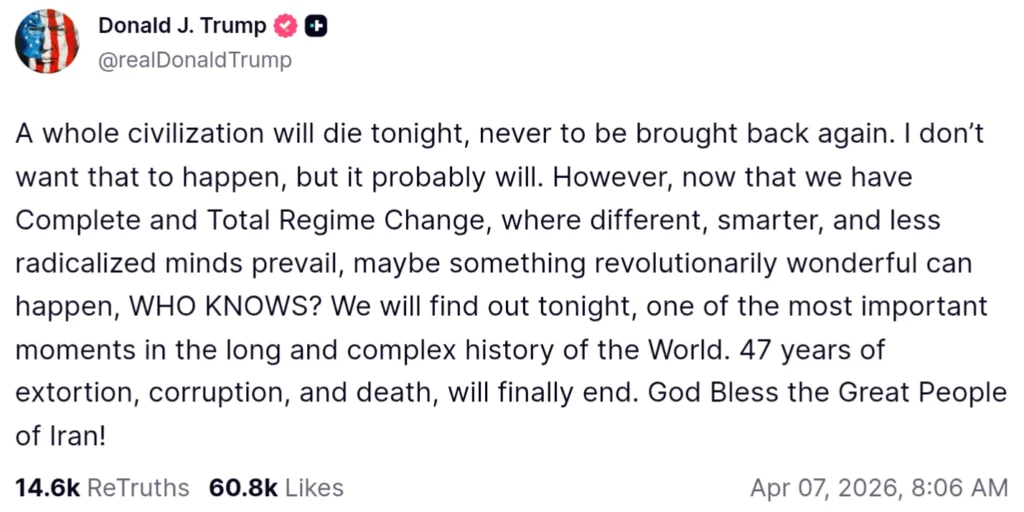
There is no point in recounting the chronology of this Middle Eastern war here—everyone is following it, glued to their screens. But if we cannot yet draw conclusions, we can at least analyze some interim results. It appears that Trump has fallen into a trap of his own making. His main problem today is that the seeming military victory over Iran—achieved, or in the process of being achieved—is not translating into a political one. A de facto military defeat implies neither a readiness to cease resistance on the battlefield nor a readiness to dismantle the existing political system. The United States and Israel managed to deal the Iranian regime a painful military blow: to knock out most of its command structures and to destroy air- and missile-defense sites, missile depots, dual-use infrastructure, and elements of the nuclear program. But after that—evidently to the surprise of Trump and his team—it turned out that military success in itself does not equal capitulation and does not even amount to a complete victory over the enemy. The government in Iran did not collapse, did not abandon its strategy, and did not agree to dismantle the very structures for whose destruction the big war had essentially been launched.
In other words, with a nominal win on the battlefield, the political game was not won. Herein lies the main problem of the fourteen-point memorandum signed by U.S. President Donald Trump and Iranian President Masoud Pezeshkian: it records not so much the success of the pressure on Iran as the West’s inability to carry that pressure through to a result that would change the architecture of the threat.
The main mistake was made at the very outset: the first strike did not substitute for a strategy. If the goal of the operation was not a one-off punishment of Iran but a fundamental change in its behavior, then a single air-and-missile campaign was clearly insufficient. The Iranian regime is built on the ideology of Islamic Shiite radicalism and fundamentalism. At its disposal are a repressive apparatus, a networked regional system of proxies, and a readiness to shift the cost of the conflict onto its own population, its neighbors, and the world economy. It is not simply a secular state with a classical army that can be coerced into peace by destroying a few echelons of military command or a handful of politico-religious leaders.
That is precisely why, from the outset, the question was never whether the United States and Israel were capable of destroying a significant part of Iran’s military infrastructure. They were. The question was different: what levers would remain in the hands of the 2 Board of Peace members after the first strike, if Tehran did not surrender? If the Iranian regime was prepared to endure destruction, seal off its information space, suppress protests among its population, and simultaneously deliver asymmetric strikes at America’s allies through missile salvos, the closure of Hormuz, and operations by Hezbollah and the Houthis, then the campaign should have been built from the very beginning as a multi-stage strategy of coercion—economic blockade, destruction of the machinery generating oil and gas revenues, political isolation, the threat of regime change—and not as a mere demonstration of force. As a result, military success did not lead to capitulation.
The first phase of the operation created the illusion of a fundamental turning point: the elimination of members of the ruling elite and the strikes on bases, depots, air-defense sites, and nuclear facilities gave the impression that operational superiority had been achieved. But it never became strategic. Iran did not admit defeat; the popular masses did not rise up and sweep the regime away; no renunciation of the nuclear program or dismantling of the regional proxy network took place; and the Iranians did not accept the package of peace-deal terms that would have allowed the United States and Israel to present the outcome as an indisputable political victory.
This is hardly surprising, for Iran retained its most important resource: the ability to inflict damage not directly on the United States and Israel, but—by exploiting the world’s systemic dependence on the energy arteries of the Persian Gulf—on practically the entire world. The Strait of Hormuz became not part of the theatre of military operations but the principal asset, and a political ON/OFF switch. According to U.S. Energy Information Administration data, in 2024 about 20 million barrels of oil and petroleum products passed through it each day—roughly 20 percent of world consumption of liquid petroleum products, and more than a quarter of the world’s seaborne oil trade. By IEA (“Strait of Hormuz Factsheet”) estimates, in 2025 about 25 percent of the world’s oil trade and 20 percent of its gas trade—more than 110 billion cubic meters of LNG, mainly from Qatar and the UAE—passed through the Strait.
That is why the blockade of Hormuz became a pivotal political point rather than a tactical episode of the military campaign. It turned out that, while surpassing Iran in firepower, intelligence capabilities, and every kind of technology, the United States and Israel could not cope with the one Iranian lever capable of raising the cost of the war for the entire world: inflationary pressure, rising energy prices, LNG shortages in Asia, multidirectional pressure on Europe, market jitters, and mounting discontent among voters in both Europe and the United States over the rising cost of living. The Trump administration and the Netanyahu government are compelled to reckon with public opinion, the state of the financial markets, inflation, upcoming elections, and the reaction of the media and of allies—above all in Western Europe. The Iranian regime is bound by no such set of constraints: it can demand—and does demand—sacrifices from its population, suppresses discontent and dissent, and presents its own “steadfastness” as a victory over its two main external enemies. That is why, as recent months have shown, even severe military and infrastructural damage does not necessarily break its will or force it into compromise.
Tehran’s unbroken will manifested itself most vividly in the playing of the “Hormuz card,” which became perhaps the main trump in the “Iranian deck.” Hormuz is not merely a narrow sea passage between Iran and Oman, wide and deep enough for supertankers to pass through. Hormuz today is a symbol of the global vulnerability of most of the world: the threat of its closure instantly becomes a factor bearing on the world economy. It is a narrow “export throat” on which Kuwait, Qatar, and Bahrain depend, Iraq to a considerable extent, and, to a certain degree, the UAE and Saudi Arabia—which, of course, have alternative export routes—but also, of course, Iran itself.
Saudi Arabia and the UAE possess operational pipelines that free them from total dependence on Hormuz—the Saudi East–West oil pipeline runs to the port of Yanbu on the Red Sea, while the UAE uses a line to Fujairah, on the coast of the Gulf of Oman—but their spare capacity is limited, and they cannot replace the entire flow passing through the strait. For LNG exports the situation is even more strained: it has become perfectly obvious that for the Qatari and Emirati export volumes going through Hormuz, there simply are no alternative sea routes.
As a result of the “Board of Peace’s war,” Iran has acquired an effective instrument of blackmail—one it did not fully employ even during the Iran–Iraq War. Moreover, it has no need to close the strait physically and permanently: it is enough to create “stable instability,” sustained uncertainty, and a “deferred threat” to shipping. Frightening statements to this effect can be combined with attacks on individual vessels, selective mining, and missile-and-drone salvos, which will inevitably entail a manifold increase in insurance premiums—or the outright refusal of coverage by insurers—along with the simple refusal of ships’ captains to enter the risk zone. The declared risk of a blockade is at times more effective than the blockade itself: the insurance market, freight, and logistics themselves begin to whip up the situation and intensify the crisis, restricting the freedom of navigation to the point of impossibility.
Despite all the American statements that “Iran does not control the strait” and that “vessel traffic continues,” the very fact of the threat is already changing market behavior—and it is precisely here that Iran’s strategic advantage lies, a gift from Trump’s team: not absolute military control over the sea, but the ability, on a regular basis, to generate enough “risk expectations” that the world’s financial and energy markets pay a high political price. In launching the “big war in the Greater Middle East,” the United States and Israel openly declared their goals: to halt the Iranian nuclear program; to remove or neutralize the existing stockpiles of enriched uranium; to limit ballistic-missile production to short-range missiles (300 to 500 kilometers); and to end support for the network of Iranian proxies—the Houthis, Hamas, and Hezbollah. There were also goals not declared openly but quite obvious: to secure influence over energy supplies to China, and thereby to control—and, in the longer term, reduce—China’s “weight” in the Greater Middle East. That was the maximum for whose sake, as Washington evidently reckoned, it made sense to launch an operation of such scale.
How that operation unfolded is already history. It ended in negotiations and the signing of a memorandum. The negotiations, in turn, showed that Iran was ready to discuss the form of a pause—the memorandum—but was not ready to renounce the foundations of its power, that is, everything that makes it a formidable regional player: the nuclear program; the missile arsenals, together with the plans for their build-up and modernization; and the regional networked proxy infrastructure. Thus, the memorandum, viewed as an interim political outcome of the war, looks problematic for the United States, if not an outright failure. A number of commentators went further, characterizing it as “Trump’s capitulation.”
The assessments voiced in the United States on virtually every platform after the signing of the memorandum—with the possible exception of the narrow circle of propagandists working for Trump—boiled down to two basic theses: a “one hundred percent surrender of positions,” and a “complete and unconditional capitulation.” Iran did not budge a millimeter from its 2015 positions as reflected in the JCPOA—the Joint Comprehensive Plan of Action, the “5+1 Agreement,” or, in Trumpist terminology, “Obama’s bad deal with Iran.” Of course, having promised in 2015 not to build nuclear weapons, Iran nonetheless continued to run its centrifuges, accumulate nuclear material, and enrich it to high concentrations—which, under certain conditions, would have made it possible to build a nuclear bomb. Much has been written and said about this over the past 11 years. But it is important to note that the current “60-Day Memorandum” is, from a legal standpoint, entirely comparable to the “5+1 Agreement.” Iran, unlike the current American administration, has not retreated a single step from its positions of 11 years ago.
Trump, who harshly criticized Obama for the 2015 agreement, is now prepared to do what Obama could never even have contemplated: to pay Iran for peace, both by unfreezing Iranian assets and by creating a $300 billion reparations fund. The victor pays reparations? An absurdity—or the new rules of a universal game without rules? The United States is de facto discussing payments to Iran for safe navigation—there is talk of “environmental payments”—through the Strait of Hormuz. Next in line: a new Montreux Convention, and the creation of a regime similar to that governing the Bosphorus and the Dardanelles? It takes one’s breath away to contemplate the prospects of such a development in international maritime law—Singapore and Denmark are surely watching the emergence of the new precedent with the closest attention. It follows from the text of the memorandum that Iran has the right to levy charges on vessels passing through the Strait of Hormuz.
In the several centuries of the existence of international maritime law, its most important principle—advanced by the Dutch in the seventeenth century, then fully embraced by the British and subsequently by all the other maritime powers—the principle of freedom of navigation, of freedom of international shipping, had never been violated. The United States upheld this principle de jure throughout the twentieth century; adherence to it was, for America, one of the key grounds on which it entered first World War I and then World War II. Now, however, Trump is doing something inexplicable, endorsing Iran’s international blackmail. In essence, a process is under way whereby the strategic principles of international law are being replaced by tactical, situational arrangements yielding momentary gain. And for Trump, as the November midterm elections to the U.S. Congress draw nearer, that gain is perfectly obvious: lower gasoline prices on the American domestic market.
In practical terms, Trump is following the path not of dismantling the strategic threat but of freezing the conflict on terms under which Tehran retains its key instruments of pressure. Ending the energy crisis is now becoming the chief motive behind the political decisions of Trump and his team. In light of the coming elections, this is rational: rising prices for oil, gas, shipping, and insurance quickly turn into inflation, and inflation into “electoral punishment”—the threat that Trump could lose not only the House of Representatives but the Senate as well. Yet the tactical rationality of this decision for Washington does not make it strategically advantageous, if one weighs its military-political and economic consequences not only for the United States and Israel but also for America’s regional allies in the Arab world.
Tehran, by comparison with the “warriors of the Board of Peace,” finds itself in a winning position: it withstood the blow, did not capitulate, tied the reopening of Hormuz to concessions from the attackers, forced Trump to seek a compromise, and “sold” all of this at home as proof of the regime’s steadfastness—and to the outside world as a nation rallying around the flag. Even if Iran has lost a significant part of its infrastructure, it has preserved its political agency and its right to dictate the negotiating agenda, and it has tangibly strengthened the Beijing–Tehran axis. But Iran’s greatest success in the region was the inclusion in the memorandum of a provision for a ceasefire “on all fronts,” including Lebanon. Only a short while ago, it seemed, Israel and Lebanon were holding direct negotiations on eliminating a common threat—Hezbollah—and on excluding Iranian influence as a destructive force in the region; today, however, the political logic of the memorandum turns Hezbollah into part of Iran’s negotiating perimeter. It officially becomes part of Iran’s military infrastructure, ceasing to be a purely Lebanese terrorist organization, or a mere foreign ally of Iran.
This is clearly something Israel neither wanted nor expected. If, before the memorandum appeared, Israel insisted on its right to respond independently to Hezbollah’s threats, now each of its operations in Lebanon can be presented by Tehran as a violation of the provisions of that very memorandum—and Iran’s response will always be at the ready: the threat to Hormuz. Iran thus acquires a lever of pressure on both the United States and Israel. How this will most likely work is obvious: Hezbollah provokes or escalates a threat; Israel responds; Iran declares a violation of the regional truce; the world’s markets tremble with fear for Hormuz; and Washington presses Israel “not to wreck the agreement.”
A new ‘triangle of dependence’ is emerging: Israel defends its border and the security of its citizens; Iran strikes at the ‘nervous system’ of the world economy; and the United States tries to hold down oil prices and preserve political stability. As a result, Israeli security may become an object of American hedging against economic risk. This is the strategic trap—and not only for the United States and Israel, but for the Greater Middle East and the Western world as a whole. For Iran such a mechanism is advantageous, because it shifts the cost of the conflict onto other shoulders: Israel will have to pay with restrictions on its freedom of action in the region; the United States, with the risk of economic and political crisis; the Gulf states, with fear for their exports and—no less important—their imports; and Europe and Asia, with energy prices and inflationary pressure. Tehran itself, of course, also suffers economic damage—perhaps the heaviest of all the parties to the conflict—but the Iranian regime has already proved that it is prepared to pay any internal price, however high, to preserve its power and its regional influence.
Everything happening now suggests that the Americans are turning away from the Jewish state. The signing of the memorandum ending the military phase of the conflict has set in motion a fundamental revision of relations with Israel among American politicians of both the Democratic and, in part, the Republican camp. Evidence of the abandonment of the principle of support for Eretz Israel—hitherto inviolable for both parties—came in a harsh statement by U.S. Vice President Vance, who sharply criticized America’s closest Middle Eastern “special” ally. “You’re a country of 9 million people. You cannot just kill your way out of solving every single national security problem that you have,” he said. This is a tectonic shift for America, where support for the Jewish people—long before the founding of the State of Israel in 1948—was part of the political tradition. As far back as 1790, the first U.S. President, George Washington, put it thus in a letter to the Hebrew Congregation of Newport: “May the children of the stock of Abraham who dwell in this land continue to merit and enjoy the good will of the other inhabitants.”
For nearly the whole of American history, U.S. politicians built or strengthened their careers on the consistent defense of the Jewish community and of Israel. Former President Joseph Biden and Senate Democratic leader Chuck Schumer advocated large-scale military aid to Israel for decades, while Republican Senator Ted Cruz loudly declared that one of the main tasks of his work in the Senate was to be Israel’s leading defender. Pro-Israel organizations actively supported loyal members of Congress and vigorously countered their critics. A pro-Israel stance was advantageous for the political careers of American legislators.
But times have changed. Pollsters in the United States are recording growing skepticism toward Israel among young Republicans, and the picture is similar on the “left flank.” An unquestionably alarming signal for Israel came in the results of the New York primaries, which brought sensational success to anti-establishment candidates who came out against Israel in general, and its Prime Minister Netanyahu in particular—candidates backed by New York Mayor Zohran Mamdani.
The United States has stopped making an exception of Israel to the principle of “America First.” The war against Iran has demonstrated the limits of force in the absence of a political strategy and of detailed planning for every stage of the operation. The United States and Israel were able to deal Iran a heavy blow, but they were unable to convert it into the regime’s capitulation or the dismantling of its threats. Iran lost much, but it preserved the main thing: the ability to tie its own security to the security of the world economy.
The memorandum ending the war became not its final point but a new battlefield. Iran has grasped the West’s sore spot: democratic governments fear not only war itself but also its cost to their own voters. It has likewise grasped the sore spot of its neighbors: the countries of the Greater Middle East are vitally dependent on stable and predictable transport logistics. Iran will now press on these sore spots repeatedly.
And Donald Trump—stubbornly fighting the Democrats’ political legacy on the international stage while following, “on the Iranian track,” the path of his political opponent, the Democrat Barack Obama—has, without noticing it, buried forever one of the most important elements of the political legacy of the Republican George W. Bush: the Greater Middle East project. Though neither he nor his team may ever even have known of it.


