


Every five years—sometimes 10 years—the United Nations confronts a peculiar institutional exercise: the selection of a Secretary General. The process is remarkable less for its constitutional clarity than for its studied opacity. A single sentence in the UN Charter, Article 97, constitutes the entirety of the Organization’s written constitutional guidance: the Secretary General “shall be appointed by the General Assembly upon the recommendation of the Security Council.” From this laconic foundation, eight decades of improvisation, geopolitical negotiation, and accumulated custom have produced something that is recognizable as a process but has never been authoritatively codified in any single document.
The selection deserves an unexpurgated opportunity to be understood as an exercise in and of itself—neither the theater of global politics nor the biography of its participants, but a discrete institutional exercise worthy of rigorous examination.
This essay traces that exercise chronologically: from the pivotal 2015 General Assembly resolution that attempted to open the process to scrutiny, through the first test of that new transparency regime in 2016, through the quieter reversion to closed practice in 2021, and onward to the procedural mechanics—the straw ballots, the Wisnumurti Guidelines, and the informal architecture of Council deliberation—that will govern the selection of the next Secretary General by January 1st, 2027. The aim is not to assess candidates or adjudicate alignments, but to illuminate the process as a system: its formal rules, its informal norms, and the permanent tension between the Security Council’s gatekeeping authority and the General Assembly’s democratic aspirations.
The 2015 Inflection Point: Opening the Curtains
For most of the UN’s history, the selection of a Secretary General was conducted in conditions of near-total institutional opacity. Member States were consulted bilaterally, if at all. The Security Council deliberated behind closed doors and presented the General Assembly with a fait accompli—a single name to ratify rather than a candidate to scrutinize. The Assembly dutifully complied. No formal nomination process existed; no public record was kept of the considerations that elevated one name above others. The Secretary General emerged from the process as if by spontaneous generation, bearing the imprimatur of the Council’s 5 permanent members.
The gathering pressure for reform came not from any single catalyst but from the cumulative weight of decades of General Assembly revitalization initiatives. The trajectory is traceable across four key moments. In 1997, resolution 51/241 issued the first explicit call for transparency in the selection. Resolution 60/286 in 2006 encouraged public nominations. Resolution 70/305 in 2016 institutionalized informal dialogues between candidates and the full membership. And resolution 79/327 in 2025 reaffirmed these commitments and pressed for early presentation of candidatures.
The hinge point was September 2015. On the 11th of that month, the General Assembly adopted resolution A/RES/69/321—the most significant procedural reform of the Secretary General selection process in the Organization’s history. Four key innovations defined its architecture. First, it invited Member States formally to submit candidatures, transforming what had been an informal lobbying exercise into something resembling a structured application process. Second, it required that candidates submit formal vision statements for public dissemination, introducing a measure of programmatic accountability that had never previously been expected of aspirants to the post. Third, it mandated informal dialogues between candidates and Member States in open General Assembly settings—town-hall style engagements that gave the full membership, for the first time, a structured opportunity to question those seeking the Organization’s highest office. Fourth, it established a joint letter from the Presidents of the General Assembly and the Security Council as the formal mechanism for opening each selection cycle, thereby inscribing the Assembly’s institutional stake in the outcome in the opening choreography of every future process.
What the resolution conspicuously did not do was alter the fundamental constitutional architecture. The Security Council remained the decisive forum; the P5 veto remained inviolate. Resolution’s A/RES/69/321 intent, understood by its drafters, was to broaden participation without altering the Security Council’s decisive prerogative. That tension—between the democratizing impulse and the structural permanence of the Council’s authority—would define everything that followed.
The 2016 Selection Cycle: First Test of the New Transparency Regime
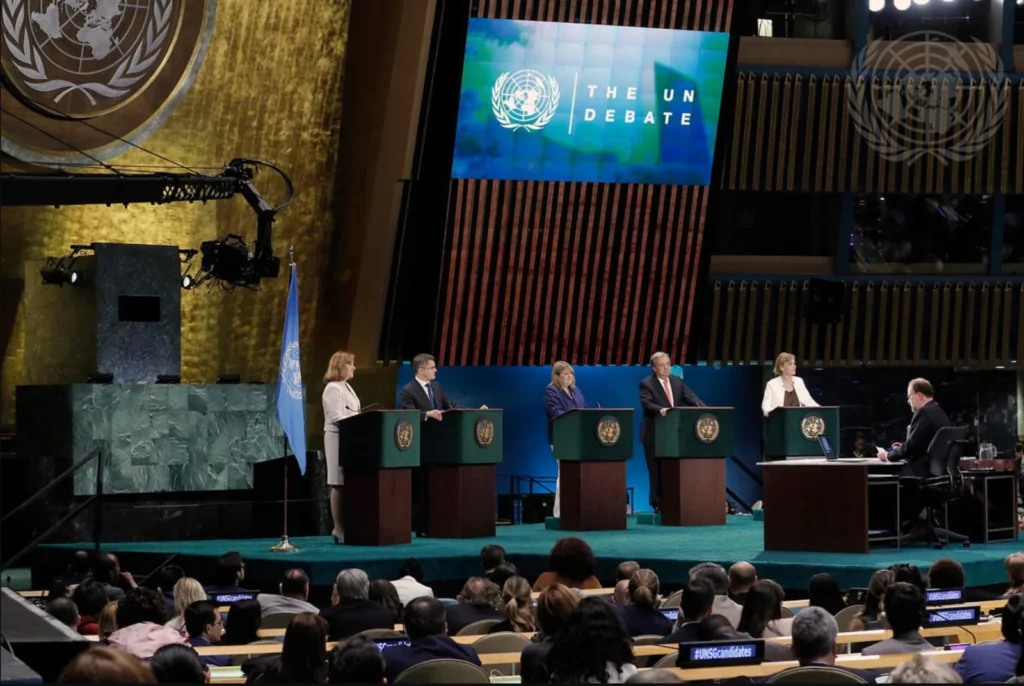
The 2016 selection cycle was, by any historical measure, extraordinary. For the first time in the Organization’s history, the full cast of candidates presented themselves publicly to the UN membership. 13 individuals—an unprecedented number—formally entered the process, each submitting vision statements and appearing before informal General Assembly dialogues. The sessions were broadcast. Civil society organizations, academic institutions, and advocacy groups tracked the proceedings in real time. For observers who had spent careers monitoring a process that traditionally left no public footprint, the spectacle was genuinely novel.
The candidates were diverse in background, nationality, and disposition. They addressed questions on peacekeeping, sustainable development, climate action, and institutional reform. They were pressed by Member States with varying agendas and competing regional priorities. The dialogues produced an unprecedented volume of publicly available material about who the candidates were and what they proposed to do. For the first time, people around the world could follow the selection almost in real time.
Within the Security Council, the process evolved on a parallel and quite different track. The Council adapted the new transparency environment to its own institutional rhythms through the refinement of straw balloting—a non-binding polling process of long standing—augmented by an important new instrument: color-coded ballots that distinguished the votes of the 5 permanent members from those of elected members. This innovation was not codified in any Council resolution; it emerged from internal deliberation as a practical tool to manage the tension between external public transparency and internal deliberative necessity. The color-coded ballot allowed each permanent member, in effect, to signal a veto without formally casting one—a mechanism for managing momentum that gradually shaped the field rather than abruptly terminating candidacies.
The lessons of 2016 were instructive and somewhat sobering for transparency advocates. The new architecture created genuine information about candidates that had never previously existed, and it generated civic engagement with the selection at a scale the UN had never before experienced. It also confirmed that the P5 veto remained the structural fulcrum around which all other dynamics revolved. Candidates who accumulated broad elected-member support but attracted persistent color-coded opposition from one or more permanent members found themselves unable to advance, however strong their public profiles. The process demonstrated that transparency and accountability could be meaningfully expanded at the margins of the selection without displacing the Council’s constitutional authority at its center.
Between Openness and Tradition: 2017 to 2021
The optimism generated by 2016 found its natural terminus in 2021. When the question of reappointment arose, the institutional apparatus assembled at such effort five years earlier was largely set aside. No competitive field materialized. No formal dialogues were convened. The reappointment proceeded through the Security Council and General Assembly in conditions that closely resembled the pre-2015 norm rather than the post-2015 aspiration. The contrast with 2016 was stark.
Whether this constituted a “failure to implement” the open procedures envisioned in A/RES/69/321 depends partly on how one reads that resolution’s scope. A defensible case exists that the 2015 reforms were primarily designed to govern competitive selection cycles—moments when the field is genuinely open—rather than reappointment scenarios, where the dynamics are structurally different. An incumbent seeking renewal faces neither the uncertainty nor the scrutiny of a newcomer; the membership has a record to evaluate; the Council’s deliberations proceed from a more constrained starting position.
Nevertheless, the 2021 UNSG reappointment process reinforced an uncomfortable lesson: that procedural reforms adopted in one institutional moment do not automatically bind subsequent actors in different circumstances. The durability of transparency norms depends on consistent application; selective application, even where individually defensible, creates precedential ambiguity. Member States who had invested political capital in the 2015 reforms found themselves uncertain whether 2016 had established a new normal or merely represented an exceptional episode. The institutional credibility of the reformed process was, at minimum, placed in question—a question that the 2026 to 2027 cycle will have an opportunity to answer.
The Charter’s Enduring Sparseness
Article 97 of the UN Charter states, in relevant part, that “the Secretary General shall be appointed by the General Assembly upon the recommendation of the Security Council.” Nine words govern one of the most consequential appointments in international affairs. No qualification criteria are specified. No term limits are inscribed in the Charter text (they are a matter of General Assembly resolution and accumulated practice). No nomination procedure is outlined. The Charter is, by design or oversight, maximally permissive—which means, in practice, that the Council, as the body empowered to recommend, has exercised near-total discretion over the process’s architecture.
This structural reality carries several important implications. First, the Council’s de facto authority to define the process has meant that procedural norms have developed through practice rather than codification, rendering them both adaptable and fragile. Second, the P5 veto operates not merely as a final filter but as a shaping force throughout: the range of viable candidates is substantially pre-determined by the anticipated preferences of the P5, long before formal consideration begins. Third, the configuration of international power—the shifting coalitions, bilateral relationships, and regional calculations that determine which candidates attract or repel P5 support—shapes the field in ways that are rarely visible and never formally acknowledged.
This architecture is sometimes described as a paradox, but it is more accurately understood as a structural feature with deep roots in the Charter’s original design. The Security Council is charged with the maintenance of international peace and security; the Secretary General is, among other responsibilities, the chief administrative officer of the system through which that charge is exercised. It is worth recalling that neither the Economic and Social Council nor the International Court of Justice was given any role in the selection—even though economic and social development and rule of law are, alongside peace and security, Charter principles and purposes.
That the Council should exercise decisive influence over who occupies the post is neither accidental nor obviously unreasonable. The tension with democratic representativeness—the sense that 193 Member States should have more meaningful influence—is real and has animated decades of General Assembly advocacy. But the Charter’s text, absent amendment, leaves the architecture intact.
Mechanics of the Security Council Consideration
The internal machinery by which the Security Council narrows the field of Secretary General candidates is not inscribed in the Council’s formal rules of procedure. It has developed through practice, adapted to circumstances, and evolved in response to the changing external transparency environment. At its core, the mechanism is the straw ballot: a non-binding, secret poll of Council members that functions as a temperature gauge rather than a decision.
Straw balloting allows the Council to test the room without triggering the procedural consequences of a formal vote. A candidate who performs poorly in repeated rounds faces the practical reality that their path to a formal recommendation is blocked, without any permanent member having formally cast a veto. The process is iterative: multiple rounds of balloting across multiple meetings gradually reduce the field as candidates read the results and assess their prospects. Withdrawal before formal vote is the norm; overt defeat is the exception. The system achieves its purpose—the quiet elimination of non-viable candidacies—while maintaining the appearance of consensual process.
The refinement introduced in 2016, the color-coded ballot distinguishing permanent from elected members, added a critical dimension to this intelligence. A candidate might carry strong elected-member support across multiple rounds while attracting a single “discourage” marking from a permanent member. That signal, while not a veto in the formal sense, is in practical terms dispositive. Campaigns and candidacies adjust accordingly; candidates facing persistent permanent-member opposition withdraw before formal votes are required, preserving the fiction of consensual deliberation while allowing the structural reality of P5 determinacy to operate beneath the surface.
The net effect of this mechanism is to render the Council’s deliberations simultaneously more transparent—in that color-coded results provide a rough indication of where permanent members stand—and less formally accountable—in that no permanent member need ever formally exercise a veto on the record. Whether this represents an improvement in democratic governance or a more sophisticated form of managed opacity is a question on which observers reasonably differ. What is not in question is that the straw ballot system, refined over decades, has become the primary tool through which the Council performs its constitutional selection function.
One additional development merits specific mention, because it introduces a mechanism that, while not specific to the Secretary General selection, is directly and consequentially relevant to it. A/RES/76/262, adopted by the General Assembly in April 2022, established a standing mandate: whenever a veto is cast in the Security Council, the President of the General Assembly must convene a formal plenary session within ten working days to discuss the matter. The resolution creates no legal consequence for the exercise of the veto. The Charter’s language is unambiguous on that point, and A/RES/76/262 does not amend the Charter. What it does create is a reputational cost. If a permanent member were to veto a Secretary General candidate during the current selection cycle, the General Assembly would convene within 10 working days to hold a public debate on that use of the veto. The prospect of that debate—on the floor, webcasted, before all 193 member states—does not eliminate the veto, but it elevates, modestly but meaningfully, the political price of its gratuitous exercise.
Influential Process Guides and Precedents
No single authoritative text governs the Secretary General selection process from start to finish. The Charter provides the constitutional basis; General Assembly resolutions layer transparency requirements on top; Security Council practice defines the internal mechanics. Into the gap between formal rule and operational reality, a body of informal but influential process guidance has developed.
The most significant of these is the set of working procedures known as the Wisnumurti Guidelines—named for the Council presidency under which they were developed. The Guidelines, which are informal and non-binding in character, address the procedural sequencing of Council deliberations in seven substantive areas: general principles governing the process; its legal basis in the Charter and Rules of Procedure; the submission of candidatures; the maintenance of candidate lists; the decision-making process within the Council; the mechanics of the Council’s formal decision; and the requirement to consult with the President of the General Assembly before transmitting a recommendation. Together, these provisions constitute the closest approximation to a procedural manual that the selection process possesses.
The Guidelines’ authority derives not from any formal adoption process but from consistent reference and the absence of any better alternative. They have been cited by Security Council presidencies, drawn upon by candidates and their advisers, and discussed in academic and policy literature as a touchstone for understanding how the Council approaches its selection function. Their influence illustrates a broader principle at work throughout UN practice: where formal rules are sparse, practice solidifies into custom, custom acquires the force of quasi-law, and documents that memorialize that custom accumulate authority through citation.
Alongside the Guidelines, a small ecosystem of civil society and academic institutions has developed significant process-tracking and norm-codification roles. Organizations such as Security Council Report, the 1 for 8 billion campaign, and various academic monitoring projects have documented straw ballot results, tracked candidacy announcements, and analyzed procedural patterns in ways that the Council’s own official records do not. These unofficial archives perform a function the formal record cannot: they create an institutional memory for a process that is structured to leave minimal official trace, and they provide a common reference point for Member States and candidates navigating an otherwise under-documented system.
The Road to January 1st, 2027
The selection that will culminate in a decision by January 1st, 2027 is already underway in the informal sense that matters most: the cultivation of support, the assessment of permanent-member dispositions, and the positioning of candidacies are processes that begin long before any formal mechanism opens. The joint letter from the Presidents of the General Assembly and the Security Council—the formal starting pistol established by A/RES/69/321—will open the official cycle, but the real work of the selection begins in capitals and corridors well in advance.
Several institutional dimensions of the current cycle merit particular attention. At the February 2025 debate of the General Assembly’s Ad Hoc Working Group on the Revitalization of the Work of the General Assembly, ‘the central common theme of the debate, shared practically by all delegations, was the priority and urgency to appoint a female candidate for the first time to the office of the Secretary General.’ 35 delegations spoke—among them Algeria on behalf of the Non-Aligned Movement, Malaysia on behalf of ASEAN, and the European Union on behalf of its Member States. The breadth of that consensus, while not legally binding, represents a powerful normative expectation that will shape the political climate in which the Council deliberates. It is a rare example of the General Assembly—the body with the lesser formal role—successfully framing the terms on which the Council’s discretion will be publicly evaluated.
Procedurally, the pathway follows the template established in 2016. The joint letter invites Member States to submit nominations; candidates present vision statements; informal dialogues are convened before the full membership; and the Security Council conducts its straw ballot process, culminating in a formal recommendation to the General Assembly. The entire sequence is expected to conclude in the second half of 2026, with the new Secretary General taking office on January 1st, 2027.
What remains genuinely uncertain—as it always has been—is whether the procedural architecture assembled since 2015 will hold under the pressures of a fully competitive selection. The 2016 experience suggests that the reformed process can accommodate genuine competition; the 2021 experience cautions against assuming that procedural reforms, once adopted, are self-executing. The institutional stakes in 2026–2027 are therefore not merely about who becomes Secretary General, but about whether the selection process itself will consolidate or erode the transparency gains of the past decade.
The procedural calendar of the current selection is, by historical standards, unusually well documented. A/RES/79/327 and the joint letter of November 25th, 2025, between the Presidents of the General Assembly and the Security Council—published as A/80/544-S/2025/765—established a structured sequence that is publicly accessible.
The milestones are showcased in Figure 1.
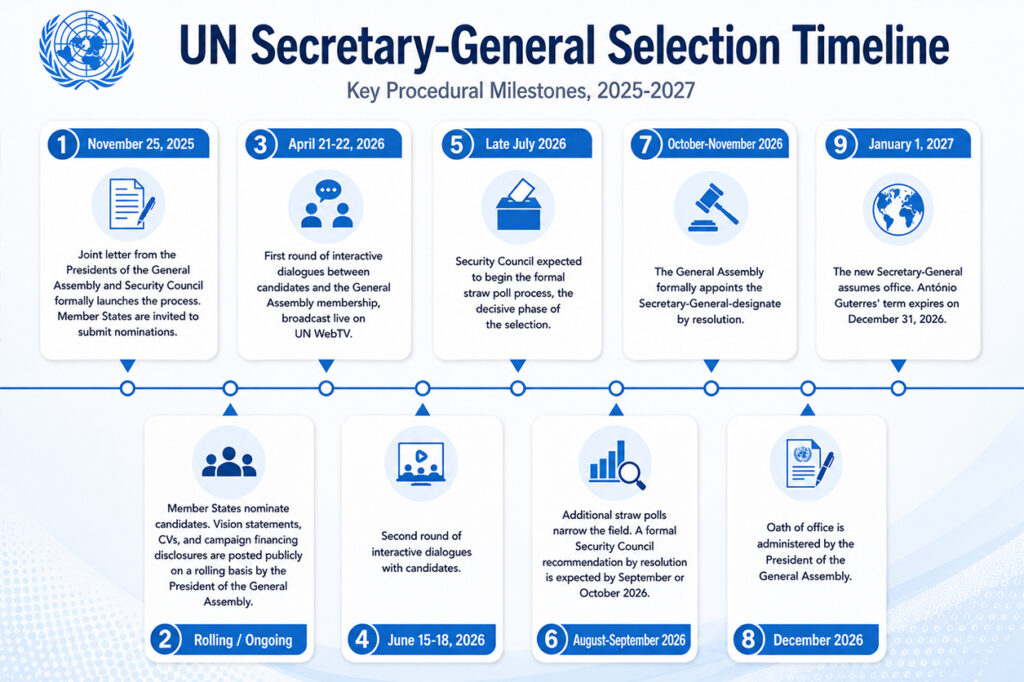
Several features of this calendar merit emphasis. The January 1st, 2027 deadline is firm. Unlike some political transitions, which accommodate grace periods or extended handovers by custom or legislative flexibility, the United Nations Charter establishes no such mechanism. Guterres’s mandate ends on December 31st, 2026; his successor’s mandate begins the following day. The Security Council recommendation must therefore precede the General Assembly appointment by enough time to allow the newly appointed Secretary General to prepare for the responsibilities of the office—a consideration the joint letter of November 25th explicitly acknowledges.
Most consequentially: the straw poll phase—commencing in late July and extending through August and September—is, as I have argued throughout this essay, the moment of actual decision. Everything that precedes it is preparation: the nomination process, the vision statements, the interactive dialogues, the diplomatic consultations in capital cities and UN corridors. Everything that follows it is formalization: the Council’s formal recommendation, the General Assembly’s appointment resolution, the oath of office. The straw polls are where the field narrows, where vetoes are signaled or withheld, and where the outcome is effectively determined. They are also, by design, entirely invisible to the public.
The Durable Paradox
The selection of the United Nations Secretary General is, at its core, an exercise in navigating the gap between formal mandate and operational reality. The Charter provides a sentence; practice has filled the remaining volume. The result is a process that is simultaneously more transparent than it was a decade ago—thanks to the architecture of A/RES/69/321 (2015) and the transparency milestones of 1997, 2006, 2016, and 2025—and more opaque than its formal appearance suggests, because the decisive moments of deliberation remain closed to the membership and the public.
What this essay has traced is not the drama of any particular selection, but the structure through which every selection proceeds: the constitutional sparseness that confers decisive authority on the Security Council; the informal tools—straw ballots, color-coded ballots, the Wisnumurti Guidelines—through which that authority is exercised; the transparency reforms that have since 2015 introduced a measure of public accountability without redistributing the fundamental power architecture; and the institutional questions that attend every new selection cycle about whether procedural gains will prove durable.
By January 1st, 2027, a new Secretary General will have been appointed. The process that produces that outcome will be recognizable to anyone familiar with its predecessors—and still not fully visible to anyone outside the room where the decisive deliberations occur. That durable paradox, more than any individual appointment, is what defines the selection of the United Nations Secretary General as an institutional phenomenon.


