


William Shakespeare wrote that “one man in his time plays many parts” in the theatre of the world. The Secretary General of the United Nations faces the even greater challenge of playing many different parts at the same time. The UN leader has to cater to multiple audiences simultaneously, juggling diplomats, international officials, the media, and civil society. She or he must also grapple with a huge variety of policy issues, ranging from peacemaking and economic development to human rights and climate change. The Secretary General is effectively expected to be a political chameleon, able to move deftly between multilateral forums and policy debates.
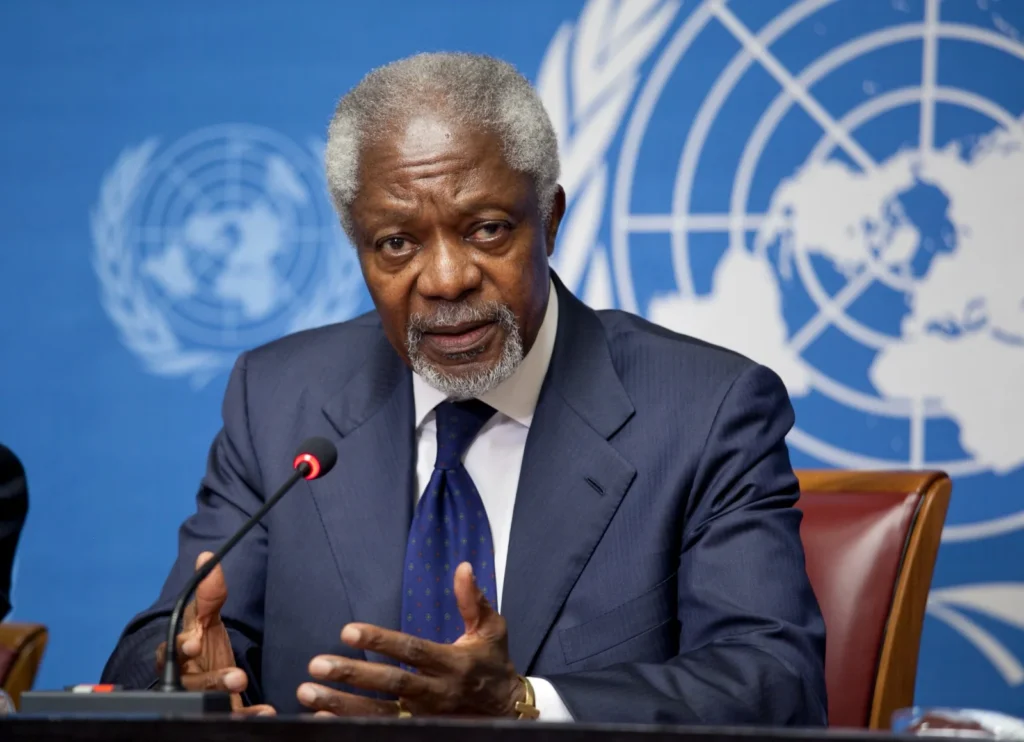
This is an awful lot to demand of one man or woman. Most Secretaries General end up associated with a handful of political priorities that come to define their tenure. Kofi Annan, generally cited as the most successful UN chief of the post-Cold War era, was unusual in managing to make major contributions across all three of the UN’s main pillars of action. On peace and security, he helped relaunch UN blue-helmet operations as a significant security tool after the disasters of Srebrenica and Rwanda. He also launched the Millennium Development Goals—bringing a new sense of purpose to global aid efforts—and guided the creation of the Human Rights Council.
Neither of Annan’s successors has had quite the same hit rate, but each has found flagship issues to pursue. Ban Ki-moon, who wanted to lead on issues not intimately associated with his predecessor, seized on climate change as an emerging global thread and plugged away at the drawn-out negotiations that eventually led to the Paris climate accords in 2015. That, along with the Sustainable Development Goals, has proved to be his legacy. Outgoing Secretary General António Guterres, meanwhile, is chiefly associated with the ongoing battle against climate change and with efforts to seed international cooperation around artificial intelligence.
Different factors shape how each Secretary General plays the role, and which priorities they select. Annan’s interest in peacekeeping stemmed from his prior experience overseeing blue-helmet missions as Under-Secretary General for Peacekeeping Operations. Guterres’s focus on AI has been symptomatic of his interest in the long-term drivers of human change, which has led him to take advice from futurologists such as Yuval Noah Harari. But luck plays a big part too. Guterres ran for office promising to focus on conflict prevention and crisis diplomacy. On taking office in 2017, he found himself having to balance efforts to maintain relations with the first Trump administration against a commitment to keeping climate diplomacy alive despite Trump’s exit from the Paris agreement. That left him little time to concentrate on the details of crisis management.
As the race to replace Guterres reaches its climax, diplomats and UN officials have been mulling over what sort of leader can bring new energy to the organization after a period of international crises and divisions—and what the successful candidate’s priorities should be. This conversation has shifted over time. A few years ago, the conventional wisdom in New York was that, like Guterres, the next Secretary General would largely focus on global challenges such as climate change. Diplomats from the so-called Global South have insisted that development should also stay high on the UN agenda. But after the double shock of Russia’s all-out aggression against Ukraine and Israel’s brutal campaign against Hamas in Gaza, diplomats from all backgrounds now say they would also like to see the incoming leader invest more in conflict prevention and resolution.
How can any single person manage all the facets of the job? To take a leaf out of Shakespeare’s description of the Seven Ages of Man, here are the seven main parts that any Secretary General must play in parallel.
The Administrator
Given the great expectations the Secretary General faces, it is easy to forget that the job description is pretty thin. The UN Charter says only that he or she “shall be the chief administrative officer of the organization” and shall perform such other functions as are entrusted to the office by Member States.
While the administrative side of the job is not the most glamorous—and critics of the UN scoff at Secretaries General who are “more secretary than general”—it is inescapable. Successive UN leaders have struggled with budget crises and with scandals involving alleged corruption or sexual abuse by UN officials. Kofi Annan’s career at the top of the organization nearly came to an early end after revelations of mismanagement in the “oil-for-food” relief mechanism for Iraq. Anyone who hopes to succeed at the higher-profile parts of the job needs first to get the administrative piece nailed down.
This is particularly true at present, as the organization is still creaking under the impact of recent U.S. budget cuts, which forced Guterres to shrink the UN secretariat staff by 20 percent. While this was enough to keep the UN afloat, there is a general feeling among diplomats that the next Secretary General will need to take further—and perhaps more drastic—steps to put the organization on a sustainable financial footing. That is not easy: getting institutional reforms through the UN system means navigating a thicket of governance structures, arcane regulations, intra-UN turf wars, and diplomatic negotiations. To make matters worse, morale among UN staff is exceptionally low after the recent round of job cuts, making it harder to rally officials to take risks or sign on to big reforms that could put their own positions in jeopardy.
Diplomats from the 5 veto powers that dominate Security Council discussions of the Secretary General’s selection have told their counterparts from other countries that finding a reliable manager is one of their main priorities. China, which has become a major financial contributor to the organization since the turn of the century, shares U.S. concerns about keeping costs down. The next Secretary General’s administrative and financial responsibilities will loom large indeed.
The Mediator
If the governments that pay the bulk of the UN’s costs want a solid administrator, ambassadors from many small and middle powers say they want a Secretary General who can play at the highest level of international diplomacy. António Guterres, hobbled by tensions among the major powers, pulled off only one major mediation success—the 2022 Black Sea Grain Initiative between Russia and Ukraine—in his decade in office. UN insiders now often reflect on how earlier Secretaries General, such as Dag Hammarskjöld and U Thant, managed to play a significant part in resolving crises such as those over Suez and Cuba during the Cold War. The next Secretary General will face calls to play a similar brokering role among China, Russia, and the United States.
That is easier said than done. While it is true that Hammarskjöld and Thant helped resolve some Cold War crises, they failed to make much impact on others. If Hammarskjöld won praise for his handling of Suez in 1956—overseeing the deployment of the first large-scale UN peacekeeping force after the Franco-British invasion of Egypt went awry—he also faced criticism for failing to play a significant role over the simultaneous Soviet invasion of Hungary. Thant repeatedly tried, and failed, to find a diplomatic solution to the U.S. war in Vietnam.
Today, it is far from clear that Donald Trump, Vladimir Putin, and Xi Jinping really want the UN running back-channel diplomacy between them, let alone formally attempting to mediate. Guterres was unable to secure even a phone call with President Trump for the first six months of the latter’s second term, despite having had fairly good relations with him during the first. Even when it comes to frictions between lesser powers, the UN faces obstacles. Rising mediators like Qatar and Türkiye are now leading conflict-resolution efforts that would once have been the UN’s domain—though Ankara did collaborate with the UN on the Black Sea initiative.
Nonetheless, there is still political space for the UN to play a greater part in resolving some protracted crises. Frustrated UN officials say their senior leadership has become too risk-averse, even when the U.S. and other powers have asked the secretariat for advice on how to handle crises such as those in Sudan and Haiti. The next Secretary General will need to move rapidly to show that he or she can take a more proactive approach to conflict prevention and resolution.
The Developer
If institutional management and conflict management will be early priorities for the incoming Secretary General, he or she will also have to reassure representatives of the Global South that they care about the development agenda. There is a strong suspicion that—as Western donors reduce their aid budgets, and the Trump administration rejects the Sustainable Development Goals altogether—richer countries will nudge the next UN chief to downplay economic matters. But it will be almost impossible to avoid talking about them. With the end of the SDG implementation period in 2030 suddenly quite close, there is already talk in New York of the need to negotiate a new framework and set of targets to guide future aid efforts.
While the Secretary General will be expected to guide that discussion, he or she will face the reality that the UN’s practical role in delivering development is declining. Other actors, such as the World Bank and other international financial institutions, play a much greater part in spurring economic growth. António Guterres has spoken out about the need for the Bank to give greater weight to the interests of poorer nations—both in its lending practices and in its governance—but diplomats and officials in Washington shrug off criticism from New York.
Some aid experts argue that the time has come for the UN to adopt a narrower approach to development, providing a platform for debates over the norms and principles that guide international economic cooperation while leaving the practicalities to better-resourced players. But while representatives of developing countries acknowledge in private that the UN’s role in development has diminished, they will not stop using the organization—and especially the General Assembly, where the Global South predominates—as a space to press their calls for additional financing and a more equitable global economic system. The Secretary General will have to find a way to show respect for these calls, and ideally to facilitate more constructive debate between Global North and Global South about what the future of development looks like.
The Moralist
One of the hardest aspects of being Secretary General is that the UN chief must engage in hard political bargaining—which inevitably involves a good deal of compromise and cynicism—while also speaking out consistently in favor of international law, human rights, gender equality, and the other principles endorsed by Member States. Whatever the transactional diplomats in New York may want from the UN, many people around the world still look to the organization for moral and legal clarity, and fault it when they think it falls short.
António Guterres has learned this the hard way over Ukraine and Gaza. On Ukraine, he has repeatedly criticized Russia for breaching the UN Charter by launching a war of aggression, which has poisoned his relations with Moscow as the war has dragged on. Yet supporters of Ukraine have faulted him for not being even more outspoken, and for maintaining some contact with Russia—as when he attended a BRICS summit hosted by President Putin in Kazan in 2025.
On Gaza, by contrast, he spoke out forcefully against Israeli military operations, but in doing so alienated not only the Israelis—who declared him persona non grata—but also the Biden and Trump administrations. Even UN officials who agreed with his moral stance wondered whether the organization risked dealing itself out of any political role over Palestine—though it is unlikely that Israel, which views the whole UN as biased against it, would have conceded such a role anyway.
More broadly, there is a widespread sense among UN watchers and civil society that the organization’s defense of liberal values and norms is in retreat. Diplomats in New York increasingly treat human rights as largely a matter for their colleagues in Geneva, since raising rights issues is only likely to complicate already-complex negotiations. The days when the Security Council passed broad normative resolutions on topics such as the Women, Peace and Security agenda are now firmly in the past. Nonetheless, the UN as a whole, and the Secretary General in particular, cannot give up entirely on affirming the importance of international law and normative agendas—these are the foundations on which the entire organization rests. The next Secretary General will need to thread the needle, finding a way to underline the importance of these issues that resonates with the global public without stopping other leaders from taking his or her calls.
The Communicator
If the Secretary General’s views are to resonate widely, she or he must first find ways to attract public attention at all—a challenge in its own right. The UN has struggled to adapt to the new media environment, in which formal press releases from New York and Geneva vanish beneath the maelstrom of social media. A few UN leaders, such as Under-Secretary General for Humanitarian Affairs Tom Fletcher, are adept at using platforms like Twitter to get their messages across. But the average UN-related social media feed is a mish-mash of repetitive slogans about the virtues of global cooperation and photographs of middle-aged officials in suits shaking hands in conference rooms in the UN basement (I am one of them). Meanwhile, traditional outlets like the New York Times have reduced their coverage of the UN.
To make matters worse, the organization is in many cases itself a target of disinformation and misinformation, as governments and malign actors attempt to discredit its reporting on issues such as human rights abuses. In the Sahel, Russian-backed groups flooded the internet with false claims about the behavior of UN peacekeepers in Mali, setting the stage for the government’s expulsion of the blue helmets in 2023. The rise of disinformation is so troubling that Guterres at one point convened a meeting of senior officials to discuss the future of truth in this new era.
No new Secretary General will be able to put the genie of misinformation and disinformation back in the bottle. But Guterres’s successor will need to find ways to get his or her messages out more effectively. That is partly a matter of technology, with senior officials getting better at social media; but many UN insiders, including communications experts, say it is above all about changing the language with which the organization communicates. Too many UN speeches and media campaigns—especially those associated with the Sustainable Development Goals—are couched in technocratic terms that make little sense to non-specialists and seem detached from the scale of the economic, social, and political crises that many people around the world face. A good first step toward improving UN communications would be to start using plainer language.
The Visionary
While speaking to the realities of the moment, the Secretary General also has a platform from which to address the longer-term challenges and opportunities facing humanity. In prioritizing climate change and AI, both Ban Ki-moon and António Guterres leaned into this role. Under Guterres, the UN has not only focused more on technology but launched initiatives on far-sighted topics such as factoring the interests of unborn generations into policymaking. It is arguable that, at a time when many governments are fixated on short-term challenges, the UN’s great strength is precisely its capacity to take the long view.
This long-termism does not always go down well with the diplomats in New York who have to draft the speeches and negotiate the agreements involved. Some feel that, at a time of acute crises, grand thematic debates are a luxury. One Arab diplomat remarked to me during the war in Gaza that he struggled to focus on the interests of future generations when he knew children were dying daily. The next Secretary General is likely to find that Member States resist proposals for further big initiatives about the future until he or she has done the homework on the organization’s management and budget—and preferably brought some short-term crises under control.
Nonetheless, the scale of global technological and environmental change is such that the next Secretary General cannot ignore these trends. Guterres’s successor should not rush to expand the organization’s agenda for its own sake but can still build on his legacy by seeking practical ways to strengthen cooperation around long-term threats in parallel with more immediate concerns.
The Human
While reflecting on global trends and hurtling between international conferences, the Secretary General also has to try to stay grounded. Some previous holders of the office, such as Boutros Boutros-Ghali gained reputations for being aloof. That helps neither with internal management—UN officials are more likely to swallow difficult reforms if they believe the Secretary General empathizes with them—nor with public affairs. Kofi Annan gave many fine speeches, but one of his most enduring appearances was on the children’s television show Sesame Street, where he mediated between a group of bickering Muppets (perhaps not so different from his day job). Much of what the UN does can feel remote. A Secretary General willing to show her or his human side will likely win friends—and perhaps keep a better sense of what the organization should be aiming to do to improve lives around the world.


