H.E. Mr. Vuk Jeremić is President of the Center for International Relations and Sustainable Development (CIRSD) and Editor-in-Chief of Horizons Horizons – Journal of International Relations and Sustainable Development.
Sixty-five years ago, in September 1961, Belgrade became, for a few extraordinary days, the diplomatic capital of the world. The first summit of the Non-Aligned Movement was the product of deep historical forces shaping much of humanity. It was also the moment when Yugoslavia succeeded in turning its own geopolitical vulnerability into a source of global influence.
The world in which non-alignment emerged was still recovering from catastrophe on an unprecedented scale. Two world wars in the first half of the twentieth century had exhausted Europe’s great powers politically, economically, and demographically. One consequence of their mutual destruction was the disintegration of their empires—even, paradoxically, those of the victorious powers, Britain and France. Britain’s withdrawal from empire was for the most part negotiated; France’s retreat, from Indochina to Algeria, was considerably more turbulent.
At almost exactly the same time, a new division of the world was taking shape. In 1946, Winston Churchill famously declared that an “Iron Curtain” had descended from Stettin on the Baltic to Trieste on the Adriatic. On opposite sides of this divide stood the new masters of Europe — the United States and the Soviet Union.
Their rivalry soon extended far beyond Europe, just as the exhaustion of the old imperial powers opened the way for dozens of newly sovereign states.
For Moscow, this created a historic opportunity. Peoples that had spent decades or centuries under European colonial yoke had little reason for sentimental attachment to the West. Their former colonial masters now belonged to the Western bloc, while the Soviet Union actively supported many anti-colonial movements. A vast part of humanity therefore became a natural arena for Soviet influence.
It was at precisely this point that Yugoslavia entered the stage.
FROM THE COMINFORM TO A THIRD WAY
Yugoslavia emerged from the Second World War devastated by brutal occupation and civil war. The communists had prevailed, a one-party state was established, and every indication suggested that Belgrade would become one of Moscow’s most reliable allies in Europe.
It did not.
The simmering rivalry between Tito and Stalin culminated in the Cominform Resolution of 1948. Beneath the ideological accusations was a much larger question: could a communist country pursue a foreign policy independent of the Kremlin?
What followed was a prolonged war of nerves. The threat of Soviet intervention was real. Yugoslavia prepared for the worst, while the West recognized the strategic significance of Tito’s defiance and provided substantial economic and military assistance.
In the end, Stalin blinked first. No invasion came, and following his death relations with Moscow gradually normalized. Yugoslav independence had survived.
But the country’s leadership understood that the underlying strategic problem had not disappeared. Moscow could wait for more favorable circumstances to bring Yugoslavia back into its orbit and eliminate a dangerous precedent: a socialist state that had demonstrated that resistance to Soviet hegemony was possible.
Yugoslavia therefore needed to give its independence a broader strategic meaning. It had to become more valuable to the West than merely a source of tactical irritation for Moscow in the Balkans. In other words, it had to significantly contribute to containing the global expansion of Soviet influence, without becoming a Western satellite.
Out of that necessity came one of the most original foreign-policy ideas of the twentieth century.
BELGRADE 1961
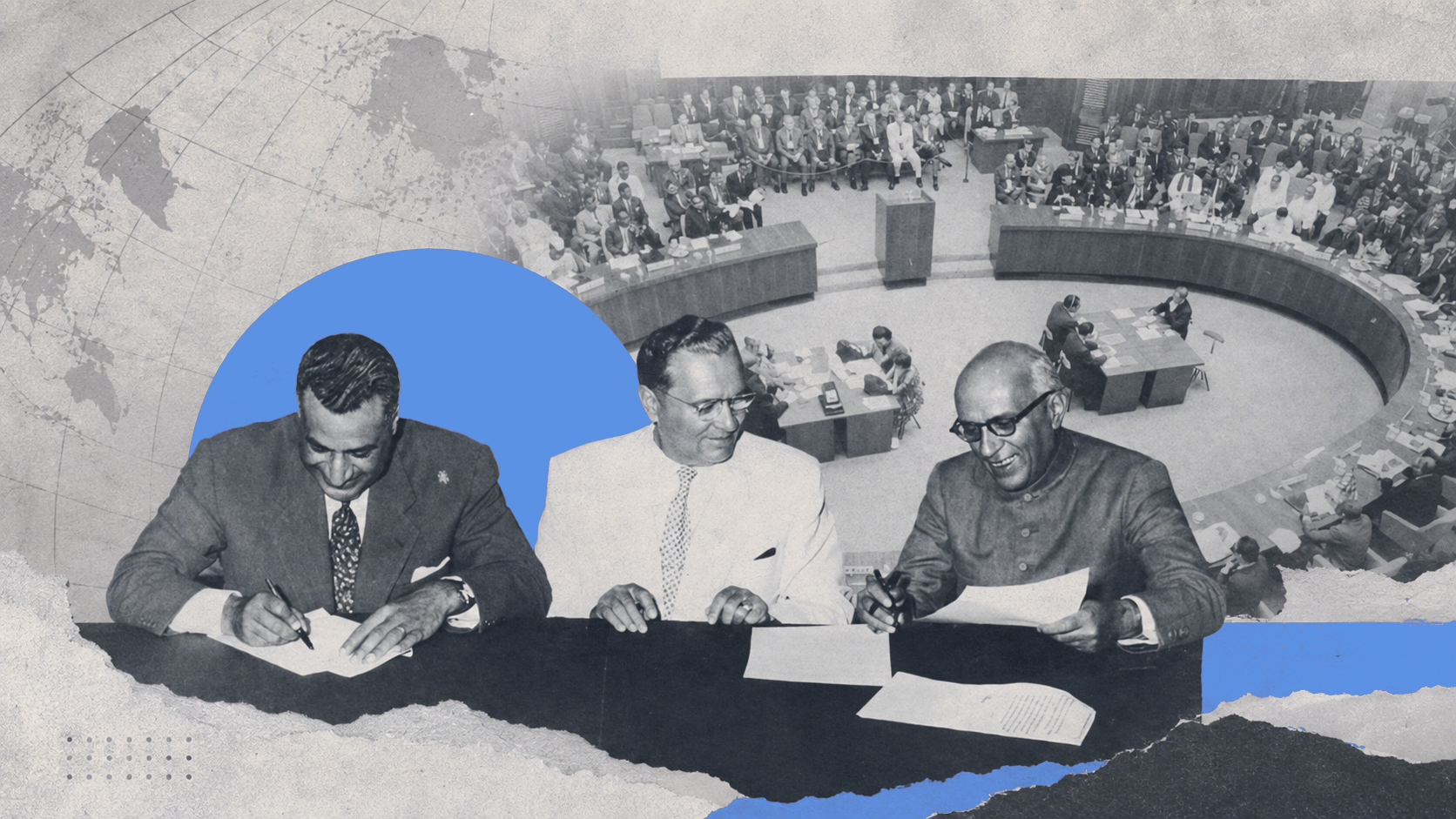
The Bandung Conference of 1955 laid the political foundations of non-aligned solidarity. The convergence of Tito, Nehru, Nasser, Sukarno, and Nkrumah created the critical mass necessary for a genuinely global movement.
Within that group, Yugoslavia occupied a singular position. It was neither a former colony nor a colonial power. It was European, but belonged to neither bloc; socialist, but independent of Moscow. It had fought for—and won—the ability to speak with equal confidence to the West, the East, and the newly independent states of what was then called the Third World.
Non-alignment did not mean passive neutrality. Its core principles were sovereignty, self-determination, decolonization, peaceful coexistence, disarmament, and the rejection of the idea that great powers had the right to decide for smaller states where they belonged.
For Yugoslavia, this was a strategic triumph. Instead of remaining a lonely island between NATO and the Warsaw Pact, it became one of the leaders of a political space encompassing a vast share of the world’s territory and population.
THE GOLDEN AGE OF YUGOSLAV DIPLOMACY
What followed was a remarkable rise in Belgrade’s international standing. By almost any measure, it was the golden age of Yugoslav diplomacy.
Tito was its most recognizable face, but behind him arose an exceptional diplomatic tradition. From Koča Popović to Budimir Lončar, successive generations of diplomats gave Yugoslavia an international weight far greater than its size would have suggested.
Nowhere was this more visible than at the United Nations. Through a dense network of friendships across Asia, Africa, the Arab world, and Latin America, Belgrade often possessed something like a controlling bloc of political relationships and votes in the General Assembly.
The Non-Aligned Movement became a major voice in support of decolonization, the struggle against apartheid, the Palestinian cause, disarmament, and demands for a more equitable international economic order. It was never entirely cohesive, but it became impossible to ignore.
THE BITTER TASTE OF VICTORY
The greatest historical paradox of non-alignment came with the end of the Cold War.
Its central proposition—that states need not be subordinate to one of two rival blocs—had, in a sense, won. The Warsaw Pact dissolved, the Soviet Union disappeared, and Europe’s bipolar division came to an end.
In September 1989, just two months before the fall of the Berlin Wall, Yugoslavia once again hosted a summit of the Non-Aligned Movement. Then came one of history’s crueler ironies: instead of emerging as a shining star of the post-bloc world, one of the founding states of non-alignment disintegrated in bloodshed.
The complexity of the Yugoslav wars, particularly the conflict in Bosnia and Herzegovina, badly damaged Belgrade’s relations with a significant part of the Movement during the 1990s, especially with many Muslim-majority states. The Federal Republic of Yugoslavia’s participation in the Movement was suspended in 1992.
After the democratic changes of 2000, the country turned decisively toward the West—toward European integration and, within parts of the political establishment, even rapprochement with NATO, despite the bombing campaign we had endured only shortly before. Rebuilding relations with the non-aligned world was not a priority. When the Federal Republic of Yugoslavia returned to the United Nations, Belgrade sought only observer status in the Movement in 2001.
2008: SERBIA RETURNS TO THE WORLD
The turning point came in 2008, after Serbia’s democratic leadership became deeply disillusioned by the support of key Western powers for Kosovo’s unilateral declaration of independence.
Serbian diplomacy then embarked on a global campaign of a kind the country had not undertaken for many years. Arrayed against us were the United States at the height of its unipolar power and almost the entire European Union at the zenith of its political and economic influence. Pressure on governments around the world to recognize Pristina was enormous.
The support of Russia and China, as permanent members of the UN Security Council, was indispensable in preventing Kosovo’s secession from being legitimized through a new Security Council resolution. But preventing the broader international consolidation of Kosovo’s independence required something much larger: a truly global diplomatic effort.
For years, we traveled across the world, often to countries no Serbian minister had visited in decades. Gradually, we gained sympathy and support. Many governments came to see our position as part of a broader question that went beyond Kosovo itself: could a small state resist the will of the most powerful and insist on the principle of sovereignty and territorial integrity?
For some, that struggle echoed the courage to say “no” to Stalin in 1948.
That was the beginning of the renaissance in Serbia’s relations with the non-aligned world.
BELGRADE 2011
We became active again in the Movement’s forums and then decided to attempt something that many considered impossible: to mark the fiftieth anniversary of the founding summit with a major ministerial conference in Belgrade in 2011.
Serbia was no longer a member of the Movement, only an observer, and because of its EU accession process, a return to full membership was not a realistic option. We therefore had to secure diplomatic consensus for a non-member state to host a major Non-Aligned gathering.
The opposition did not come only from abroad. I vividly remember fierce criticism from parts of both the government and the opposition, much of it directed at me as foreign minister and as the principal “culprit” behind the idea. I also remember the dismissive comments of some Western diplomats, who openly encouraged such criticism.
What followed, however, was unforgettable.
More than 100 national delegations came to Belgrade. The gathering took place in the National Assembly, in the very building where the Movement’s founders had met in 1961. The atmosphere was extraordinary. One scene remains particularly vivid in my memory: the gala reception at the White Palace, where Crown Prince Alexander Karađorđević welcomed ministers from non-aligned countries and spoke to them with respect about Tito, his late father’s nemesis.
For much of the world, Serbia finally began to move beyond the negative legacy of the 1990s. The depth of that rehabilitation became clear the following year. In the election for President of the UN General Assembly, held by secret ballot, Serbia’s candidate defeated the EU-backed favorite by 99 votes to 85.
Without the support of a large number of our friends from the non-aligned world, that victory would not have been possible.
THE LESSON FOR SERBIA TODAY
The non-alignment of 1961 cannot simply be reproduced in 2026. But its central lesson may be more relevant today than at any point since the end of the Cold War.
We are living through an era of geopolitical recession and increasingly pronounced multipolarity. Armed conflicts and trade disputes are multiplying, while power is no longer measured only in tanks, missiles, or aircraft carriers. Technology, artificial intelligence, energy, critical minerals, financial flows, and supply chains have all become instruments of strategic competition.
In such a world, small states must proceed with exceptional care.
Yugoslavia’s policy of non-alignment propelled it into the highest orbit of international diplomacy and gave it influence far beyond what its size would otherwise have commanded. It did so not because it kept an equal distance from everyone, but because it preserved enough strategic autonomy to speak to everyone without fear.
For Serbia in the twenty-first century, that may be the most important legacy of Belgrade 1961: to guard its sovereignty jealously, resist premature alignment, and cultivate strong relationships with every relevant center of power—established and emerging alike.
In a world becoming dangerously unpredictable, that is not nostalgia.
It is a strategy for survival—and for prosperity.