Theresa Schuetrumpf is a PPE undergraduate at Kings College London. She is an editorial intern at the Center for International Relations and Sustainable Development (CIRSD).
When I asked my grandmother what she remembered about the end of World War II, she did not talk about geopolitics or Germany’s future role in Europe. She remembered the relief. “Wir waren froh, endlich kein Alarm mehr,” she said finally, no more air-raid alarms. There was little time to look back. “Wir schauten nach vorn” [We looked forward]. Adults and children cleared away the rubble, schools reopened, and Germany began to rebuild itself.
For her generation, the lesson of the war was simple: never again. Families had been torn apart, soldiers had disappeared, and the country had been reduced to ruins. “Nie wieder Krieg” [Never again war] was not a political theory. It was a feeling, carried in the body more than in any doctrine. The writer W. G. Sebald later argued that this instinct to look forward rather than back was widespread among postwar Germans, who largely chose not to dwell on the destruction they had lived through, let alone put it into words. My grandmother’s own account, decades later, still carries that same reflex.
Almost 80 years later, Germany is having a very different conversation. It is spending more on defense, reviving conscription registration, stationing troops permanently on NATO’s Eastern flank, and being asked to assume a far greater role in defending Europe. Most commentary treats this as a straightforward question of hardware and budgets. I do not think it is. The real question is if young Germans have any reason to believe this is a country worth defending, and whether the state has actually earned that belief. I want to argue that Germany currently has both a historical problem and a material one, and that the two intertwine each other in ways the defense debate rarely acknowledges.
A Familiar Debate, A New Question
Germany’s problem has never simply been that it dislikes the military. The country has sent soldiers abroad for decades. As Dr. Jana Puglierin of the European Council on Foreign Relations noted, Germany had already confronted the meaning of “Nie wieder” during the Kosovo War in 1999, when Joschka Fischer reframed the phrase as “Nie wieder Auschwitz.” German responsibility, he argued, could sometimes mean using force to defend human rights and international law. So the current shift is not a sudden leap from pacifism to militarism.
For decades, most Germans could live with the assumption that security was something the state and its alliances simply provided. There was no urgent need to worry about obligatory military service or a war inside of Europe. The political scientist Hanns Maull captured this assumption in his description of postwar Germany as a “civilian power,” a state that pursued its interests through trade and diplomacy and treated restraint itself as a source of legitimacy. Russia’s invasion of Ukraine broke that assumption. For the first time in decades, a major war in Europe is not someone else’s problem. This is the exact position where the debate becomes too simplified: politicians assume that once the threat is named, the willingness to respond follows automatically. It does not. That is the reason why a “Wehrpflicht” [compulsory military service] is necessary in the first place. A society does not rearm its mindset just because its government rearms its army.
The Bundeswehr Debate Nobody Wants to Have
In Germany, we argue about a lot of things. We argue about how many brigades the Bundeswehr needs, whether conscription should return, whether it should apply to women as well as men. We argue far less about why a young German today should feel any obligation to answer that call. The honest answer is: many do not and why should they? This reaction is not simply cowardice or a lack of gratitude, as it is often framed in the press. It is the product of two forces pulling in the same direction at once, and both deserve to be taken seriously rather than dismissed.
The first is historical. Young Germans did not grow up with the DDR (East vs. West Germany) contrast, the Cold War threat that made “civilian power” feel like a bold moral choice rather than a default. They grew up with the war taught almost exclusively as a lesson in guilt: the Holocaust, the Wehrmacht’s crimes, and the moral catastrophe of German militarism. That education was necessary and I do not want to relativize it. But it also means that an entire generation was raised to associate the very idea of German strength—soldiers, uniforms, and national defense—with something shameful, without ever being given an equally clear vocabulary for what legitimate, democratic strength might look like instead. Hence, when the state suddenly asks this generation to embrace conscription, it is not simply asking them to serve. It is asking them to reverse, almost overnight, an identity they were carefully taught to hold.
A survey by the Bundeswehr’s own social science institute found that a large share of Germans still see mandatory service as a serious infringement on the rights of young adults, and youth organizations such as Greenpeace Jugend found that most 16- to 25-year-olds reject the return of conscription outright and want to be included in the political debate about it rather than simply informed of the outcome. Studies of youth mental health in Germany, including the long-running “Jugend in Deutschland” survey, have also tracked rising anxiety directly tied to the war in Ukraine and fears of being drawn into a wider conflict. I do not read that anxiety as weakness. I read it as the psychological cost of asking a generation to hold two irreconcilable ideas at once: that German power is inherently dangerous, and that German power is now urgently needed.
The second problem is material, and I think it is under-discussed to the point of being almost dishonest. Ask a 25-year-old in Germany why they should be willing to sacrifice time, income, or in the worst case scenario their life for this country, and you run into the fact that the same state asking for that sacrifice has spent the last two decades quietly pushing the cost of its own promises onto them. The clearest example is the pension system. Germany’s 2026 pension commission has recommended tying the statutory retirement age directly to rising life expectancy, meaning today’s 20-year-olds can expect to work years longer than their parents before receiving a pension that, on current projections, will replace a smaller share of their income.
A ZDF Politbarometer poll found that 71 percent of Germans believe younger people are currently being overburdened by pension policy—and among 18- to 34-year-olds, that number rises to 82 percent. This matters enormously for the defense debate, even though the two are almost never discussed together. If the state’s implicit message to its youngest citizens is “keep paying in, keep working longer, and trust that something will be left for you,” it has very little moral standing to add “and also be ready to defend this country with your life” on top of it. You cannot ask people to risk everything for a state that has shown, again and again, that it is willing to quietly extend their debts and defer their future whenever it is politically convenient.
This viewpoint makes young Germans selfish, and I resist the framing common among older commentators that this generation simply lacks a sense of duty. The German youth is asking, in this authors opinion a reasonable manner, for the relationship between citizen and state to be reciprocal. Dr. Puglierin put it to me in a phrase I found striking: “Sicherheit kommt nicht aus der Steckdose” [Security does not simply come out of the socket]. Instead it is something a society has to contribute to, not something it can passively consume. This viewpoint makes sense but, I would push the same logic back onto the state: trust does not come out of the socket either. If Germany wants a generation willing to contribute to its security, it has to first demonstrate that it takes their long-term interests—their pensions, their housing costs, and their ability to build a life here—just as seriously as it takes its own defense budget. At this moment the German state has not made its case, and until it does, the Bundeswehr debate will keep running into a wall of justified distrust rather than a shortage of patriotism.
The Danger of Rejecting Patriotism Altogether
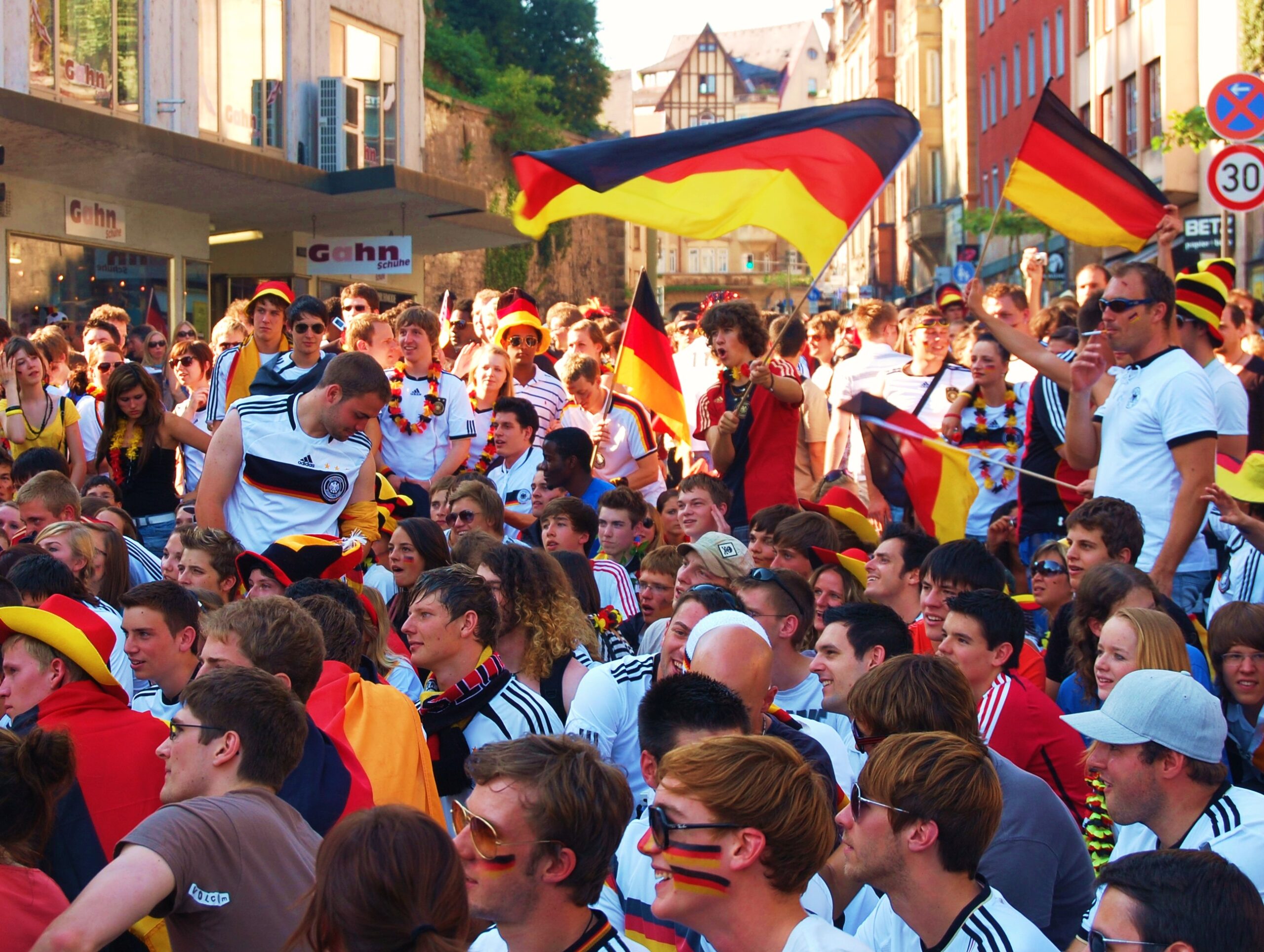
This brings me to what I believe to be the most dangerous part of the current moment. Faced with this historical guilt and material distrust, a real strand of German politics has concluded that the safest response is to reject patriotism altogether to treat any pride in the country as a step toward the nationalism of the past. When the new Bundestag was sworn in in 2025, several Die Linke MPs, including Gregor Gysi and Heidi Reichinnek, publicly declined to sing the national anthem, reflecting a broader discomfort with the idea of national pride as part of German identity. This is a serious political mistake.
A state cannot ask its citizens to defend it, pay into it, and believe in its future if its own political class treats pride in that state as something slightly embarrassing. If the message from parts of the democratic left is essentially “there is nothing here worth being proud of,” then young Germans are left with only one place to look for an alternative story: the far right, which is more than happy to supply one. This is not a hypothetical risk; it is already happening. The AfD has built an entire political identity around the claim that it is the only party willing to say Germans should feel proud of their country, while figures like Alexander Gauland have called for renewed pride specifically in the German soldiers of the World Wars’, and Thuringia’s Björn Höcke has openly called for a “180-degree turn” in how Germany remembers the Nazi period. That is not patriotism. It is historical revisionism wearing patriotism’s clothes, and it is only gaining ground because mainstream democratic parties have left the entire emotional register of “being proud of Germany” unclaimed. Every time a mainstream party refuses to defend patriotism as a legitimate, democratic sentiment, it hands the far right a monopoly on national pride by default. This is precisely, counter to the outcome that a party like Die Linke should want to produce.
What Germany can Actually be Proud of
I want to be direct about my own position: I believe that Germany does not need to rediscover nationalism, and it should be extremely careful not to. But it badly needs to become comfortable with patriotism, and there is a real, defensible case for what that patriotism should be about. This is close to what the philosopher Jürgen Habermas, building on a term coined by Dolf Sternberger, called “Verfassungspatriotismus.” A constitutional patriotism where: loyalty is not to blood or soil but to a set of democratic principles and institutions, understood not as a cold, abstract loyalty to a legal text but as something citizens actively live out and improve. German soldiers swear to defend the “Recht und die Freiheit der Bundesrepublik Deutschland” [Rights and freedom of the Federal Republic of Germany], not the nation in any ethnic sense. The Bundeswehr remains a parliamentary army, subordinate to elected civilians. That distinction is not a technicality. It is the entire answer to the question of what exactly Germans should be defending.
Furthermore, there is a concrete, everyday version of this pride that gets lost in abstract philosophy. Germany is, whatever its flaws, a country that guarantees universal health insurance to every resident, has built one of the most extensive social insurance systems in the world, and since 1949, sustained an uninterrupted, functioning democracy with real courts, a free press, and constitutionally protected rights. None of that is nothing. This is not to say that Germany’s social state is beyond criticism, I have just spent several paragraphs arguing the opposite, that its pension system is failing younger generations and needs serious reform. But both viewpoints can be true at once: a country can have deep, unresolved problems in how it treats its youngest citizens, and still be a country whose basic democratic and social achievements are worth being proud of and worth defending. Refusing to say that second part out loud does not make Germany more honest about its problems. It just leaves the field open for parties who will happily say it in the ugliest possible way.
It is also worth noting that the far right’s use of “we are the only patriots” is a rhetorical trap, and one that the political mainstream keeps walking into. It costs the AfD nothing to claim a monopoly on pride in Germany, because as long as other parties treat patriotism as suspect, no one contests the claim. If Germans are increasingly being asked to defend their country, they need an answer to a basic question, and it should not come from Höcke or Gauland: what exactly are we defending? Not German superiority. Not a romanticized nation. Not military power for its own sake. We are defending a constitutional democracy, a functioning social state, and a European order in which countries are not forced to have their borders redrawn by violence. That is a form of patriotism entirely compatible with “Nie wieder,” and it is the only version of patriotism strong enough to compete with the far right’s version.
A European, not a German, Project
In addition, there is a European dimension to this situation. Germany’s growing military role is welcomed in much of Northern and Eastern Europe, where another question is increasingly being discussed: if America does less, who will defend us? But not everyone is equally comfortable with a militarily stronger Germany. France, as an example, has long understood military power as central to its own role in Europe, and as Dr. Puglierin highlighted, the concern among some European partners is not that Germany will become aggressive again, but that its growing military weight could quietly shift the balance of power within the continent.
Consequently, Germany’s new responsibility should not mean becoming the strongest country in Europe. It should mean becoming stronger for Europe. Germany’s history does not require it to remain weak, nor does it grant permission to become dominant. It requires Germany to understand power differently than it once did, as something exercised in concert with others, not above them and that same logic should apply domestically too: a stronger Germany is only legitimate if it is a fairer one, for its own young citizens as much as for its neighbors.
What my Grandmother Understood
My grandmother’s final answer to me captured this tension between deterrence and restraint better than any policy paper could. When I asked whether she thought it had been wrong for Germany to abolish its army after World War II, she answered: “Es war falsch, unser Heer abzuschaffen” [It was wrong to disband our army]. But she immediately qualified it: “Wir wollen keine Kriege mehr führen” [We do not want to wage wars anymore]. And then: “Wir sind auch nur stark mit einem starken Heer, dann wird man schon überlegen, ob man uns überhaupt angreift.” [We are only strong with a strong army, and then others will think twice about attacking us at all].
She does not want Germany to fight wars. She wants Germany to be strong enough that it never has to. This is close to the answer, but I would add one condition she did not have to think about in 1945: strength has to be earned twice over now. Once abroad, through a credible defense, and once at home, through a state that treats its own younger generation fairly enough to deserve their loyalty. “Nie wieder” does not have to mean never again possessing military power. It can mean never again using power irresponsibly, never again asking for sacrifice without offering fairness in return, and never again leaving pride in this country to the people who least deserve to define it.
The real Zeitenwende, then, may not ultimately be measured in euros spent on defense or tanks delivered to the Bundeswehr. It may be measured by whether Germans—especially young Germans—can be given an honest, reciprocal reason to defend a country they are also entitled to be proud of. That is not a rejection of the lessons of 1945. It may be exactly what taking them seriously now requires.