Nikola Perišić is a PhD candidate at the Faculty of Political Sciences, University of Belgrade, and a Research Associate at the Institute for Political Studies. His research interests include electoral processes and systems, political communication, media and political discourse, with a particular focus on rhetorical, stylistic, and discursive approaches to the study of political communication.
The 2026 state election cycle in Germany has now come to an end, bringing significant changes to the country’s political landscape and further deepening the political crisis. Predictions of continued growth for the Alternative for Germany (AfD) have largely materialized, but the election results show that the problem facing the German political system is not simply the rise of the AfD. Equally important, and perhaps more significant in the long term, is the weakening of the traditional mainstream parties, above all the CDU and SPD, as well as the increasingly pronounced fragmentation of the political space. The elections in Saxony-Anhalt on September 6th, followed by those in Mecklenburg-Western Pomerania and Berlin on September 20th, revealed three different faces of the transformation currently taking place in German politics. In Saxony-Anhalt and Mecklenburg-Western Pomerania, the AfD emerged as the strongest individual political force, while in Berlin the Left Party (Die Linke) came first. The common denominator of these results is therefore not simply a “shift to the right,” but rather the weakening of the traditional political center and the strengthening of parties on different sides of the political spectrum.
The most important event of this year’s electoral cycle was the election in Saxony-Anhalt. The AfD won 43.8 percent of the vote, an increase of as much as 23 percentage points compared with 2021. The CDU, by contrast, fell to 17.2 percent, while the SPD and the Greens won 9.3 and 8.9 percent, respectively. Voter turnout reached 77.8 percent, 17.5 percentage points higher than in the previous election. The AfD’s result is particularly significant because the party not only won the election, but also made an enormous leap compared with the previous electoral cycle. At the same time, the CDU lost almost half of its previous support. This indicates that the change in voter sentiment cannot be explained solely by an additional inflow of votes to the AfD, but also by a significant loss of support for the traditional parties.
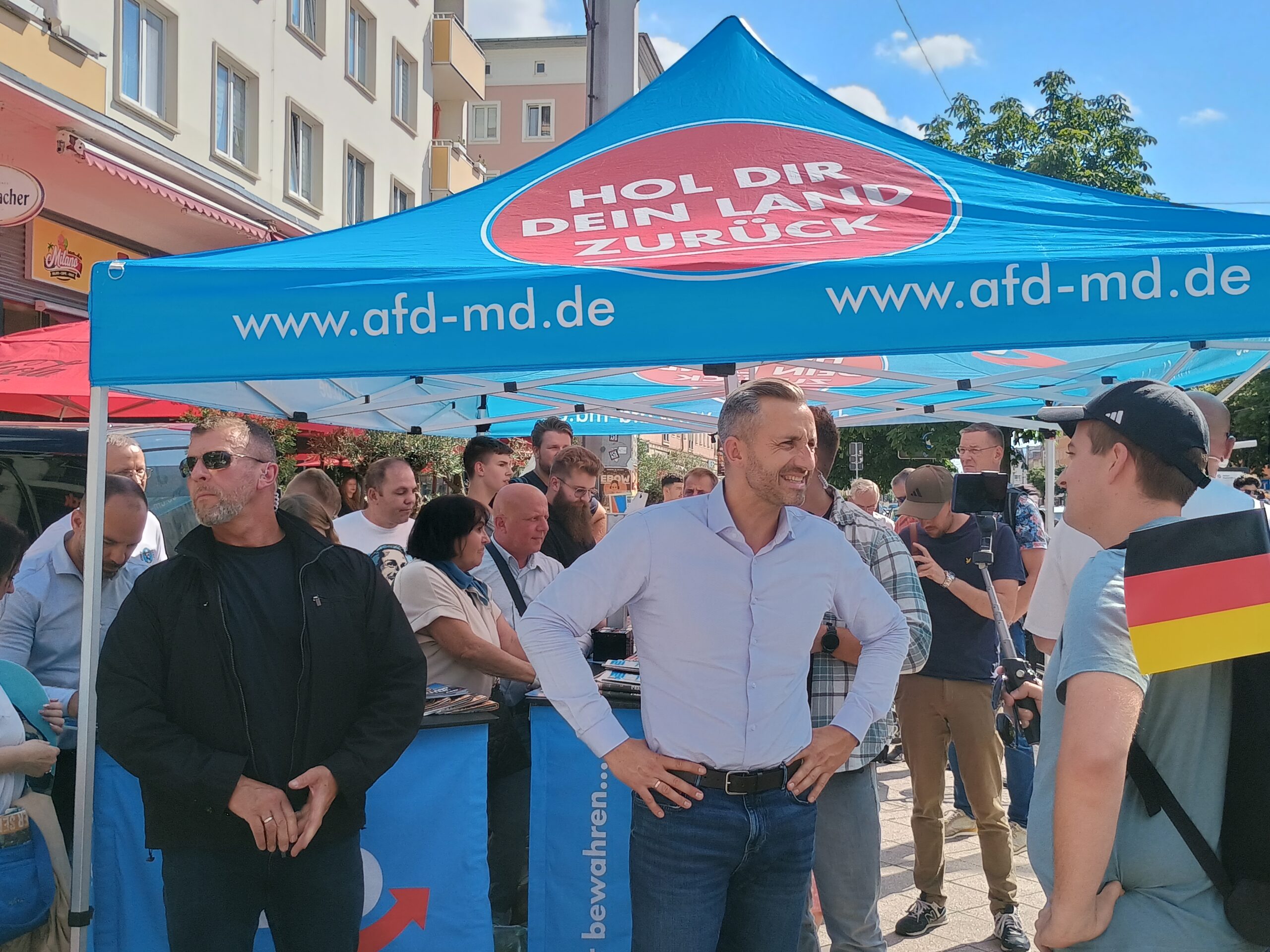
The elections in Mecklenburg-Western Pomerania confirmed that the result in Saxony-Anhalt was not an isolated case. The AfD won 38.3 percent of the vote, while the SPD, led by Manuela Schwesig, finished with 35.4 percent. The CDU suffered a historic defeat, receiving just 4.9 percent, its worst result in a state election since 1949. This result is particularly important because the SPD managed to remain very close to the AfD. Unlike in Saxony-Anhalt, where the gap between the first- and second-placed parties was enormous, the electoral contest in Mecklenburg-Western Pomerania was considerably closer. Nevertheless, the AfD also achieved a historic result here and became the strongest individual party. Within the space of just a few weeks, it had therefore finished first twice in state elections in Eastern Germany.
One of the biggest problems facing the AfD in both states where it achieved exceptionally strong results is precisely its limited coalition potential. The party has succeeded in winning a large share of the electorate and becoming the strongest individual political force, but it has still failed to establish enough political alliances to translate such electoral support into executive power. This is precisely where a clear distinction emerges between electoral victory and the ability to form a government. In democratic parliamentary systems, the number of votes won represents the starting point, but not the final stage of the political process. After an election comes the formation of a parliamentary majority, which requires finding partners capable of securing enough seats to elect a government. In the case of the AfD, this process is particularly complicated because the other relevant parliamentary parties continue to reject the possibility of formal coalition cooperation with the party.
This situation raises one of the most important questions concerning the AfD’s future: is it possible to remain the strongest political party in the long term while simultaneously remaining outside executive government? The answer depends on how long the other parties are prepared to maintain the existing model of political isolation. The stronger the AfD becomes, the more complex the question of its institutional isolation will become, as the gap between its electoral weight and its actual ability to participate in executive decision-making continues to widen. This is where the broader paradox of the German political scene lies. The AfD can be the strongest party without being the governing party. Its electoral strength increases its number of seats and political visibility, but its coalition potential determines how much of that strength can be translated into executive power. For this reason, electoral mathematics and political mathematics do not necessarily coincide.
One of the biggest problems facing the AfD in both states where it achieved exceptionally strong results is precisely its limited coalition potential. The party has succeeded in winning a large share of the electorate and becoming the strongest individual political force, but it has still failed to establish enough political alliances to translate such electoral support into executive power. This is precisely where a clear distinction emerges between electoral victory and the ability to form a government. In democratic parliamentary systems, the number of votes won represents the starting point, but not the final stage of the political process. After an election comes the formation of a parliamentary majority, which requires finding partners capable of securing enough seats to elect a government. In the case of the AfD, this process is particularly complicated because the other relevant parliamentary parties continue to reject the possibility of formal coalition cooperation with the party.
This situation raises one of the most important questions concerning the AfD’s future: is it possible to remain the strongest political party in the long term while simultaneously remaining outside executive government? The answer depends on how long the other parties are prepared to maintain the existing model of political isolation. The stronger the AfD becomes, the more complex the question of its institutional isolation will become, as the gap between its electoral weight and its actual ability to participate in executive decision-making continues to widen. This is where the broader paradox of the German political scene lies. The AfD can be the strongest party without being the governing party. Its electoral strength increases its number of seats and political visibility, but its coalition potential determines how much of that strength can be translated into executive power. For this reason, electoral mathematics and political mathematics do not necessarily coincide.
In the capital, Die Linke won 25.3 percent, while the AfD received 16.3 percent. The CDU finished behind Die Linke, while the SPD won approximately 12 percent. At the same time, elections were held for the district assemblies (Bezirksverordnetenversammlungen – BVV), where Die Linke also achieved a very strong result, while the CDU and SPD recorded substantial losses. According to the available results, Die Linke received around 24.2 percent, the CDU 17.7 percent, the AfD 17.3 percent, the Greens 16.1 percent, and the SPD 12.1 percent. Berlin therefore represents an important counterpoint to the eastern states. While the AfD is gaining strength in Saxony-Anhalt and Mecklenburg-Western Pomerania, Die Linke is strengthening its position in the capital. The results of 2026 therefore cannot be adequately described simply as a “strengthening of the right.” It is more precise to speak of the erosion of the traditional center and the rise of political polarization. Voters in different parts of the country are turning towards different alternatives, while the traditional parties are finding it increasingly difficult to maintain their former dominant position.
A particular problem is the position of the CDU. The party of Chancellor Friedrich Merz has suffered significant losses precisely at a time when it is attempting to consolidate the federal government. The CDU has lost votes in different directions, including to the AfD and the SPD. This means that the CDU’s problem cannot be reduced to a single issue or a single competitor. The party is under pressure from different sides of the political spectrum. At the center of this situation is Friedrich Merz himself. His position throughout 2026 has become increasingly complicated. Low government approval ratings, weak CDU results in the state elections, and the rise of the AfD have placed pressure on the Chancellor to demonstrate that his political strategy can work. According to a poll published by Reuters in mid-September, 78 percent of German respondents questioned Merz’s leadership, while the CDU/CSU stood at only 18 to 20 percent in national polling. This is particularly problematic because Merz cannot view the issue simply as a problem for the CDU’s state-level organizations. He is both Chancellor and leader of the party heading the federal government. Consequently, every major CDU defeat at the state level inevitably acquires a federal dimension.
Merz’s decision not to travel to New York for the United Nations General Assembly also acquired considerable political symbolism. Merz had been expected to participate in the UN General Debate, but the trip was cancelled at a time when the CDU had already suffered a heavy defeat in Saxony-Anhalt and was facing elections in Mecklenburg-Western Pomerania and Berlin. Reuters placed the decision directly in the context of growing political pressure in Germany. The event also has a symbolic dimension. At a moment when Germany’s Chancellor was expected to make international appearances in New York, Merz remained in Berlin, where his party was facing very serious electoral challenges. It is important, however, to distinguish between fact and political interpretation.
The German government’s official explanation was that Merz’s presence in Berlin was necessary, while Reuters identified domestic political pressure as the immediate context for the cancellation of the trip. Therefore, the decision not to attend the UN General Assembly cannot in itself be used as evidence that the decision was made exclusively because of the elections, but it can be viewed as a symbol of the priorities of German domestic politics at a time when Merz is facing significant pressure. In this sense, an interesting contrast emerges: a Chancellor seeking to restore Germany’s stronger international position was nevertheless forced to devote part of his political attention to the domestic stability of his party and government.
The real question following the 2026 elections will therefore be less about who won the most votes and much more about whether the traditional German political system still possesses the capacity to transform electoral fragmentation into stable government. If the trend of weakening support for the CDU and SPD, combined with the simultaneous strengthening of the AfD and other alternative political forces, continues, Germany will face a change in the political logic that for decades rested on a relatively stable center and predictable coalition patterns. The 2026 elections can therefore be seen as a warning that Germany’s political crisis is no longer located at the margins of the system, but at its very center. The AfD has demonstrated that it can become the strongest political force, while the traditional parties are finding it increasingly difficult to mobilize their former levels of support, and the electorate is becoming more widely distributed among different political alternatives. Germany is thus entering a new phase in which the question of who will form the next government is no longer sufficient. A much more important question is what kind of political system will be capable of forming that government, and how long the existing rules will be able to maintain a balance between increasingly strong electoral fragmentation and the need for stable executive government.